
Close Menu
    Facebook X (Twitter) Instagram
    SciTechDaily
    • Biology
    • Chemistry
    • Earth
    • Health
    • Physics
    • Science
    • Space
    • Technology
    Facebook X (Twitter) Pinterest YouTube RSS
    SciTechDaily
    Home»Earth»Between Volcanic Eruptions and Destructive Earthquakes: San Salvador’s Fiery Saga
    Earth

    Between Volcanic Eruptions and Destructive Earthquakes: San Salvador’s Fiery Saga

    By Lindsey Doermann, NASA Earth ObservatoryOctober 14, 2023No Comments3 Mins Read
    Facebook Twitter Pinterest Telegram LinkedIn WhatsApp Email Reddit
    Share
    Facebook Twitter LinkedIn Pinterest Telegram Email Reddit
    San Salvador 2023 Annotated
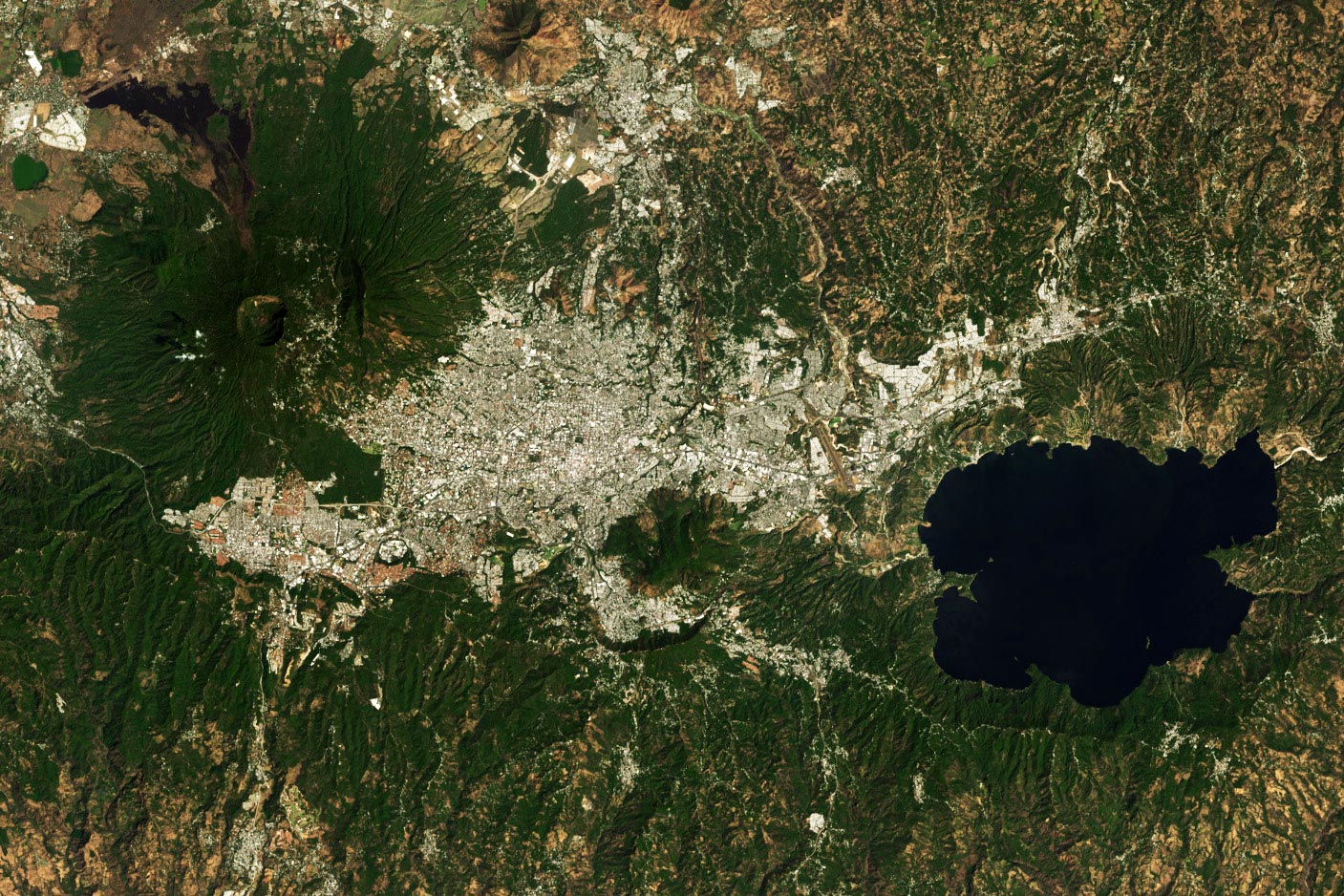
    Captured on February 24, 2023, this satellite image shows El Salvador’s capital, San Salvador, which sits amidst a volcanic chain on Central America’s Pacific coastline. Its geology boasts 20 volcanoes active in the past 10,000 years, and its history is marked by significant eruptions and earthquakes. The city, established as the capital in 1839, is home to a major portion of the country’s population.

    The cultural and political hub of El Salvador lies along the Central American Volcanic Arc.

    Along the Pacific coastline of Central America, a string of volcanoes runs for more than 1,000 kilometers (600 miles) from Guatemala to Panama. In El Salvador, the capital city of San Salvador sits in line with this chain of cones and calderas.

    This image illustrates the city’s distinctive setting among volcanic features. The greater metropolitan area of San Salvador stretches from the base of the San Salvador stratovolcano to the west to Lake Ilopango, a volcanic caldera, to the east. The image was acquired by the OLI (Operational Land Imager) on Landsat 8 on February 24, 2023.

    El Salvador’s Dynamic Geology

    The dynamic geology owes to its position along a subduction zone, where the Cocos Plate plunges under the Caribbean Plate and gives rise to the Central American Volcanic Arc. Though only about the size of New Jersey, the country of El Salvador is home to 20 volcanoes that have been active in the past approximately 10,000 years. Most have been fairly quiet in recent history. The San Miguel volcano, to the east of this image, is the most active and has erupted repeatedly during the past several centuries, including most recently in May 2023.

    Historical and Geological Significance of San Salvador

    Abutting the city of San Salvador, the volcano of the same name rises to an elevation of 1,900 meters (6,200 feet). When it last erupted, in 1917, it sent a lava flow streaming northward from a vent on its flank. A magnitude 6.3 earthquake centered at the volcano preceded the eruption by 35 minutes. Other powerful and destructive earthquakes have struck the city, including in 1965, 1986, and 2001. Consequently, few of the city’s older buildings such as its colonial cathedrals remain today.

    East of the city, Lake Ilopango is one of El Salvador’s largest lakes and the remnant of a massive eruption dating back to Mayan times. In a 2020 study, a team of researchers concluded that the caldera-forming eruption occurred around the year 431 C.E. and was 50 times larger than the 1980 eruption of Mount St. Helens. It was previously suspected that, due to its voluminous emissions, the Ilopango eruption was responsible for an anomalously cold decade in the Northern Hemisphere around 540 C.E. Additional evidence, such as from ice cores, has refined the eruption date to significantly earlier than the cold spell.

    San Salvador: The Urban Heart of El Salvador

    The city of San Salvador became the capital of El Salvador in 1839. Today, a significant portion of the country’s population—approximately 1.1 of 6.6 million people—lives in its urban core. El Salvador claimed its independence from Spain in 1821 and celebrates its Independence Day on September 15 each year. That date aligns with Hispanic Heritage Month, celebrated in the United States from September 15 to October 15.

    NASA Earth Observatory image by Wanmei Liang, using Landsat data from the U.S. Geological Survey.

    Never miss a breakthrough: Join the SciTechDaily newsletter.
    Follow us on Google and Google News.

    Earthquakes Geography NASA NASA Earth Observatory Volcano
    Share. Facebook Twitter Pinterest LinkedIn Email Reddit

    Related Articles

    Hunga Tonga Island Obliterated – NASA Satellites Capture Massive Blast

    A Wolf Awakens in the Galápagos Islands at Night

    A Deadly Day on Mount Semeru: Destructive Rivers of Debris on Indonesian Volcano

    Wall of Lava Burns a Path Through La Palma

    Cumbre Vieja Lights Up the Night – Astronaut Photo Captures Volcanic Eruption From Space

    Volcanic Eruption Lights Up Iceland Following Swarms of Small Earthquakes

    Socked in Stratovolcano: Astronaut on ISS Captures Incredible View of Uninhabited Atlasov Island

    Kilauea’s Lava Lake Returns – Hawaii’s Most Active Volcano Is Erupting Again

    Newberry Volcano Photographed by Astronaut Onboard the International Space Station

    Leave A Reply Cancel Reply

    • Facebook
    • Twitter
    • Pinterest
    • YouTube

    Don't Miss a Discovery

    Subscribe for the Latest in Science & Tech!

    Trending News

    Scientists Discover How Coffee Impacts Memory, Mood, and Gut Health

    Why Did the Neanderthals Disappear? Scientists Reveal Humans Had a Hidden Advantage

    Physicists Propose Strange Experiment Where Time Goes Quantum

    Magnesium Magic: New Drug Melts Fat Even on a High-Fat, High-Sugar Diet

    Weight-Loss Drugs Like Ozempic May Come With an Unexpected Cost

    Mezcal “Worm” in a Bottle Mystery: DNA Testing Reveals a Surprise

    New Research Reveals That Your Morning Coffee Activates an Ancient Longevity Switch

    This Is What Makes You Irresistible to Mosquitoes

    Follow SciTechDaily
    • Facebook
    • Twitter
    • YouTube
    • Pinterest
    • Newsletter
    • RSS
    SciTech News
    • Biology News
    • Chemistry News
    • Earth News
    • Health News
    • Physics News
    • Science News
    • Space News
    • Technology News
    Recent Posts
    • Harvard Scientists Reveal Secret Structure Behind How You Smell
    • Scientists Just Discovered the Hidden Trick That Keeps Your Cells Alive
    • This Simple Movement Could Be Secretly Cleaning Your Brain
    • Male Birth Control Breakthrough: Scientists Find Way To Turn Sperm Production Off and Back On
    • A Common Vitamin Could Hold the Key to Treating Fatty Liver Disease
    Copyright © 1998 - 2026 SciTechDaily. All Rights Reserved.
    • Science News
    • About
    • Contact
    • Editorial Board
    • Privacy Policy
    • Terms of Use

    Type above and press Enter to search. Press Esc to cancel.