
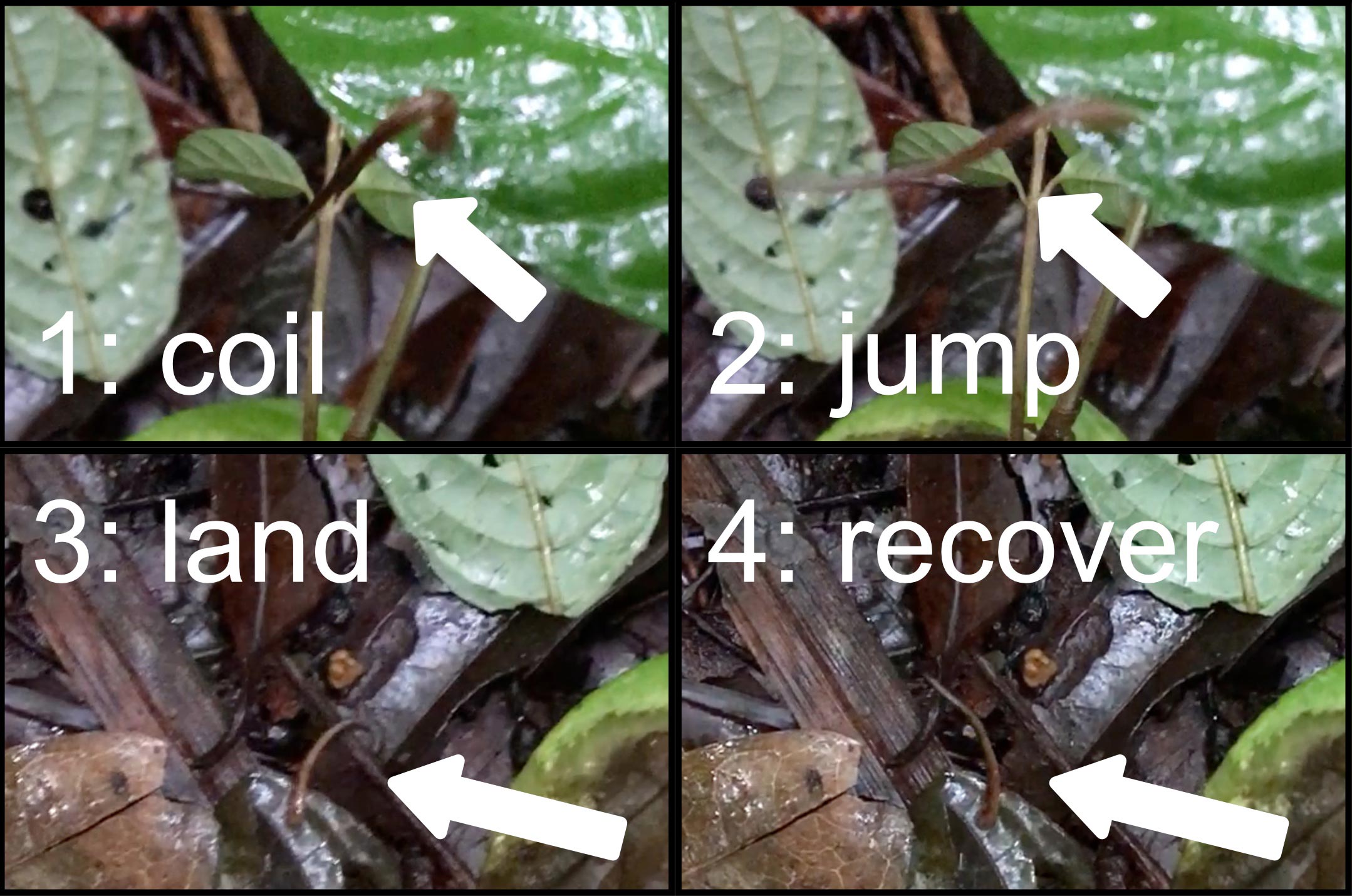
Scientists publish footage of Madagascar Chtonobdella leeches jumping, rebutting previous doubts.
A study has documented terrestrial leeches jumping from leaves, exhibiting spring-like movements. This newfound behavior, observed in the Chtonobdella genus during Madagascar field studies, revises our understanding of leech mobility.
Video evidence that at least one species of terrestrial leech can jump is presented in a new study, showing behavior that scientists have debated for more than a century. Researchers from the American Museum of Natural History, Fordham University, and City University of New York (CUNY)’s Medgar Evers College published the footage and corresponding analysis today (June 20) in the journal Biotropica.
“We believe this is the first convincing evidence that leeches can jump and do so with visible energy expenditure,” said lead author Mai Fahmy, a visiting scientist at the Museum and a postdoctoral researcher at Fordham University. “There have been previous accounts of leeches jumping, including onto people, but those reports were often explained away as leeches just attaching to passerby as they brushed against shrubs or dropping from a branch above. This study dispels that argument.”
This video taken in Madagascar in 2017 shows a Chtonobdella leech taking a small jump followed by a big leap to the ground. Credit: © Mai Fahmy
Observational Insights From Madagascar
During two separate expeditions to Madagascar in 2017 and in 2023, Fahmy recorded video of leeches from the genus Chtonobdella coiling back on a leaf and then taking off. Fahmy and coauthor Michael Tessler, an assistant professor at CUNY’s Medgar Evans College and a research associate at the Museum, compare this motion to a “back-bending cobra,” or to a spring being pulled back. In both cases, the leech keeps its body extended as it soars through the air to the ground, in a notable departure from their usual inchworm-like movements.
“Essentially, it executes a graceful jump but with a seemingly hard landing,” Tessler said.
This video taken in 2023 in Madagascar shows two Chtonobdella leeches questing on the same leaf and briefly interacting with each other. Then, as in the 2017 video, one leech assumes a recoiled body posture before jumping from the leaf to the ground. Credit: © Mai Fahmy
Comparison With Other Jumping Invertebrates
Several other worm-like invertebrates can jump, including the legless larvae of gall midges (Asphondylia sp.), which assume a loop posture before propelling themselves into the air, the larvae of Mediterranean fruit flies (Ceratitis capitata), “skipper flies” (Prochyliza xanthostoma), and several caterpillars, including Lymantria monacha and Orgyia leucostigma. While naturalists and leech biologists have long argued about the ability of terrestrial leeches in the family Haemadipsidae to jump, with some making observations of leeches leaping in their travel notes, there has been little concrete evidence until now.
Fahmy collected the jumping leech she observed on the 2023 trip, and the researchers identified it as Chtonobdella fallax, a common species in Madagascar. The larger Chtonobdella group of leeches to which C. fallax belongs can be found across Madagascar, the Seychelles, the Malay Archipelago, and the South Pacific Islands.
Implications for Leech Behavior and Conservation
“We do not know how often this may happen or whether these leeches use this ability to seek out hosts, but, given that we caught multiple jumps in two short recordings, this behavior may be common for this species,” said Tessler, who studied leeches extensively as a graduate student in the comparative biology Ph.D. program at the Museum’s Richard Gilder Graduate School.
Understanding overall leech behavior is also important to conservation efforts because leeches—and more specifically, their blood meals—are increasingly being collected to survey vertebrate biodiversity.
“If we can identify how leeches find and attach to hosts, we can better understand the results of their gut content analyses,” Fahmy said. “Leeches are also often overlooked and understudied, and, as a natural part of the ecosystem, leeches themselves may be in need of conservation protection.”
Reference: “A jumping terrestrial leech from Madagascar” by Mai Fahmy and Michael Tessler, 20 June 2024, Biotropica.
DOI: 10.1111/btp.13340
Never miss a breakthrough: Join the SciTechDaily newsletter.
Follow us on Google and Google News.