
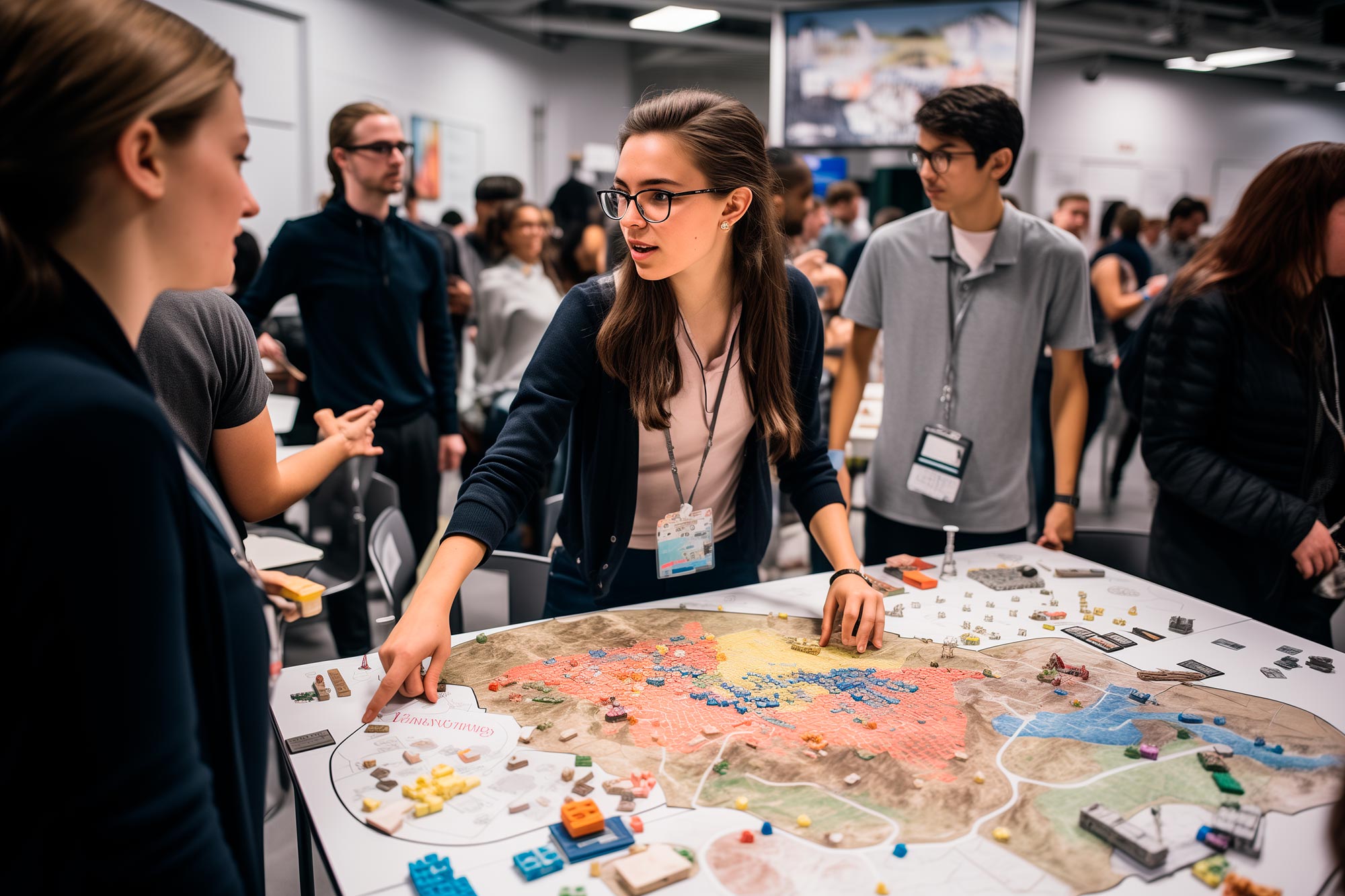
This unique lab uses games as a way for students to play, explore, and learn to think critically about the role of games in society.
Students fill the glass-walled room and spill out into the common area. They gather around tables and desks cluttered with board games and game pieces. Along the far wall, large screens show students exploring the latest virtual reality experience alongside classmates reliving their favorite retro video games.
Welcome to an open house of the MIT Game Lab, where play and experimentation are joined by serious inquiry about the gaming industry and its role in society.
Research and Education at the Game Lab
In addition to its rollicking open houses, which take place at least once a semester, the Game Lab hosts public events, organizes research projects, and teaches courses through MIT Comparative Media Studies/Writing (CMS/W).
The Game Lab’s work is designed to help students think critically about the games they’ve often been playing for years without considering the values they might project, and to prepare them to engage in thoughtful design practices themselves.
“Students come to the Game Lab because it sounds like fun, which is great, but they realize through our research that there’s also something really serious at work in games,” Game Lab Director and Professor T.L. Taylor says. “I think students often have this moment where they realize this thing they’ve been enjoying actually has a lot of stakes in it; these are things that really matter.”
The Game Lab analyzes the gaming industry and its impact, explores new technologies and formats, and creates games that tackle important issues. Many new games are tied to larger research projects.
“There’s a desire from our students to express themselves through games, whether that’s through making educational games or games with specific messages or lessons,” says Game Lab research scientist and lecturer Mikael Jakobsson. “Games are a big part of most people’s lives, so there’s a thirst among our students for not only learning how to make games, but also studying games as social and cultural artifacts.”
Through that research, students come to appreciate the impact of games on the world.
“Games are hugely important in society and culture,” Taylor says. “We’re really trying to always think critically and productively about what we do with this powerful form of media and entertainment, and to think about games as a place in which imagination and stories about the world can be worked over and thought about.”
The Early Years and Collaborations
The MIT Game Lab was founded in cooperation with the Singapore government in 2006. Early on, it would host workshops on game design with students from Singapore in the summer, then conduct teaching and research with MIT students during the school year.
The Singapore collaboration ended in 2012, but the lab continued its work, often partnering with outside companies, private donors, and other groups around campus to explore the influence of games on different aspects of society.
Engagement With Real-World Issues
In one project with the Samuel Tak Lee MIT Real Estate Entrepreneurship Lab, students designed a game to explore the basics of real estate development, including managing capital and debt and deciding what sorts of buildings to build and where.
The lab also does work with communities to help them think about civic engagement. It has held workshops around the world with local students and other community members to challenge them to think about issues in their societies through the lens of game design. One such collaboration led to the game Promesa, which Jakobsson created with Puerto Rican graphic artist Rosa Colón Guerra and the design collective Popcicleta to promote what the creators call a “countercolonialist” viewpoint in the context of a game about the island’s debt crisis.
Beyond Game Creation
Aside from making games, researchers also consider the influence of historically popular games.
“We’re not making games as much as studying them,” says junior Michelle Liang, who works at the Game Lab as an undergraduate researcher. “It’s so easy to detach entertainment as its own separate world, when in fact media is influenced by a lot of different factors and biases. A lot of the Game Lab’s work is geared toward enhancing that understanding.”
The Game Lab’s organizers say that work distinguishes them from other gaming-focused groups in academia, which often equip students with specific skills to get jobs in the videogame industry.
“We’re not a pipeline program to go work in the gaming industry,” Taylor explains. “Some students do go into the industry, but because we’re doing critical design practice, we’re approaching games with a much broader, critically inflective perspective by thinking about things like equity and representation.”
Liang hadn’t considered the role of games in social and political issues until she discovered the Game Lab. She immediately saw the Lab as a way to combine a number of things she was passionate about.
“It’s funny to talk about my job to people,” Liang says. “Even though we are the Institute of Technology, there’s so much more MIT has to offer.”
Changing the Rules
Jakobsson says the perception of games as nothing more than entertainment has led to a lack of introspection.
“The gaming industry has been a bit of a boys’ club where a lot of social responsibility has been shirked because they say they’re just trying to have fun and don’t have to think about how it affects society,” Jakobsson says. “Now we’re dealing with a lot of the consequences from that mindset.”
For students, involvement in the Game Lab can mean conducting research, enrolling in one of its classes, or just stopping by an open house. Regardless of how they’re exposed to the lab’s work, Taylor hopes they leave with a deeper appreciation of the power of games in our society.
“Games are a hugely important media and entertainment space, but they’re also one of our most culturally relevant and politically active spaces,” Taylor says. “Media spaces are in part where we learn about the world, for good or ill, where we construct imaginaries of the world, where we think about other possibilities. Part of the mission of CMS/W in general is taking media spaces seriously, and games are an increasingly important part of that.”
Never miss a breakthrough: Join the SciTechDaily newsletter.
Follow us on Google and Google News.