

Scientists have uncovered “Quipu,” the largest known galactic structure, stretching 1.4 billion light-years. This discovery reshapes cosmic mapping and affects key measurements of the universe’s expansion.
A team of scientists has identified the largest cosmic superstructure ever reliably measured. The discovery was made while mapping the nearby universe using galaxy clusters detected in the ROSAT X-ray satellite’s sky survey. Spanning approximately 1.4 billion light-years, this structure — primarily composed of dark matter — is the largest known formation in the universe to date. The research was led by scientists from the Max Planck Institute for Extraterrestrial Physics and the Max Planck Institute for Physics, in collaboration with colleagues from Spain and South Africa.
A Vastly Structured Universe
On the largest scales, the universe appears nearly uniform. However, when examined at distances smaller than about a billion light-years — especially in our cosmic neighborhood — matter is not evenly spread. Instead, it gathers into vast superclusters, separated by enormous voids. Understanding these structures is crucial for cosmology and is a key reason scientists map the nearby universe.
Breaking Cosmic Size Records
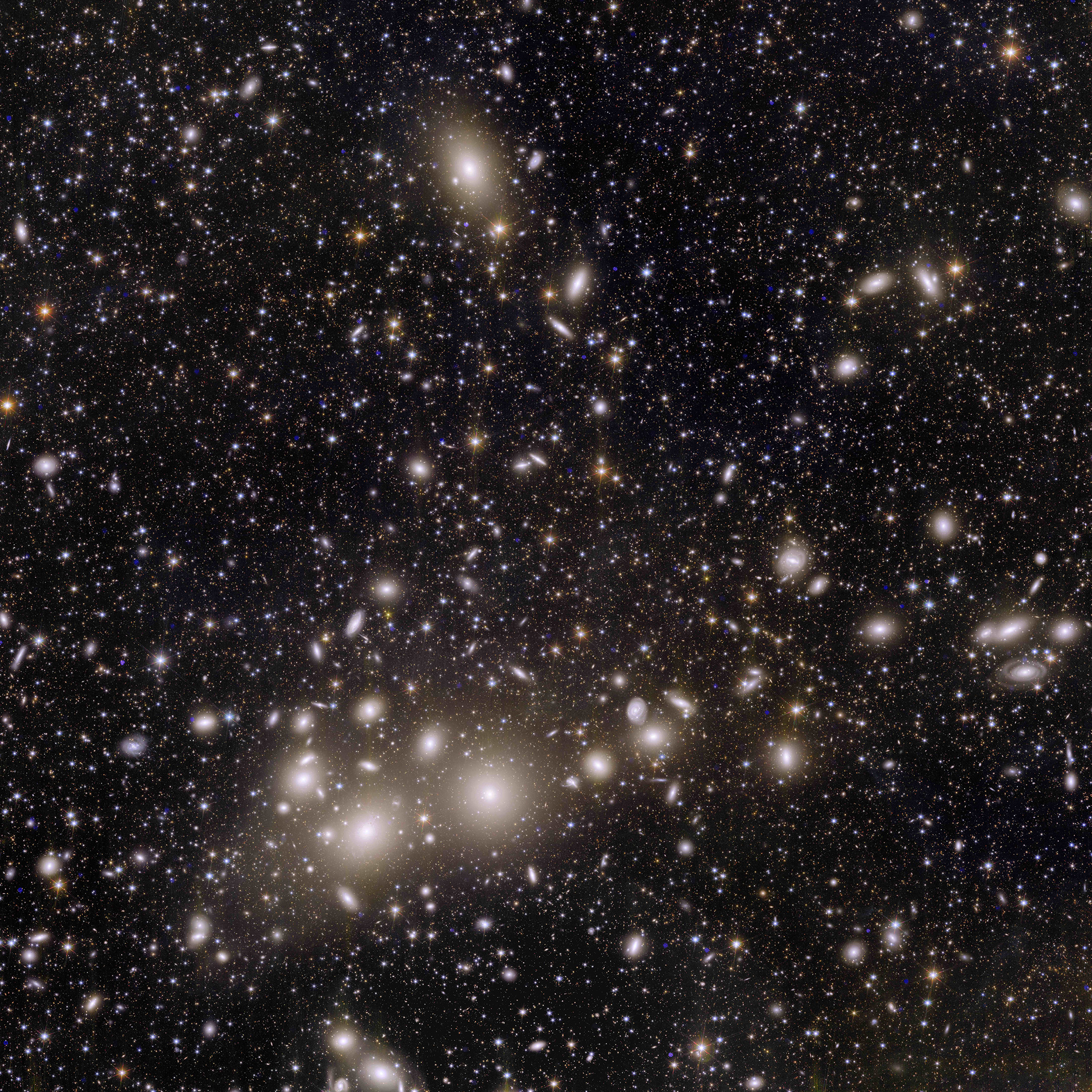
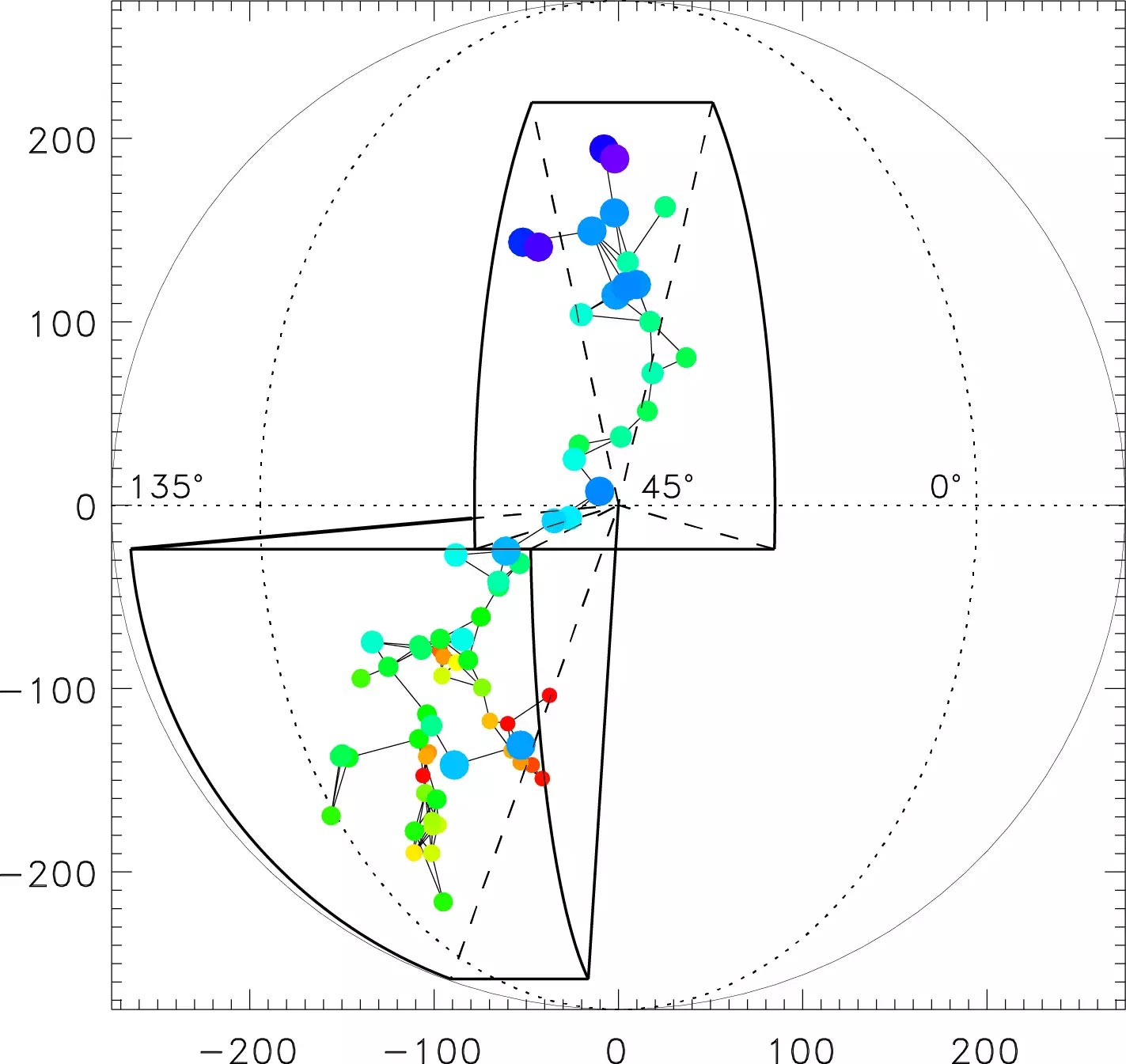
“If you look at the distribution of the galaxy clusters in the sky in a spherical shell with a distance of 416 to 826 million light-years, you immediately notice a huge structure that stretches from high northern latitudes to almost the southern end of the sky,” explains Hans Böhringer, the project leader. It consists of 68 clusters of galaxies and has an estimated total mass of 2.4 1017 solar masses with a length of around 1.4 billion light years. This breaks the size record of all reliably measured cosmic structures. The largest of them so far, the “Sloan Great Wall”, for example, has a length of around 1.1 billion light years and it is located much further away.
An ATLAS of Galaxy Clusters
For their study, the scientists used an almost complete atlas of galaxy clusters in the nearby universe. “The catalogue was created with the help of the ROSAT X-ray satellite, built by the Max Planck Institute for extraterrestrial Physics. In 1990, the satellite mapped the entire sky using a high-resolution X-ray telescope for the first time,” explains Joachim Trümper, the ROSAT project leader and emeritus Director of the Max Planck Institute for extraterrestrial Physics.
In the decades that followed, researchers worked to identify the galaxy clusters more precisely and to determine their distances. This resulted in a three-dimensional image of their distribution, in which the galaxy clusters precisely trace the structure of the large-scale distribution of matter in the universe, much like lighthouses trace a coastline. The catalogue covers the entire cosmic volume out to a distance of one billion light-years. In this region, the new structure appears much larger than all other structures.
Importance for Science: Cosmography and Cosmology
This finding is crucial for mapping the universe, but also for cosmological measurements. The researchers have shown how the presence of these structures affects the measurement of the Hubble constant or the microwave background. The cosmic background radiation was created shortly after the Big Bang and gives us important clues about the structure and evolution of the universe. The Hubble constant indicates the current expansion rate of the universe. “Even if these are only corrections of a few percent, they become increasingly important as the accuracy of cosmological observations increases,” emphasizes Gayoung Chon from the Max Planck Institute for Physics.
The Cosmic “Quipu” – A Woven Superstructure
The scientists have named their remarkable discovery “Quipu,” a term from the language of the Incas. The Incas used bundles of strings with knots for their bookkeeping and as letters. The superstructure resembles this ancient script, appearing as a long fibre with side strands woven into it. The scientists also chose the name because most of the distance measurements of the galaxy clusters were made at the European Southern Observatory in Chile. The earthly quipus are on display at the Archaeological Museum in the capital Santiago de Chile – bringing us back to Earth from the far reaches of the cosmos.
Reference: “Unveiling the largest structures in the nearby Universe: Discovery of the Quipu superstructure” by Hans Boehringer, Gayoung Chon, Joachim Truemper, Renee C. Kraan-Korteweg and Norbert Schartel, 31 January 2025, Astrophysics > Cosmology and Nongalactic Astrophysics.
arXiv:2501.19236
Never miss a breakthrough: Join the SciTechDaily newsletter.
Follow us on Google and Google News.
1 Comment
Looks similar to the planetary Ring Nebula in the constellation Lyrae.