

A cosmic jet aimed at Earth reveals how blazars hurl particles to extreme energies, solving a long-standing mystery.
Key Points
- A glimpse into a galaxy’s core: Astronomers have captured a detailed image of the birthplace of a powerful cosmic jet. With its artificial colors, the view strikingly resembles the legendary “Eye of Sauron.”
- The neutrino puzzle: PKS 1424+240 stands out as the brightest known source of neutrinos of its kind. Yet its jet seemed far too sluggish to account for the extreme neutrino emissions observed.
- Magnetic spirals powering particles: After 15 years of careful observations with the Very Long Baseline Array, scientists have revealed the jet’s structure in unprecedented detail. The image shows ring-shaped, or toroidal, magnetic fields that act like a coiled spring, accelerating particles to extraordinary energies. This mechanism finally explains both the high-energy neutrinos and the gamma rays pouring from this blazar.
A Cosmic Puzzle
Billions of light-years from Earth, the blazar known as PKS 1424+240 has puzzled scientists for years. It was singled out by the IceCube Neutrino Observatory as the brightest blazar producing neutrinos, while also shining intensely in very high-energy gamma rays detected by ground-based Cherenkov telescopes. The mystery was that its radio jet seemed to drift unusually slowly, defying the assumption that only rapidly moving jets could drive such powerful emissions.
After 15 years of precise monitoring with the Very Long Baseline Array (VLBA), astronomers have now created the most detailed image of this jet ever obtained.
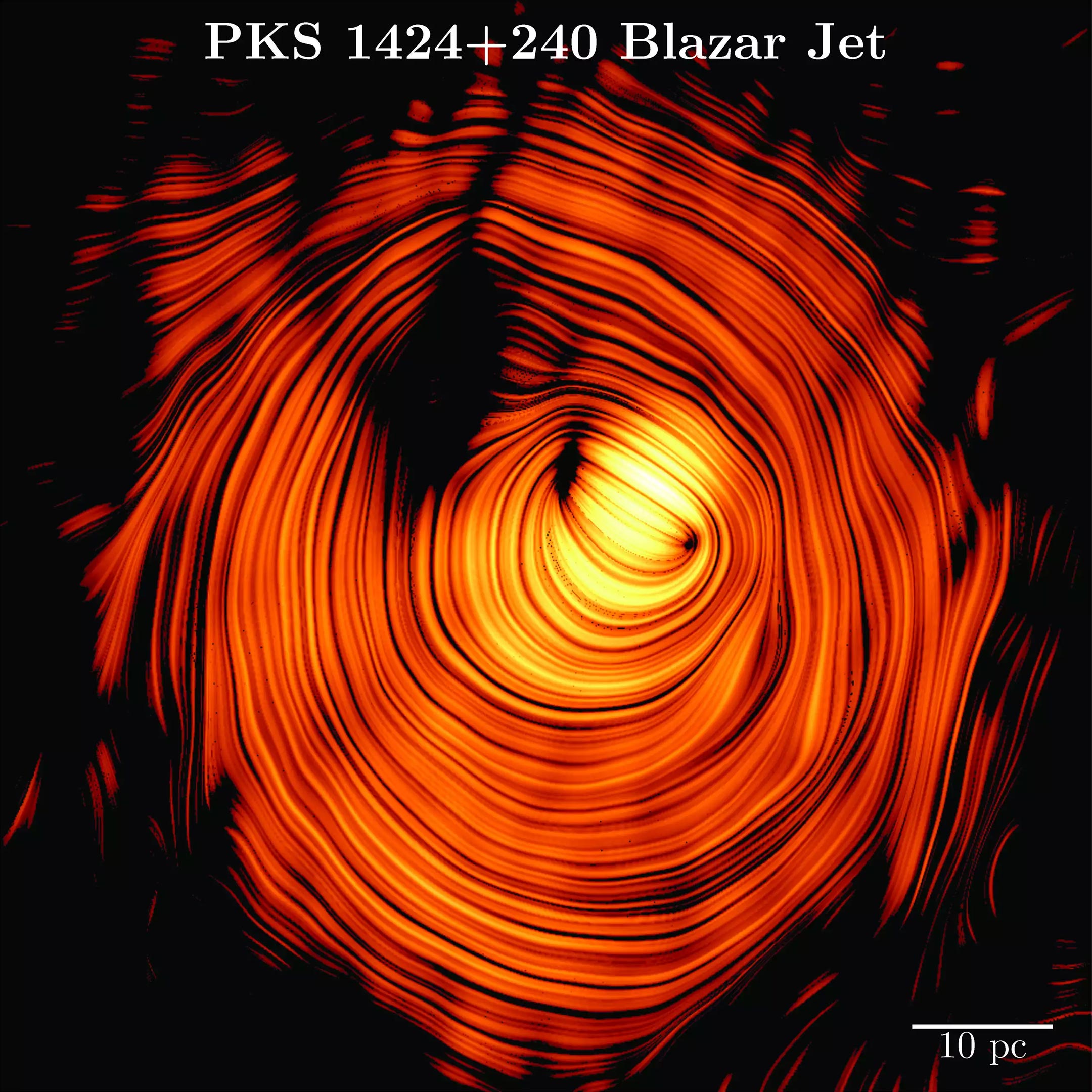
A Stunning Magnetic Field Discovery
“When we reconstructed the image, it looked absolutely stunning,” says Yuri Kovalev, lead author of the study and Principal Investigator of the ERC-funded MuSES project at the Max Planck Institute for Radio Astronomy (MPIfR). “We have never seen anything quite like it — a near-perfect toroidal magnetic field with a jet, pointing straight at us.”
Because the jet is directed almost exactly toward Earth, the light it produces is enormously amplified by relativistic effects. “This alignment causes a boost in brightness by a factor of 30 or more,” explains Jack Livingston, a co-author at MPIfR. “At the same time, the jet appears to move slowly due to projection effects — a classic optical illusion.”
Peering Into the Blazar’s Heart
This head-on geometry allowed scientists to peer directly into the heart of the blazar’s jet — an extremely rare opportunity. Polarized radio signals helped the team map out the structure of the jet’s magnetic field, revealing its likely helical or toroidal shape. This structure plays a key role in launching and collimating the plasma flow, and may be essential for accelerating particles to extreme energies.
“Solving this puzzle confirms that active galactic nuclei with supermassive black holes are not only powerful accelerators of electrons, but also of protons — the origin of the observed high-energy neutrinos,” concludes Kovalev.
MOJAVE: Decades of Jet Monitoring
The discovery is a triumph for the MOJAVE program, a decades-long effort to monitor relativistic jets in active galaxies using the Very Long Baseline Array (VLBA). Scientists employ the technique of Very Long Baseline Interferometry (VLBI), which connects radio telescopes across the globe to form a virtual telescope the size of the Earth. This provides the highest resolution available in astronomy, allowing them to study the fine details of distant cosmic jets.
“When we started MOJAVE, the idea of one day directly connecting distant black hole jets to cosmic neutrinos felt like science fiction. Today, our observations are making it real,” says Anton Zensus, Director at MPIfR and co-founder of the program.
A Milestone in Multimessenger Astronomy
This result strengthens the link between relativistic jets, high-energy neutrinos, and the role of magnetic fields in shaping cosmic accelerators — marking a milestone in multimessenger astronomy.
Background Information
A blazar is a type of active galactic nucleus powered by a supermassive black hole that launches a jet of plasma moving at nearly the speed of light. What makes a blazar special is its orientation: one of its jets is pointed within about 10 degrees of Earth. This alignment makes blazars appear bright across the electromagnetic spectrum and allows scientists to study extreme physical processes — including the acceleration of particles to energies far beyond those achieved in human-made accelerators.
The VLBA (Very Long Baseline Array) is an array of ten antennas, at locations across the continental United States and in Hawaii and St Croix, which operates in the very long baseline interferometry (VLBI) mode. Spacings between the antennas vary up to approximately ten thousand kilometers, providing angular resolution on the sky as fine as 50 micro-arcseconds.
MOJAVE (Monitoring Of Jets in Active galactic nuclei with VLBA Experiments) is a long-term program to monitor radio brightness and polarization variations in jets associated with active galaxies visible in the northern sky. The observations are made with the Very Long Baseline Array, which enables us to make full polarization images with an angular resolution better than 1 milliarcsecond (the apparent separation of your car’s headlights, as seen by an astronaut on the Moon). We are using these data to better understand the complex evolution and magnetic field structures of jets on light-year scales, close to where they originate in the active nucleus, and how this activity is correlated with a high energy electromagnetic and neutrino emission.
MuSES, which stands for Multi-messenger Studies of Energetic Sources, is a pioneering initiative in astrophysics. It is dedicated to the study of Active Galactic Nuclei, which are among the most powerful particle accelerators known in the cosmos. These celestial bodies harness the gravitational energy of matter accreted by supermassive black holes and convert it into electromagnetic and kinetic energy, resulting in the production of highly relativistic electrons and protons. The acceleration of protons and its relation to neutrino production is not well understood, posing a formidable challenge to researchers. MuSES aims to address these fundamental questions by exploiting recent advances in multi-messenger astronomy.
Reference: “Looking into the jet cone of the neutrino-associated very high-energy blazar PKS 1424+240” by Y. Y. Kovalev, A. B. Pushkarev, J. L. Gómez, D. C. Homan, M. L. Lister, J. D. Livingston, I. N. Pashchenko, A. V. Plavin, T. Savolainen and S. V. Troitsky, 12 August 2025, Astronomy & Astrophysics.
DOI: 10.1051/0004-6361/202555400
The MuSES project has received funding from the European Union (ERC grant agreement No 101142396). Views and opinions expressed are however those of the author(s) only and do not necessarily reflect those of the European Union or European Research Council Executive Agency (ERCEA). Neither the European Union nor the granting authority can be held responsible for them.
Never miss a breakthrough: Join the SciTechDaily newsletter.
Follow us on Google and Google News.
2 Comments
Researchers have never seen anything quite like it — a near-perfect toroidal magnetic field with a jet, pointing straight at us.
VERY GOOD.
Spins are ubiquitous.
An entire generation has been severely misled and poisoned by so-called peer-reviewed publications. In today’s physics, the so-called peer-reviewed journals—including Physical Review Letters, Nature, Science, and others—stubbornly insist on and promote the following:
1. Even though θ and τ particles exhibit differences in experiments, physics can claim they are the same particle. This is science.
2. Even though topological vortices and antivortices have identical structures and opposite rotational directions, physics can define their structures and directions as entirely different. This is science.
3. Even though two sets of cobalt-60 rotate in opposite directions and experiments reveal asymmetry, physics can still define them as mirror images of each other. This is science.
4. Even though vortex structures are ubiquitous—from cosmic accretion disks to particle spins—physics must insist that vortex structures do not exist and require verification. Only the particles that like God, Demonic, or Angelic are the most fundamental structures of the universe. This is science.
5. Even though everything occupies space and maintains its existence in time, physics must still debate and insist on whether space exists and whether time is a figment of the human mind. This is science.
6. Even though space, with its inviscid, incompressible, and isotropic characteristics, provides a solid foundation for the development of physics, physics must still insist that the ideal fluid properties of space do not exist. This is science.
And so on.
The so-called peer-reviewed journals—including Physical Review Letters, Nature, Science, and others openly define differences as sameness, sameness as differences, existence as nonexistence, and nonexistence as existence—all while deceiving and fooling the public with so-called “impact factors (IF),” never knowing what shame is.
Highly appreciated and thank you so very much. I learned quite a bit.