
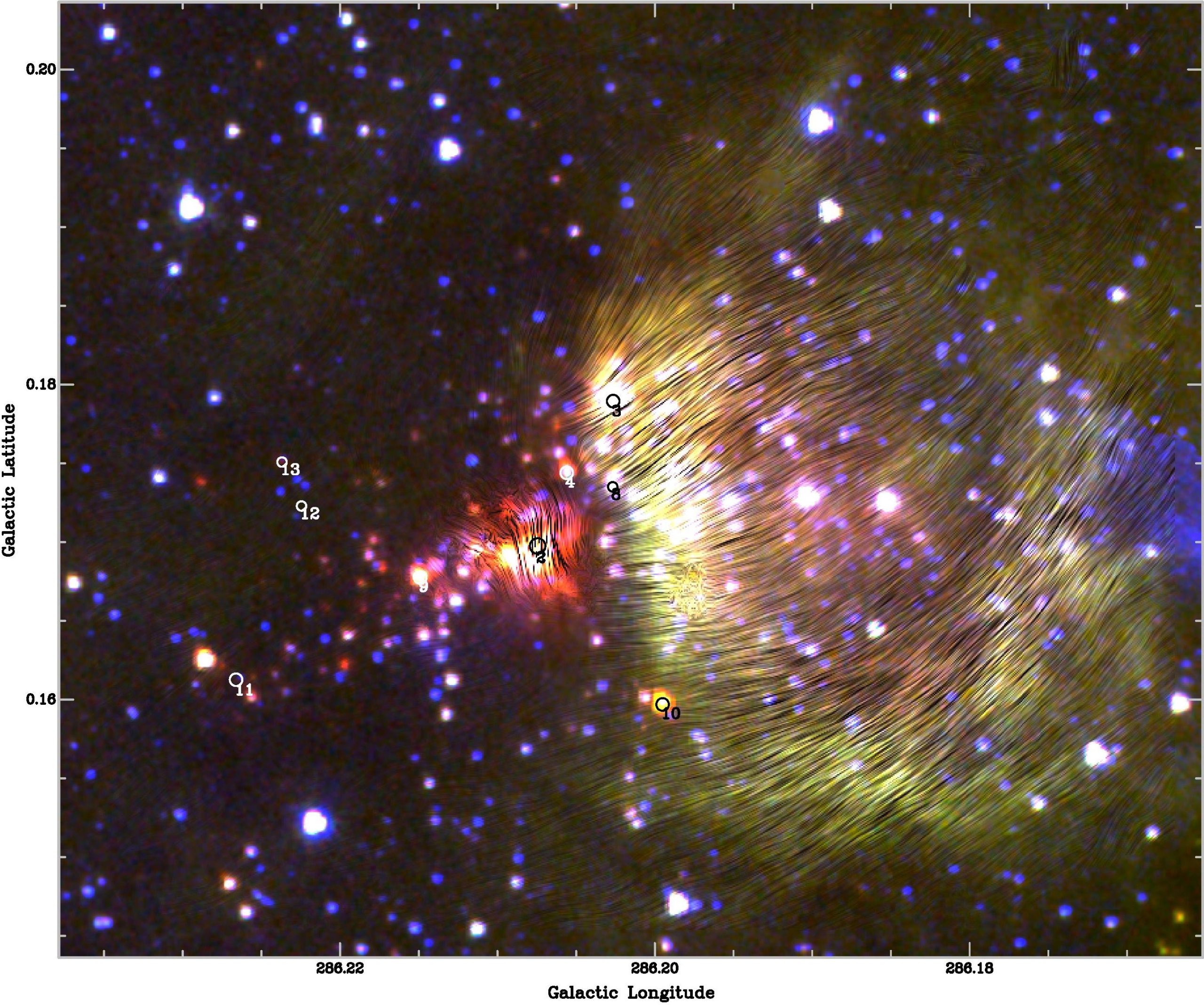
Formation of Massive Star Caught in the Act with Magnetic Field Mapping
The stellar nursery where the action is taking place, called BYF 73, is not your typical star-forming cloud. It’s relatively small, but at its central core is a young star that holds the record for the highest known rate of protostellar mass accretion, the process by which a growing star accumulates mass from its surrounding material.
Using SOFIA and another observatory – the Atacama Large Millimeter/submillimeter Array (ALMA) in Chile – Peter Barnes, a research scientist at the Space Science Institute in Boulder, Colorado, and his team examined the magnetic fields within this cloud amid ongoing star formation. Studying the orientation of magnetic fields can shed light on their role in massive-star formation, a long-standing question. Massive stars form through a different process from their more average counterparts, relying on an ongoing exchange of material with their environment, rather than accreting mass from a surrounding disk of matter.
Birth of a “Masquerading Monster”
Previous ALMA research had shown that within the core of BYF 73 lies a “masquerading monster:” a single protostar, MIR 2, which is about 1,300 times the Sun’s mass and responsible for about half of the region’s power output. These ALMA values place MIR 2 in the very early stages of massive star formation, with an age of around 40,000 years — on human timescales, it began forming sometime after the arrival of humans to Australia.
“It’s exciting because MIR 2 seems to be so young, and massive stars evolve very quickly by astronomical standards and are very rare, making their early stages easy to miss,” said Barnes.
Data from SOFIA and ALMA both offer high resolution and sensitivity in their respective wavelength ranges, allowing Barnes and his team to map the polarization of dust grains in BYF 73. This helped the researchers determine the relationship between the cloud’s magnetic field and gas density – and what that might mean for the formation of MIR 2.
When Gravity Takes Over
The researchers found that both the strength of the magnetic field and density of the gas are on the higher end of the range typical for star-forming clouds, but the relationship between the two scales is as expected. This means what’s happening in BYF 73 isn’t necessarily something unique — it just happens to be massive, and its monstrous density compared to its small size may help astronomers uncover a threshold necessary for gravity to take over and allow stars to form.
Gravity is the sole force responsible for forming stars, but the unusually strong magnetic field in BYF 73 could be acting in opposition, preventing lower-mass stars from forming until gravity becomes strong enough to form a monster.
“The original discovery of the massive inflow of material [onto MIR 2] was very exciting, since so few examples were known for higher-mass protostars. From that point on, BYF has been the gift that keeps on giving,” Barnes said.
MIR 2 is still in the very early stages of forming a massive star, and the synergies between SOFIA and ALMA’s magnetic field studies have helped clarify the factors at play in the process.
“Without their discoveries, BYF 73, and MIR 2 within it, would still be real head-scratchers,” said Barnes.
SOFIA was a joint project of NASA and the German Space Agency at DLR. DLR provided the telescope, scheduled aircraft maintenance, and other support for the mission. NASA’s Ames Research Center in California’s Silicon Valley managed the SOFIA program, science, and mission operations in cooperation with the Universities Space Research Association, headquartered in Columbia, Maryland, and the German SOFIA Institute at the University of Stuttgart. The aircraft was maintained and operated by NASA’s Armstrong Flight Research Center Building 703, in Palmdale, California. SOFIA achieved full operational capability in 2014 and concluded its final science flight on Sept. 29, 2022.
Never miss a breakthrough: Join the SciTechDaily newsletter.
Follow us on Google and Google News.