

Close Menu
    Facebook X (Twitter) Instagram
    SciTechDaily
    • Biology
    • Chemistry
    • Earth
    • Health
    • Physics
    • Science
    • Space
    • Technology
    Facebook X (Twitter) Pinterest YouTube RSS
    SciTechDaily
    Home»Chemistry»Scientists Have Developed a Living “Bio-Solar Cell” That Runs on Photosynthesis
    Chemistry

    Scientists Have Developed a Living “Bio-Solar Cell” That Runs on Photosynthesis

    By American Chemical SocietyJanuary 16, 20234 Comments3 Mins Read
    Facebook Twitter Pinterest Telegram LinkedIn WhatsApp Email Reddit
    Share
    Facebook Twitter LinkedIn Pinterest Telegram Email Reddit
    Green Energy Battery
    The researchers believe that their technique could pave the way for the creation of sustainable, multi-purpose green energy technologies in the future.

    Harnessing photosynthesis in succulents, researchers have developed a bio-solar cell capable of generating electricity and producing hydrogen gas.

    Plants are often thought of as sources of food, oxygen, and decoration, but not as a source of electricity. However, scientists have discovered that by harnessing the natural transport of electrons within plant cells, it is possible to generate electricity as part of a green, biological solar cell. In a recent study published in ACS Applied Materials & Interfaces, researchers for the first time used a succulent plant to create a living “bio-solar cell” that runs on photosynthesis.

    The electrons are naturally transported as part of biological processes in all living cells, from bacteria and fungi to plants and animals. By introducing electrodes, the cells can be utilized to generate electricity that can be used externally. Previous research had created fuel cells using bacteria but it required constant feeding. This new approach uses photosynthesis, the process by which plants convert light energy into chemical energy, to generate current.

    Photosynthesis as a Renewable Energy Source

    During this process, light drives a flow of electrons from water that ultimately results in the generation of oxygen and sugar. This means that living photosynthetic cells are constantly producing a flow of electrons that can be pulled away as a “photocurrent” and used to power an external circuit, just like a solar cell.
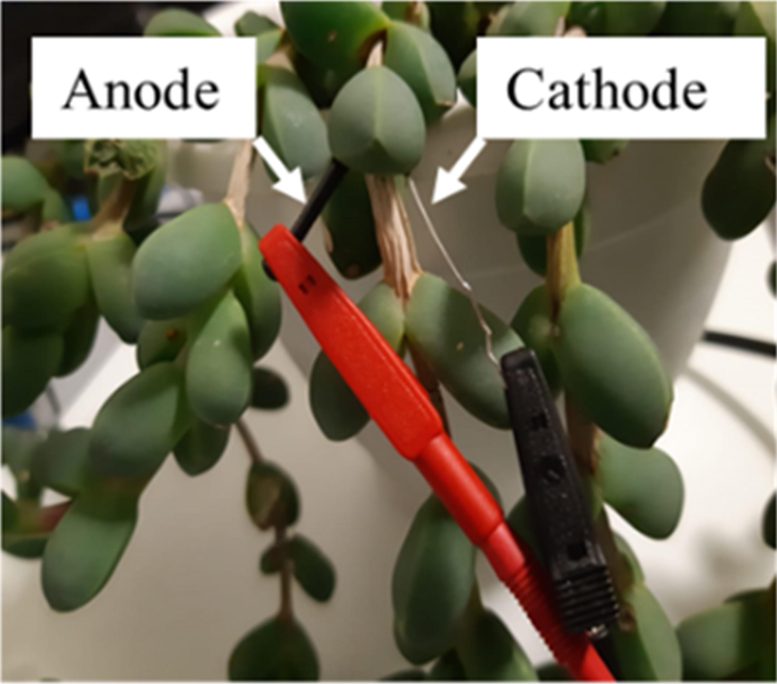
    Living Solar Cell
    The ice plant succulent shown here can become a living solar cell and power a circuit using photosynthesis. Credit: Adapted from ACS Applied Materials & Interfaces, 2022, DOI: 10.1021/acsami.2c15123

    Certain plants — like the succulents found in arid environments — have thick cuticles to keep water and nutrients within their leaves. Yaniv Shlosberg, Gadi Schuster, and Adir wanted to test, for the first time, whether photosynthesis in succulents could create power for living solar cells using their internal water and nutrients as the electrolyte solution of an electrochemical cell.

    Creating the Bio-Solar Cell with the Ice Plant

    The researchers created a living solar cell using the succulent Corpuscularia lehmannii, also called the “ice plant.” They inserted an iron anode and platinum cathode into one of the plant’s leaves and found that its voltage was 0.28V. When connected into a circuit, it produced up to 20 µA/cm2 of photocurrent density, when exposed to light and could continue producing current for over a day. Though these numbers are less than that of a traditional alkaline battery, they are representative of just a single leaf.

    Previous studies on similar organic devices suggest that connecting multiple leaves in series could increase the voltage. The team specifically designed the living solar cell so that protons within the internal leaf solution could be combined to form hydrogen gas at the cathode, and this hydrogen could be collected and used in other applications. The researchers say that their method could enable the development of future sustainable, multifunctional green energy technologies.

    Reference: “Self-Enclosed Bio-Photoelectrochemical Cell in Succulent Plants” by Yaniv Shlosberg, Gadi Schuster and Noam Adir, 23 November 2022, ACS Applied Materials & Interfaces.
    DOI: 10.1021/acsami.2c15123

    The authors acknowledge funding from a “Nevet” grant from the Grand Technion Energy Program (GTEP) and a Technion VPR Berman Grant for Energy Research and support from the Technion’s Hydrogen Technologies Research Laboratory (HTRL).

    Never miss a breakthrough: Join the SciTechDaily newsletter.
    Follow us on Google and Google News.

    American Chemical Society Bioenergy Energy Photosynthesis Plants Popular Sustainability
    Share. Facebook Twitter Pinterest LinkedIn Email Reddit

    Related Articles

    This New Device Turns Carbon Emissions Into a Valuable Chemical

    Artificial Photosynthesis Makes Biodegradable Plastic Using Sunlight

    Photosynthesis Power: A Reliable and Renewable Biological Photovoltaic Cell

    Artificial Photosynthesis Promises Clean, Sustainable Source of Energy

    Catalytic Converter Theft Is on the Rise – Here’s Why

    Double-Duty: New Catalyst Generates Hydrogen Fuel While Cleaning Up Wastewater

    Future Energy Source: Scientists Build Tiny Microbial Factories That Produce Hydrogen by Photosynthesis

    Sustainable Bioenergy Production Unlocked by New Protein Nanobioreactor

    Machinery of Photosynthesis Supercharges Solar Energy to Hydrogen Fuel Conversion

    4 Comments

    1. Jesse Kinzer on January 16, 2023 9:52 pm

      I have been thinking about biotechnology for years now and finally it is possible. This is just the beginning! Humans just leveled up! Not by playing God but playing nice with God’s creations! There is no better engineer than he!

      Reply
    2. Jacob Chacko on January 18, 2023 12:09 pm

      Let’s build a solar punk aesthetic and incorporate as much plant life into our built environments as possible.

      Reply
    3. Keven@Pepeekeo on January 19, 2023 1:33 am

      Getting closer to my long ago fantasy, my roof powers the lights, supplies gas for hot water and stove, and filters my rainwater.Keven.

      Reply
    4. Lily on January 22, 2023 12:08 am

      Wow that is fantastic 😍 I wish I could have the same as you.

      Reply
    Leave A Reply Cancel Reply

    • Facebook
    • Twitter
    • Pinterest
    • YouTube

    Don't Miss a Discovery

    Subscribe for the Latest in Science & Tech!

    Trending News

    Scientists Warn That This Common Pet Fish Can Wreck Entire Ecosystems

    Scientists Make Breakthrough in Turning Plastic Trash Into Clean Fuel Using Sunlight

    This Popular Supplement May Interfere With Cancer Treatment, Scientists Warn

    Scientists Finally Solved One of Water’s Biggest Mysteries

    Could This New Weight-Loss Pill Disrupt the Entire Market? Here’s What You Should Know About Orforglipron

    Earth’s Crust Is Tearing Open in Africa, and It Could Form a New Ocean

    Breakthrough Bowel Cancer Trial Leaves Patients Cancer-Free for Nearly 3 Years

    Natural Compound Shows Powerful Potential Against Rheumatoid Arthritis

    Follow SciTechDaily
    • Facebook
    • Twitter
    • YouTube
    • Pinterest
    • Newsletter
    • RSS
    SciTech News
    • Biology News
    • Chemistry News
    • Earth News
    • Health News
    • Physics News
    • Science News
    • Space News
    • Technology News
    Recent Posts
    • Ancient Roman Ship Coating Reveals Secrets Hidden for 2,200 Years
    • Enormous Prehistoric Insects Puzzle Scientists
    • College Student Identifies Bizarre New Carnivorous Dinosaur Three Times Older Than T. rex
    • The Most Effective Knee Arthritis Treatments Aren’t What You Expect
    • Scientists Develop Bioengineered Chewing Gum That Could Help Fight Oral Cancer
    Copyright © 1998 - 2026 SciTechDaily. All Rights Reserved.
    • Science News
    • About
    • Contact
    • Editorial Board
    • Privacy Policy
    • Terms of Use

    Type above and press Enter to search. Press Esc to cancel.