
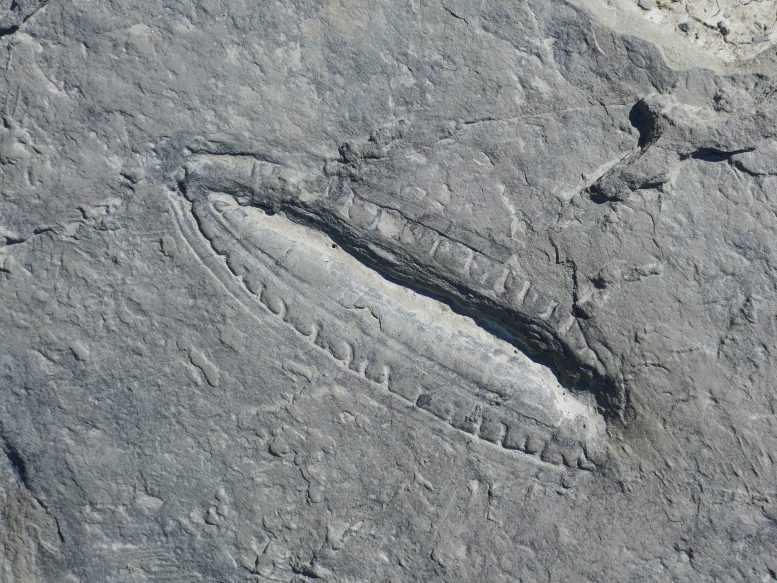
Ediacaran fossils reveal dietary habits and evolutionary insights, showing Kimberella had a gut to digest algae while Dickinsonia absorbed nutrients through its body.
Scientists from The Australian National University (ANU) have uncovered new insights into the physiology of our earliest animal ancestors by studying the contents of the last meal consumed by the Ediacara biota, the world’s oldest large organisms dating back 575 million years.
The research, published in the journal Current Biology, revealed that these ancient animals ate bacteria and algae sourced from the ocean floor, providing a deeper understanding of their ability to consume and digest food.
The scientists analyzed ancient fossils containing preserved phytosterol molecules — natural chemical products found in plants — that remained from the animals’ last meal. By examining the molecular remains of what the animals ate, the researchers were able to confirm the slug-like organism, known as Kimberella, had a mouth and a gut and digested food the same way modern animals do. The researchers say it was likely one of the most advanced creatures of the Ediacarans.
Dickinsonia: A Simpler Feeding Mechanism
The ANU team found that another animal, which grew up to 1.4 meters in length and had a rib-like design imprinted on its body, was less complex and had no eyes, mouth, or gut. Instead, the odd creature, called Dickinsonia, absorbed food through its body as it traversed the ocean floor.
“Our findings suggest that the animals of the Ediacara biota, which lived on Earth prior to the ‘Cambrian Explosion’ of modern animal life, were a mixed bag of outright weirdos, such as Dickinsonia, and more advanced animals like Kimberella that already had some physiological properties similar to humans and other present-day animals,” lead author Dr. Ilya Bobrovskiy, from GFZ-Potsdam in Germany, said.
Both Kimberella and Dickinsonia, which have a structure and symmetry unlike anything that exists today, are part of the Ediacara biota family that lived on Earth about 20 million years prior to the Cambrian Explosion – a major event that forever changed the course of evolution of all life on Earth.
“Ediacara biota really are the oldest fossils large enough to be visible with your naked eyes, and they are the origin of us and all animals that exist today. These creatures are our deepest visible roots,” Dr. Bobrovskiy, who completed the work as part of his Ph.D. at ANU, said.
The Role of Energy-Rich Algae in Evolution
Study co-author Professor Jochen Brocks, from the ANU Research School of Earth Sciences, said algae are rich in energy and nutrients and may have been instrumental for Kimberella’s growth.
“The energy-rich food may explain why the organisms of the Ediacara biota were so large. Nearly all fossils that came before the Ediacara biota were single-celled and microscopic in size,” Professor Brocks said.
Using advanced chemical analysis techniques, the ANU scientists were able to extract and analyze the sterol molecules contained in the fossil tissue. Cholesterol is the hallmark of animals and it’s how, back in 2018, the ANU team was able to confirm that Ediacara biota are among our earliest known ancestors.
The molecules contained tell-tale signatures that helped the researchers decipher what the animals ate in the lead-up to their death. Professor Brocks said the difficult part was differentiating between the signatures of the fat molecules of the creatures themselves, the algal and bacterial remains in their guts, and the decaying algal molecules from the ocean floor that were all entombed together in the fossils.
“Scientists already knew Kimberella left feeding marks by scraping off algae covering the sea floor, which suggested the animal had a gut. But it was only after analyzing the molecules of Kimberella’s gut that we were able to determine what exactly it was eating and how it digested food,” Professor Brocks said.
“Kimberella knew exactly which sterols were good for it and had an advanced fine-tuned gut to filter out all the rest.
“This was a Eureka moment for us; by using the preserved chemicals in the fossils, we can now make gut contents of animals visible even if the gut has since long decayed. We then used this same technique on weirder fossils like Dickinsonia to figure out how it was feeding and discovered that Dickinsonia did not have a gut.”
Dr. Bobrovskiy retrieved both the Kimberella and Dickinsonia fossils from steep cliffs near the White Sea in Russia — a remote part of the world home to bears and mosquitoes — in 2018.
Reference: “Guts, gut contents, and feeding strategies of Ediacaran animals” by Ilya Bobrovskiy, Alexey Nagovitsyn, Janet M. Hope, Ekaterina Luzhnaya and Jochen J. Brocks, 22 November 2022, Current Biology.
DOI: 10.1016/j.cub.2022.10.051
Never miss a breakthrough: Join the SciTechDaily newsletter.
Follow us on Google and Google News.
1 Comment
I think since all animals evolved from this critter it’s proof that life came from the sea. I’m tired of Christians claiming that God only makes it seam that way. Granted I’m not an atheist but my God helped guide evolution to a certain point then after the framework God put in all living life God let the world take over.