
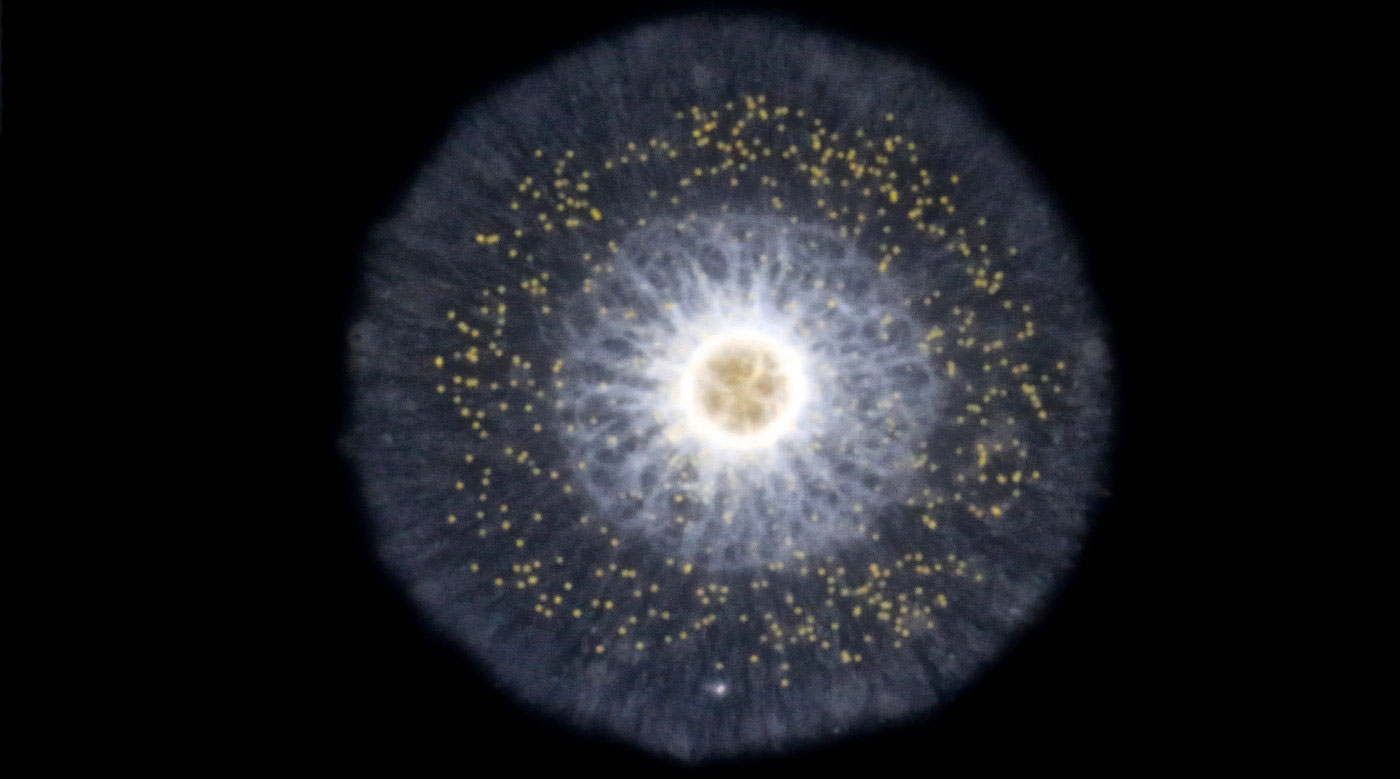
Sponges belong to our earliest ancestors. However, fossils, molecules, and genes disagree on the rise of these early animals. A large international team of researchers around Christian Hallmann and Benjamin Nettersheim from the Max Planck Institute for Biogeochemistry now found new molecular clues suggesting that sponges may have appeared much later than commonly assumed.
Animals, the most complex form of life on our planet, have only existed for the last few hundred million years, which accounts for less than one fifth of Earth’s history. Prior to that, the world’s oceans were inhabited solely by microorganisms such as bacteria and algae. Finding out exactly when animals first arose is a central, yet unresolved question in evolutionary research.
In 2009 researchers discovered fossil fat molecules, presumably originating from sea sponges, in rocks 645 million years old. Sponges belong to the oldest and most simple animals that had evolved, and their discovery in such old rocks meant that they may have been the first animals. ‘But the first unambiguous sponge fossils ever found, shaped as needles or spicules, are 100 million years younger than these old sponge molecules’, says Benjamin Nettersheim, first author of a study. ‘That’s a huge gap, the molecules and spicules cannot both be right.’ summarizes Nettersheim who recently published this critique in a News article in the same journal.
Algae instead of sponges
A team around group leader Christian Hallmann and Nettersheim, both from the Max Planck Institute for Biogeochemistry, now surprisingly found the same molecules formerly attributed to sponges, in Rhizaria: a group of unicellular organisms that include many predatory algae. Ancient forms of the Rhizaria family likely date back 770 million years, much older than the sponge fossils. Thus, in principle both sponges and Rhizaria could be the source of the fat molecules found in old rocks, but the authors argue that this would be rather unrealistic. ‘From an ecological perspective Rhizaria just make so much more sense. If sponges were the source, they would have needed to occur in massive abundances, thriving virtually everywhere, even in oxygen-depleted waters where sponges typically cannot survive’, according to Nettersheim. This consideration renders it much more likely that predatory Rhizaria, not sponges, were the main producers of the ancient molecules.
‘In general there had been three lines of evidence for the rise of early animals’, says Nettersheim, ‘they all gave different ages and we didn’t know which one to trust’. One way to estimate when an organism first emerged on Earth is by using molecular clocks, which compare the genetic differences in modern representatives and lead to a date of origin. ‘However, the calibration of such molecular clocks is problematic and this gives rise to a huge uncertainty in estimated dates for the last common ancestor of animals, ranging from 1300 to 615 million years ago’, says Hallmann. The second line of evidence had been the putative sponge molecules dating back to 645 million years; the third one the even younger sponge fossils, dating back to 560 million years.
Earliest animals 560 million years ago
With the new discovery that the ancient fat molecules most likely originate from Rhizaria rather than from sponges, the oldest scientifically confirmed sponges date back to only around 560 million years ago. At the same time in Earth history the large and complex fossils of the Ediacara Fauna appeared globally. In one of these Ediacara fossils, trace-remnants of cholesterol, which is a hallmark of animal life, were recently detected by international researchers, including members of the Hallmann group. Thus, the first confirmed appearance of both sponges and cholesterol suggest that earliest members of the animal kingdom appeared around 560 million years ago.
‘In geological terms, this is right before the onset of the Cambrian Explosion of complex lifeforms 540 to 550 million years ago, and the new timing now provides us with a coherent sequence of events. ’ says Hallmann. Using the corrected timeline, scientists can proceed to decipher the environmental context of this most important evolutionary transition that stands at the root of all complex modern life.
Reference: “Putative sponge biomarkers in unicellular Rhizaria question an early rise of animals,” by Benjamin J. Nettersheim, Jochen J. Brocks, Arne Schwelm, Janet M. Hope, Fabrice Not, Michael Lomas, Christiane Schmidt, Ralf Schiebel, Eva C. M. Nowack, Patrick De Deckker, Jan Pawlowski, Samuel S. Bowser, Ilya Bobrovskiy, Karin Zonneveld, Michal Kucera, Marleen Stuhr and Christian Hallmann, 4 March 2019, Nature Ecology & Evolution.
DOI: 10.1038/s41559-019-0806-5
Never miss a breakthrough: Join the SciTechDaily newsletter.
Follow us on Google and Google News.