
Close Menu
    Facebook X (Twitter) Instagram
    SciTechDaily
    • Biology
    • Chemistry
    • Earth
    • Health
    • Physics
    • Science
    • Space
    • Technology
    Facebook X (Twitter) Pinterest YouTube RSS
    SciTechDaily
    Home»Technology»Black Silicon Improves the Efficiency of Solar Cells
    Technology

    Black Silicon Improves the Efficiency of Solar Cells

    By Aalto UniversityJanuary 18, 2013No Comments2 Mins Read
    Facebook Twitter Pinterest Telegram LinkedIn WhatsApp Email Reddit
    Share
    Facebook Twitter LinkedIn Pinterest Telegram Email Reddit
    Black-silicon-canimprove-the-efficiency-of-solar-cells
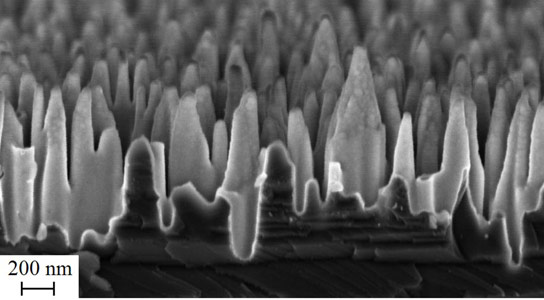
    Scientists have achieved substantial enhancements in light absorption and surface passivation of silicon nanostructures using atomic layer coating, promising advancements in high-efficiency solar cells and other light-responsive devices. Credit: Aalto University

    In a newly published study, researchers from Aalto University show that black silicon can improve the efficiency of solar cells by improving the light absorption and surface passivation.

    Scientists at Aalto University have demonstrated results that show a huge improvement in the light absorption and the surface passivation of silicon nanostructures. This has been achieved by applying atomic layer coating. The results advance the development of devices that require high-sensitivity light response such as high-efficiency solar cells.

    This method provides extremely good surface passivation. Simultaneously, it reduces the reflectance further at all wavelengths. These results are very promising considering the use of black silicon (b-Si) surfaces on solar cells to increase the efficiency to completely new levels, tells research scientist Päivikki Repo.

    More effective surface passivation methods than those used in the past have been needed to make black silicon a viable material for commercial applications. Good surface passivation is crucial in photonic applications such as solar cells. So far, the poor charge carrier transport properties attributed to nanostructured surfaces have been more detrimental for the final device operation than the gain obtained from the reduced reflectance.

    Black silicon (b-Si) can also be used in other technologies than solar cells. Numerous applications suggested for b-Si include drug analysis.

    Black silicon has been a subject of great interest in various fields including photovoltaics for its ability to reduce the surface reflectance even below 1 percent. However, many b-Si applications — especially solar cells — suffer from increased surface recombination resulting in poor spectral response. This is particularly problematic at short wavelengths.

    Reference: “Effective Passivation of Black Silicon Surfaces by Atomic Layer Deposition” by Päivikki Repo, Antti Haarahiltunen, Lauri Sainiemi, Marko Yli-Koski, Heli Talvitie, Martin C. Schubert and Hele Savin, 9 August 2012, IEEE Journal of Photovoltaics.
    DOI: 10.1109/JPHOTOV.2012.2210031

    The research has just been published in the Journal of Photovoltaics. The research is carried out by Aalto University, Finland, together with experts from Fraunhofer Institute for Solar Energy Systems ISE, Germany.

    Never miss a breakthrough: Join the SciTechDaily newsletter.
    Follow us on Google and Google News.

    Aalto University Green Technology Materials Science Photovoltaics Solar Power
    Share. Facebook Twitter Pinterest LinkedIn Email Reddit

    Related Articles

    New Technique Allows for Rapid Solar Cell Screening

    Princeton’s Nanomesh Triples Solar Cell Efficiency

    Scattered Silver Cubes Scale Up Light Absorption for Solar Power

    Installed Price of Solar Photovoltaic Power Systems Continues To Decline

    Spin Cell Technology Produces 20 Times More Electricity Than Flat, Static Panels

    Highly Transparent Polymer Solar Cell Produces Energy by Absorbing Near-Infrared Light

    3D Solar Towers, The future of Photovoltaics?

    Lithium Iron Phosphate Batteries Could Lead to Cheaper, More Efficient Solar Energy

    Researchers Develop IE2 for Analyzing Solar Cell Materials

    Leave A Reply Cancel Reply

    • Facebook
    • Twitter
    • Pinterest
    • YouTube

    Don't Miss a Discovery

    Subscribe for the Latest in Science & Tech!

    Trending News

    Scientists Call for a Complete Rethink of Alzheimer’s Treatment

    Scientists Identify Molecular Switch That Lets Exercise Reverse Muscle Aging

    Why Your Most Vivid Dreams Might Be the Key to Deep, Restful Sleep

    A Bright Star Hid a Massive Secret for 50 Years: Mystery of Gamma Cassiopeiae Finally Solved

    Scientists Identify Protein That Slows Key Effects of Aging

    Revolutionary Submarine Mysteriously Disappears Without a Trace – Scientists Are Now Preparing for a Bold Return

    Why Drinking More Water Isn’t Enough To Stop Kidney Stones

    New Study Reveals Surprising Effect of Drinking Coffee at Night

    Follow SciTechDaily
    • Facebook
    • Twitter
    • YouTube
    • Pinterest
    • Newsletter
    • RSS
    SciTech News
    • Biology News
    • Chemistry News
    • Earth News
    • Health News
    • Physics News
    • Science News
    • Space News
    • Technology News
    Recent Posts
    • Life Without a Sun? Scientists Say It May Thrive on Rogue Planet Moons
    • Your BMI Might Be Wrong: Study Finds Millions Are Misclassified
    • More Than Half of U.S. College Students Are Lonely, Major Study Reveals
    • Scientists Reveal Biological Signal Behind Mysterious Alzheimer’s Drug Side Effect
    • A Simple Blood Test Could Predict Dementia Risk 25 Years Early
    Copyright © 1998 - 2026 SciTechDaily. All Rights Reserved.
    • Science News
    • About
    • Contact
    • Editorial Board
    • Privacy Policy
    • Terms of Use

    Type above and press Enter to search. Press Esc to cancel.