
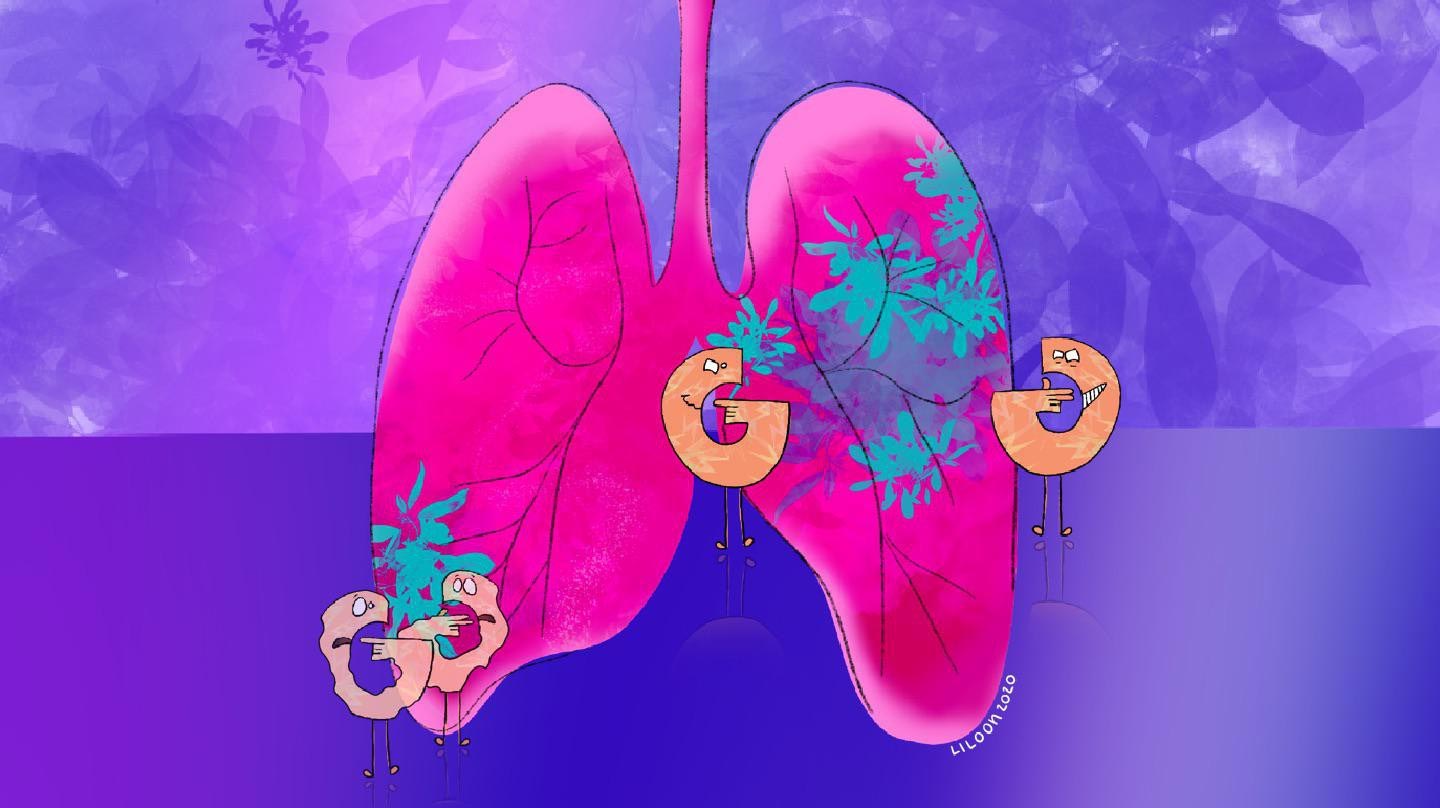
Treatments that block two sugar-transporting proteins could help slow the growth of lung tumors, new research from EPFL suggests.
Blocking a pair of sugar-transporting proteins may be a useful treatment approach for lung cancer, suggests a new study in mice and human cells published today in eLife.
Cancer cells use a lot of sugar to fuel their rapid growth and spread. This has led scientists to consider cutting off their sugar supply as a way to treat cancer. The current study suggests this could be an effective approach but it will be necessary to block multiple pathways at once to be effective.
Proteins called glucose transporters supply sugar to cells making them an appealing target for therapies intended to starve cancer cells. But scientists don’t know the best ways to do this, or if cancer cells would just switch to alternative fuel sources if they are denied sugar.
“Inhibiting sugar use in lung tumors could be an efficient treatment strategy, but whether glucose transporters should be targeted and which ones to target remains unclear,” says lead author Caroline Contat, a Ph.D. student and Doctoral Assistant at the Swiss Institute for Experimental Cancer Research, EPFL, Lausanne, Switzerland.
To find out, Contat and her colleagues genetically engineered mice with lung cancer that were missing a glucose transport protein called Glut1 or an alternate sugar transporter called Glut3. The team found that tumors grew just as fast in the mice lacking Glut1 or Glut3 as they did in mice with both transporters.
However, when they genetically engineered mice with lung cancer that lack both Glut1 and Glut3, they found that the animals grew fewer tumors and survived longer. By using an imaging technology called positron emission tomography (PET) and sugar labeled with radioactive tags, the team confirmed that the tumors used less sugar. The tumor cells also grew more slowly.
Finally, they deleted Glut1 and Glut3 in four different human lung cancer cell lines grown in the laboratory, which caused these cells to grow more slowly. “These experiments suggest Glut1 and Glut3 together are needed to fuel the growth of lung cancer,” Contat says.
Using nanoscale imaging studies, the team also found that most of the sugar-derived biomass in mouse lung tumor cells accumulates in cellular compartments called lamellar bodies and that Glut1 is necessary for this fuel storage.
“While more studies of these tumor fuel storage compartments are needed, our results suggest a new approach to lung cancer treatment that focuses on starving tumor cells of energy,” says senior author Etienne Meylan, Assistant Professor at the Swiss Institute for Experimental Cancer Research, EPFL. “In particular, treatments that block Glut1 and Glut3 simultaneously will be necessary to help stop lung tumor growth.”
Reference: “Combined deletion of Glut1 and Glut3 impairs lung adenocarcinoma growth” by Caroline Contat, Pierre-Benoit Ancey, Nadine Zangger, Silvia Sabatino, Justine Pascual, Stéphane Escrig, Louise Jensen, Christine Goepfert, Bernard Lanz, Mario Lepore, Rolf Gruetter, Anouk Rossier, Sabina Berezowska, Christina Neppl, Inti Zlobec, Stéphanie Clerc-Rosset, Graham William Knott, Jeffrey C Rathmell, E Dale Abel, Anders Meibom and Etienne Meylan, 23 June 2020, eLife.
DOI: 10.7554/eLife.53618
Never miss a breakthrough: Join the SciTechDaily newsletter.
Follow us on Google and Google News.