

A major new study has revealed that the genes we inherit at birth play a much larger role in cancer than previously thought—impacting not only how tumors form and evolve, but also how they respond to treatment.
Unlike most cancer research that focuses on mutations acquired during life, this study explored millions of inherited variants and their influence on protein activity in tumors. The findings could transform how we diagnose and treat cancer by factoring in each person’s unique genetic background—not just the tumor’s mutations. It’s a shift toward truly personalized, whole-body cancer care.
Inherited Genes and Cancer’s Hidden Influence
A new international study led by researchers at the Icahn School of Medicine at Mount Sinai, in collaboration with the National Cancer Institute’s Clinical Proteomic Tumor Analysis Consortium (CPTAC), has revealed that the genes we inherit at birth, known as germline genetic variants, play a far more significant role in cancer than previously recognized.
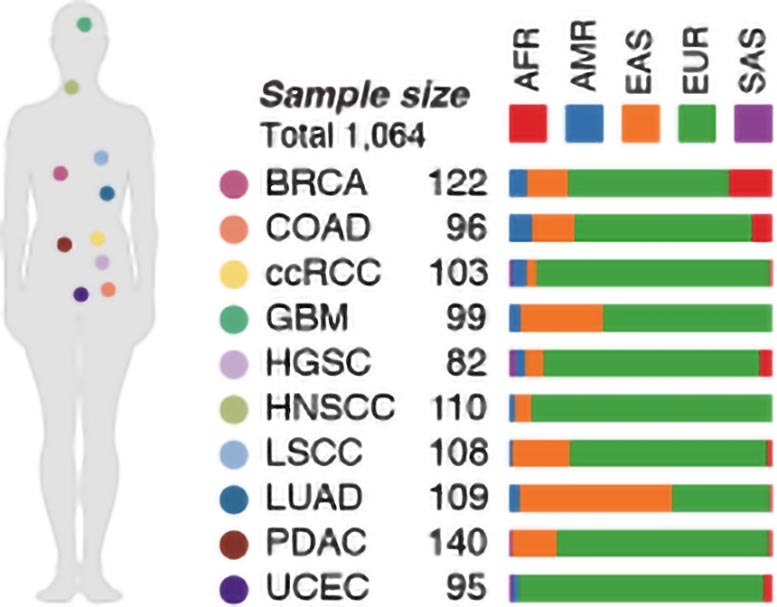
Published today in the April 14 issue of Cell, the study is the first to show how millions of inherited genetic differences can influence the activity of thousands of proteins inside tumors. By analyzing data from over 1,000 patients across 10 types of cancer, the researchers found that a person’s inherited DNA can shape how their cancer develops and behaves.
Redefining Personalized Cancer Care
These insights could transform cancer care. Today, most treatments are guided by genetic mutations found within the tumor itself. This research suggests that also considering a patient’s inherited genetic background could improve how cancers are diagnosed, how risk is assessed, and how treatments are selected.
“Every person carries a unique combination of genetic variants from birth, and these inherited differences quietly shape how our cells function throughout life,” says co-corresponding study author Zeynep H. Gümüş, PhD, Associate Professor of Genetics and Genomic Sciences at the Icahn School of Medicine at Mount Sinai. “What we’ve shown is that these variants don’t just sit in the background—they can play an active role in how tumors form, how they evolve, and even how they respond to treatment. This opens new possibilities for tailoring cancer care based not only on the tumor itself, but also on the patient’s underlying genetic makeup.”
From Somatic Mutations to Inherited Variants
Until now, most cancer research has focused on somatic mutations, changes that occur in cells over a person’s lifetime. But inherited germline variants outnumber somatic mutations by a wide margin, and their impact on cancer has remained poorly understood, say the investigators.
To conduct the study, the researchers used an advanced technique known as precision peptidomics, which enabled them to examine how specific inherited mutations modulate the structure, stability, and function of proteins in cancer cells. By mapping more than 330,000 protein-coding germline variants, the team uncovered how these inherited differences can alter protein activity, impact gene expression, and even drive how tumors interact with the immune system.
Explaining Cancer’s Wild Variability
“Our study flips the script by showing that inherited DNA changes can influence how genes are expressed and how proteins—key drivers of cancer behavior—are produced and modified in tumors. In doing so, these variants help explain some of the wide variation doctors see in how cancer appears, progresses, and responds to therapies from one patient to another,” says Dr. Gümüş.
The research adds to growing evidence that personalized cancer care should take into account not just the tumor’s mutations, but the genetic background of the person, too. However, the investigators caution that the study’s findings are based on data from a primarily European-ancestry cohort, and further research is needed to ensure these insights apply across multi-ancestry populations.
Whole-Person Precision Medicine
“This is a major step toward precision medicine that considers the whole individual, not just the cancer,” says Myvizhi Esai Selvan, PhD, co-first author of the study, who is an Instructor of Genetics and Genomics at the Icahn School of Medicine at Mount Sinai. “In the evolution of cancer, the inherited genome sets the stage. It helps determine which mutations matter, how aggressive a tumor might become, and how the body’s immune system will respond.”
The team is now working on applying these insights in two major areas:
- Cancer immunotherapy: In partnership with the National Cancer Institute’s Cancer Immune Monitoring and Analysis Centers, researchers are investigating why some patients respond well to immunotherapy while others do not, an area where inherited genetic differences could hold the key.
- Lung cancer risk prediction: Through the Mount Sinai Million Health Discoveries Program and the Million Veteran Program, the researchers are developing computational models to predict lung cancer risk based on a person’s inherited genetic profile. These tools could help determine who would benefit most from early screening, improving outcomes through early detection.
Reference: “Precision proteogenomics reveals pan-cancer impact of germline variants” by Fernanda Martins Rodrigues, Nadezhda V. Terekhanova, Kathleen J. Imbach, Karl R. Clauser, Myvizhi Esai Selvan, Isabel Mendizabal, Yifat Geffen, Yo Akiyama, Myranda Maynard, Tomer M. Yaron, Yize Li, Song Cao, Erik P. Storrs, Olivia S. Gonda, Adrian Gaite-Reguero, Akshay Govindan, Emily A. Kawaler, Matthew A. Wyczalkowski, Robert J. Klein, Berk Turhan, Karsten Krug, D.R. Mani, Felipe da Veiga Leprevost, Alexey I. Nesvizhskii, Steven A. Carr, David Fenyö, Michael A. Gillette, Antonio Colaprico, Antonio Iavarone, Ana I. Robles, Kuan-lin Huang, Chandan Kumar-Sinha, François Aguet, Alexander J. Lazar, Lewis C. Cantley, Urko M. Marigorta, Zeynep H. Gümüş, Matthew H. Bailey, Gad Getz, Eduard Porta-Pardo, Li Ding, Eunkyung An, Meenakshi Anurag, Jasmin Bavarva, Chet Birger, Michael J. Birrer, Anna P. Calinawan, Michele Ceccarelli, Daniel W. Chan, Arul M. Chinnaiyan, Hanbyul Cho, Shrabanti Chowdhury, Marcin P. Cieslik, Daniel Cui Zhou, Corbin Day, Marcin J. Domagalski, Yongchao Dou, Brian J. Druker, Nathan Edwards, Matthew J. Ellis, Steven M. Foltz, Alicia Francis, Tania J. Gonzalez Robles, Sara J.C. Gosline, Runyu Hong, Galen Hostetter, Yingwei Hu, Tara Hiltke, Chen Huang, Emily Huntsman, Eric J. Jaehnig, Scott D. Jewell, Jiayi Ji, Wen Jiang, Lizabeth Katsnelson, Karen A. Ketchum, Iga Kolodziejczak, Jonathan T. Lei, Yuxing Liao, Caleb M. Lindgren, Tao Liu, Weiping Ma, Wilson McKerrow, Chelsea J. Newton, Robert Oldroyd, Gilbert S. Omenn, Amanda G. Paulovich, Francesca Petralia, Boris Reva, Karin D. Rodland, Henry Rodriguez, Kelly V. Ruggles, Dmitry Rykunov, Sara R. Savage, Eric E. Schadt, Michael Schnaubelt, Tobias Schraink, Zhiao Shi, Richard D. Smith, Xiaoyu Song, Yizhe Song, Jimin Tan, Ratna R. Thangudu, Nicole Tignor, Joshua M. Wang, Pei Wang, Ying Wang, Bo Wen, Maciej Wiznerowicz, Xinpei Yi, Bing Zhang, Hui Zhang, Xu Zhang, Zhen Zhang, David I. Heiman, Jared L. Johnson, Liang-Bo Wang, Lijun Yao, Mathangi Thiagarajan, Mehdi Mesri, Özgün Babur, Pietro Pugliese, Qing Zhang, Samuel H. Payne, Saravana M. Dhanasekaran, Shankara Anand, Shankha Satpathy, Stephan Schürer, Vasileios Stathias, Wen-Wei Liang, Wenke Liu and Yige Wu, 14 April 2025, Cell.
DOI: 10.1016/j.cell.2025.03.026
Never miss a breakthrough: Join the SciTechDaily newsletter.
Follow us on Google and Google News.