
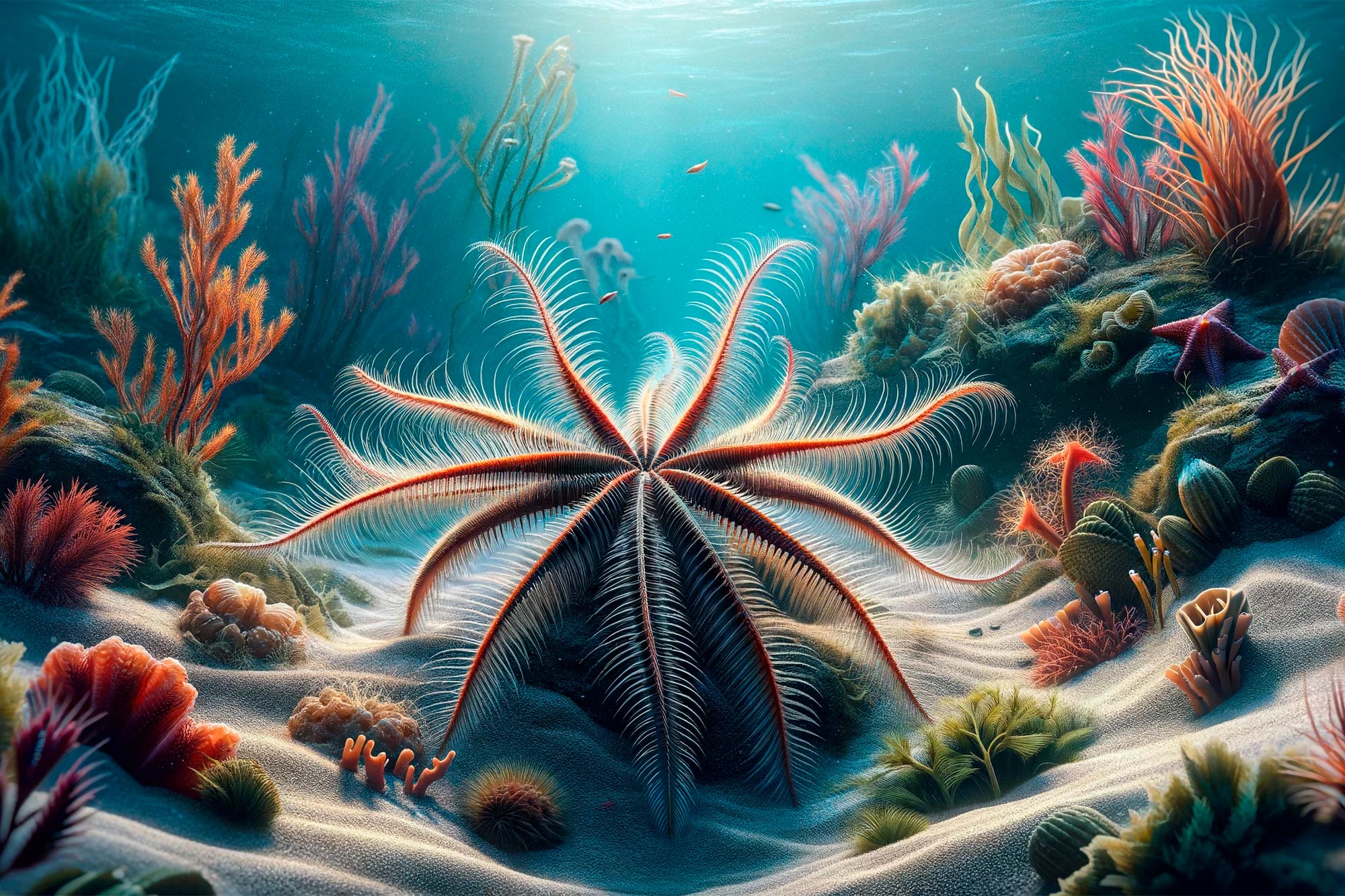
Brainless brittle stars are capable of learning through experience, as demonstrated in new research. They exhibit classical conditioning by associating darkness with feeding, a significant discovery in understanding learning processes in brainless marine creatures.
We humans are fixated on big brains as a proxy for smarts. But headless animals called brittle stars have no brains at all and still manage to learn through experience, new research reveals.
Relatives of starfish, brittle stars spend most of their time hiding under rocks and crevices in the ocean or burrowing in the sand.
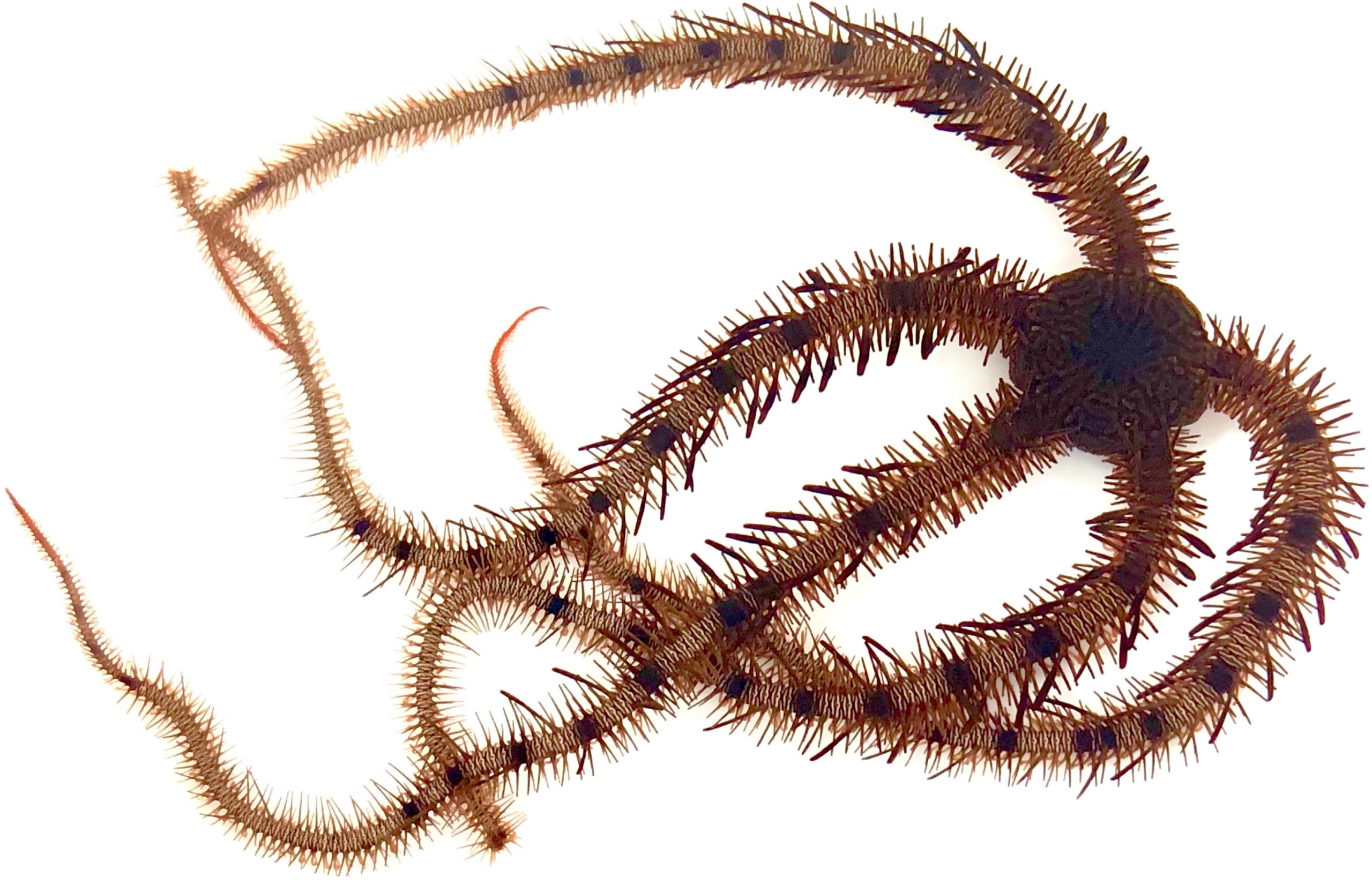
These shy marine creatures have no brain to speak of — just nerve cords running down each of their five wiggly arms, which join to form a nerve ring near their mouth.
“There’s no processing center,” said lead author Julia Notar, who did the research as part of her biology Ph.D. in professor Sönke Johnsen’s lab at Duke University.
“Each of the nerve cords can act independently,” Notar said. “It’s like instead of a boss, there’s a committee.”
Unraveling Learning in Brainless Marine Creatures
In the case of brittle stars, that seems to be enough to learn by association, Notar, Johnsen, and former Duke undergraduate Madeline Go report in the journal Behavioral Ecology and Sociobiology.
This type of learning involves associating different stimuli via a process called classical conditioning. A famous example is Pavlov’s dog experiments, which showed that dogs repeatedly fed at the ringing of a bell would eventually start drooling at the mere sound of a bell, even when no food was around.
Humans do this all the time. If you hear the “ding” of a smartphone over and over again with each new alert, eventually the sound starts to have a special meaning. Just hearing someone’s phone ping or buzz with the same chime as yours is enough to make you reflexively reach for your own phone in anticipation of the next text, email, or Instagram post.
Classical conditioning has been demonstrated in a handful of previous studies in starfish. But most echinoderms — a group of some 7,000 species that includes brittle stars and similarly brainless starfish, sea urchins and sea cucumbers — have not been tested.
To find out if brittle stars are capable of learning, the researchers put 16 black brittle stars (Ophiocoma echinata) in individual water tanks and used a video camera to record their behavior.
This time-lapse video shows a classical conditioning experiment Duke researchers conducted to see if brittle stars – which don’t have brains – could learn. Every time the lights went dim, the researchers put a pipette with a morsel of shrimp in the animals’ tanks. Over time the animals learned that “lights out” was a dinner bell call to come for dinner.
Half the brittle stars were trained by dimming the lights for 30 minutes whenever the animals were fed. Every time the lights went out, the researchers would put a morsel of shrimp — “which they love” — in the tanks, placed just out of reach.
The other half got just as much shrimp and also experienced a 30-minute dark period, but never at the same time — the animals were fed under lit conditions.
Whether it was light or dark, the animals spent most of their time hiding behind the filters in their tanks; only coming out at mealtime. But only the trained brittle stars learned to associate darkness with food.
Early in the 10-month-long experiment, the animals stayed hidden when the lights went out. But over time, the animals made such a connection between the darkness and mealtime that they reacted as if food was on its way and crept out of hiding whenever the lights went out, even before any food was put in the tanks.
These brittle stars had learned a new association: lights out meant that food was likely to show up. They didn’t need to smell or taste the shrimp to react. Just sensing the lights go dim was enough to make them come when called for dinner.
Discovering Learning and Memory in Echinoderms
They still remembered the lesson even after a 13-day ‘break’ without training, i.e., dimming the lights over and over again without feeding them.
Notar said the results are “exciting” because “classical conditioning hasn’t really been shown definitively in this group of animals before.”
“Knowing that brittle stars can learn means they’re not just robotic scavengers like little Roombas cleaning up the ocean floor,” Notar said. “They’re potentially able to expect and avoid predators or anticipate food because they’re learning about their environment.”
As a next step, Notar hopes to start to tease apart how they manage to learn and remember using a nervous system that is so different from our own.
“People ask me all the time, ‘how do they do it?’” Notar said. “We don’t know yet. But I hope to have more answers in a few years.”
Reference: “Learning without a brain: classical conditioning in the ophiuroid Ophiocoma echinata” by Julia C. Notar, Madeline C. Go and Sönke Johnsen, 21 November 2023, Behavioral Ecology and Sociobiology.
DOI: 10.1007/s00265-023-03402-x
This work was supported by the U.S. Department of Department of Defense through the National Defense Science & Engineering Graduate Fellowship Program, the Duke Nicholas School Rachel Carson Scholars program and the Duke Biology Department.
Never miss a breakthrough: Join the SciTechDaily newsletter.
Follow us on Google and Google News.