
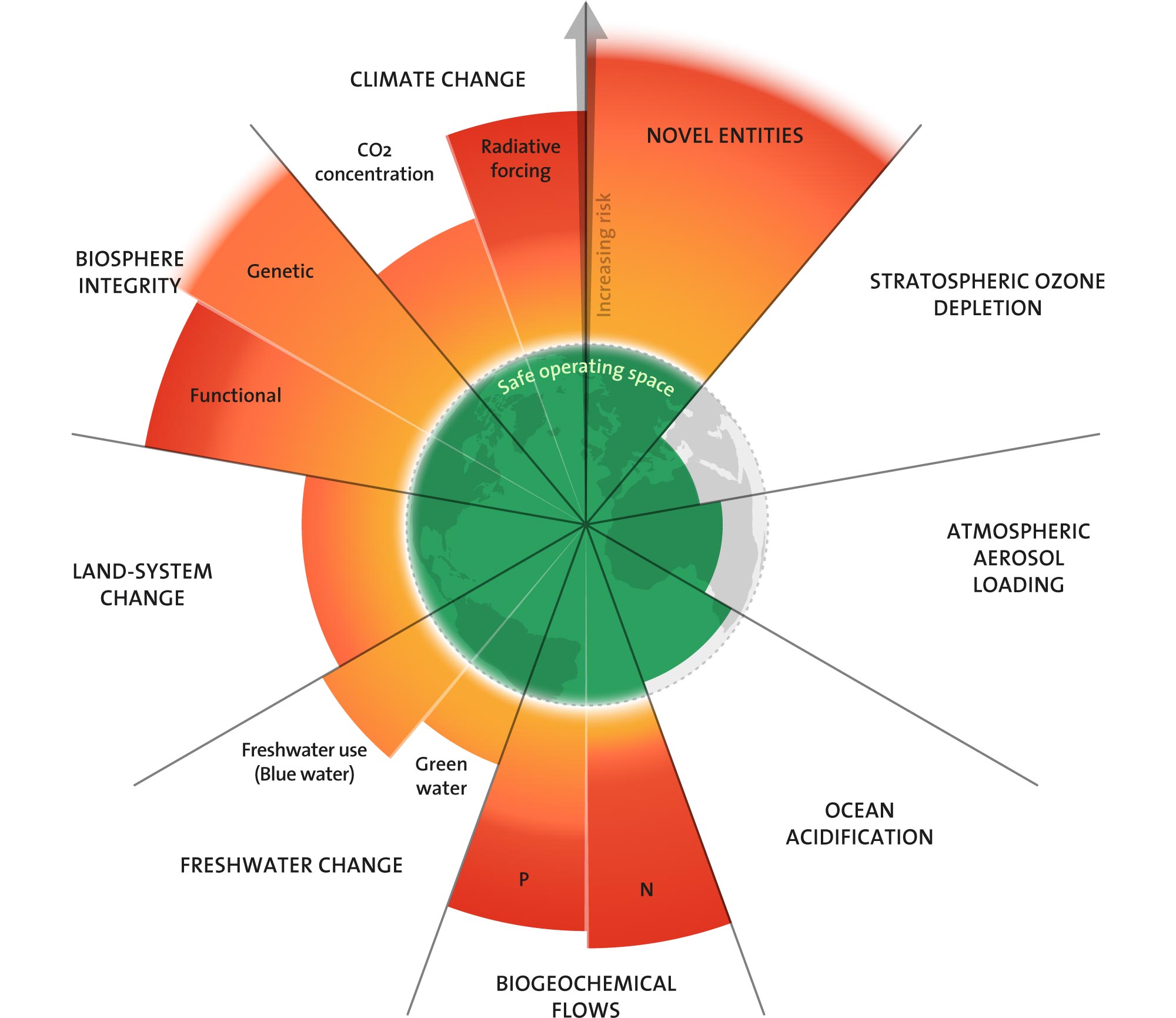
A new study updates the planetary boundary framework and shows human activities are increasingly impacting the planet and, thereby, increasing the risk of triggering dramatic changes in overall Earth conditions.
For over 3 billion years, the interaction between life (represented by the planetary boundary, Biosphere Integrity) and climate have controlled the overall environmental conditions on Earth. Human activities, for example replacing nature with other land uses, changing the amount of water in rivers and in soil, the introduction of synthetic chemicals to the open environment, and the emission of greenhouse gases to the atmosphere all influence these interactions.
Respecting and maintaining interactions in the Earth system so that they remain similar to those that have controlled Earth conditions over the past ~12,000 years are critical for ensuring human activities do not trigger dramatic changes in Earth condition – changes that likely would decrease the Earth’s ability to support modern civilizations.
Planetary Boundaries and Human Impact
The nine “planetary boundaries” represent components of the global environment that regulate the stability and liveability of the planet for people. The degree of breaching of the safe boundary levels is caused by human-driven activities impacting the components. The planetary boundaries framework applies the newest scientific understanding of the functioning of the Earth system to identify a ”safe operating space” for humanity by proposing limits for the extent to which human activities can be allowed to impact critical processes without risk of potentially triggering irreversible changes in the Earth conditions that support us.
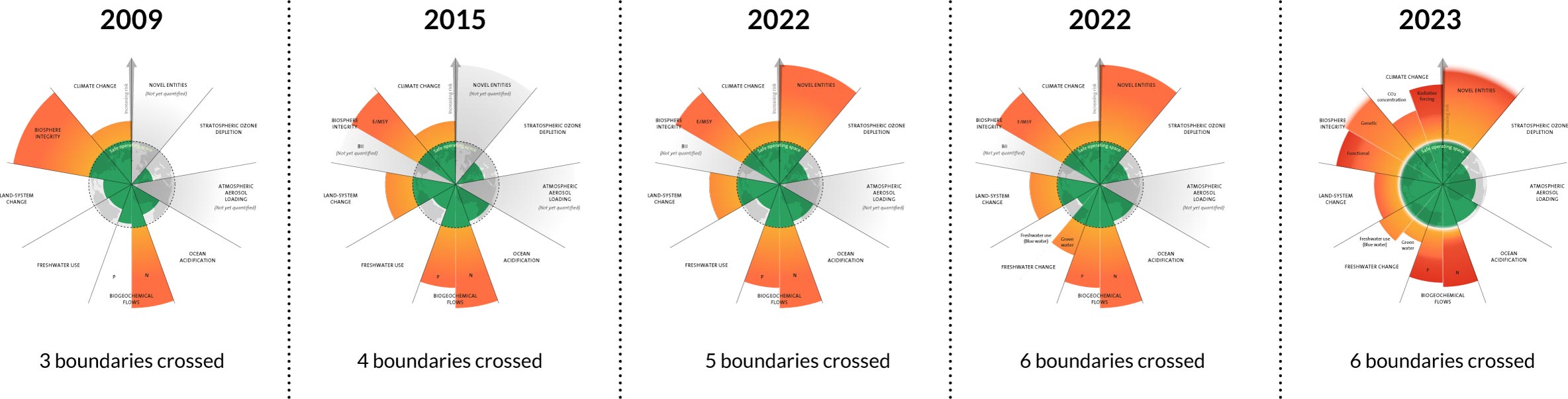
For the first time, metrics for all boundaries are presented. Six of the boundaries are found to be transgressed, and transgression is increasing for all boundaries except the degradation of the Earth’s ozone layer. A global focus on climate is not enough. The development of Earth system models that accurately reproduce interactions between boundaries, especially Climate and Biosphere Integrity, is an urgent priority.
The study, published in the journal Science Advances, represents the third update of the framework carried out by twenty-nine scientists from eight different countries.
The Earth’s “Blood Pressure” Is Too High
The trend of increasing transgression of the boundaries is worrying explains Katherine Richardson, professor at Globe Institute, Leader of the Sustainability Science Centre at the University of Copenhagen, and leader of the study:
“Crossing six boundaries in itself does not necessarily imply a disaster will ensue but it is a clear warning signal. We can regard it as we do our own blood pressure. A BP over 120/80 is not a guarantee of a heart attack but it increases the risk of one. Therefore, we try to bring it down. For our own – and our children’s – sakes we need to reduce the pressure on these six planetary boundaries.”
An important conclusion of the study is that more focus is needed on interactions between the boundaries:
“Focus on human-caused climate change is not enough if we want to protect the earth system from irreversible harm,” says Johan Rockström, Director of the Potsdam Institute for Climate Impact Research (PIK), and original proposer of the framework in 2009.
“Next to climate change, integrity of the biosphere is the second pillar of stability of our planet. Our research shows that mitigating global warming and saving a functional biosphere for the future have to go hand in hand,” co-author Wolfgang Lucht, Head of PIK’s department of Earth System Analysis, stresses.
Use of Biomass Affects Biodiversity
The need to respect the Land Use Change boundary puts focus on the increasing global use of biomass as an alternative for coal, oil, and gas. Biomass is the product of photosynthesis, the process where plants convert the sun’s energy to energy that can be used by other living organisms and, thus, supplies the energy that supports biodiversity.
“Our study shows that humans are appropriating the equivalent of ~30 % of the energy that was available to support biodiversity before the Industrial Revolution,” says Richardson.
“Surely, the removal of so much of the energy that otherwise would have been available to nature must be a driver of biodiversity loss. Therefore, we propose the adoption of Human Appropriation of Net Primary Production (HANPP), i.e., biomass use, as one of two metrics when assessing human impacts on biodiversity.”
Enhanced Earth System Models Needed
“A world that develops within science defined boundaries is the only way to navigate our current situation with rising, potentially catastrophic risks, at the planetary scale. We already recognize this on Climate, where the Paris agreement has adopted the climate planetary boundary of holding the 1.5°C limit. Similarly, the world has accepted the planetary boundary on biodiversity, when decided at the 2022 Montreal-Kunming COP15, to halt and reverse biodiversity loss on land and in the ocean,” says Johan Rockström and continues:
“Our study shows, however, that this is by far not enough. The Planetary Boundaries science provides a ‘guide for action’ if we truly want to secure prosperity and equity for all on Earth, and this goes well beyond climate only, requiring novel Earth system modeling and analysis, and systematic efforts to protect, recover and rebuild planetary resilience.”
“Hopefully,” adds Katherine Richardson, “this new study will serve as a wake-up call for many and increase focus in the international community on the necessity of limiting our impacts on the planet in order to preserve and protect the Earth conditions that allow advanced human societies to flourish.”
Reference: “Earth beyond six of nine planetary boundaries” by Katherine Richardson, Will Steffen, Wolfgang Lucht, Jørgen Bendtsen, Sarah E. Cornell, Jonathan F. Donges, Markus Drüke, Ingo Fetzer, Govindasamy Bala, Werner von Bloh, Georg Feulner, Stephanie Fiedler, Dieter Gerten, Tom Gleeson, Matthias Hofmann, Willem Huiskamp, Matti Kummu, Chinchu Mohan, David Nogués-Bravo, Stefan Petri, Miina Porkka, Stefan Rahmstorf, Sibyll Schaphoff, Kirsten Thonicke, Arne Tobian, Vili Virkki, Lan Wang-Erlandsson, Lisa Weber and Johan Rockström, 13 September 2023, Science Advances.
DOI: 10.1126/sciadv.adh2458
Never miss a breakthrough: Join the SciTechDaily newsletter.
Follow us on Google and Google News.
2 Comments
“For our own – and our children’s – sakes we need to reduce the pressure on these six planetary boundaries.”
Therein lies the problem — having children. An increasing population puts pressure on the ‘planetary boundaries.’ What does the good doctor propose as a solution?
“Six of the boundaries are found to be transgressed, and transgression is increasing for all boundaries EXCEPT the degradation of the Earth’s ozone layer.”
That assertion is questionable. The last 3 years of the Antarctic ‘Ozone Hole’ have been very similar to the conditions during the 1990s. See Annual Records near the bottom:
https://ozonewatch.gsfc.nasa.gov/
It looks like 2023 is going to set some kind of record low, having started forming early this year.