
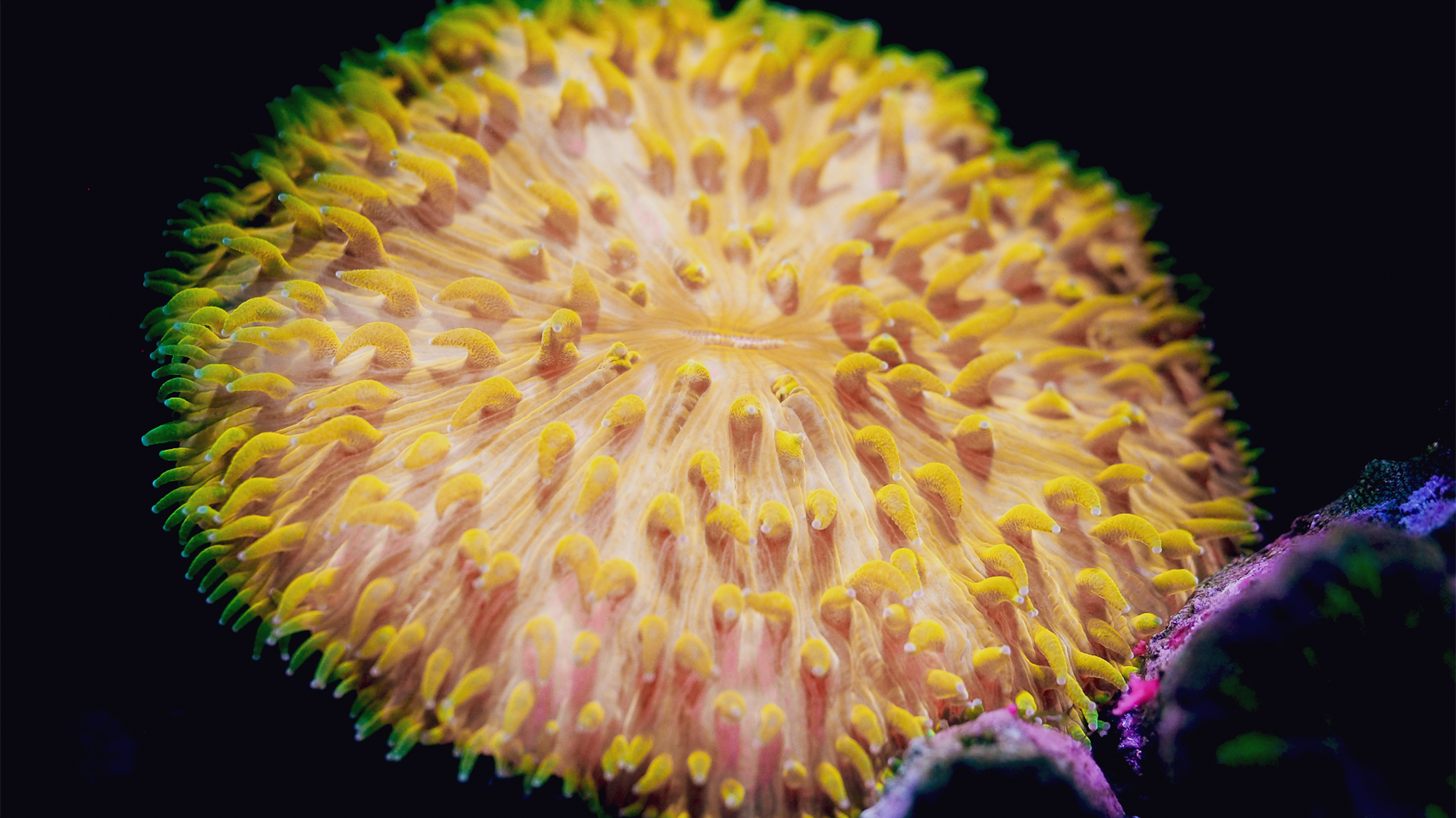
New research shows that the free-living coral Cycloseris cyclolites migrates toward blue light using a pulsed inflation method, enhancing its survival and adaptability to changing environments.
When it’s time to migrate, QUT research has revealed that the free-living coral Cycloseris cyclolites defies conventional expectations by heading directly toward light.
The study, led by Dr. Brett Lewis from QUT’s School of Atmospheric and Earth Sciences and the Reef Restoration and Adaptation Program, explored how this free-living mushroom coral moves, navigates, and responds to light in its natural habitat. The findings were published in PLOS ONE.
Super high-resolution time-lapse taken using Olympus Om-D E-M5 Mark II Camera with 60mm lens showing C. cyclolites tissue inflation, which reduces friction and increases buoyancy. This process allows local water currents to move the coral in the prevailing direction, facilitating passive locomotion. Credit: Dr Brett Lewis
“Not all corals are attached to the substrate; some are solitary and free-living, allowing them to migrate into preferred habitats,” Dr Lewis said. “However, the lifestyle of these mobile corals, including how they move and navigate for migration, remains largely obscure.”
Cycloseris cyclolites is an adorably small free-living species of mushroom coral capable of migrating to different reef habitats, often driven by the search for optimal light conditions.
Super high-resolution time-lapse, captured using an Olympus OM-D E-M5 Mark II camera with a 60mm lens, showing passive mobility in C. cyclolites. As opposed to S1, the local water currents cause the coral to roll over the substrate instead of slide. Credit: Dr Brett Lewis
Pulsed Inflation Mechanism
Using high-resolution time-lapse imaging, the team identified that Cycloseris cyclolites was able to move via a mechanism known as pulsed inflation, a process where the coral inflates and deflates its tissue in rhythmic bursts to propel itself forward, like the movement seen in jellyfish.
The mechanism appears to be a widespread strategy for free-living corals, aiding in functions such as self-righting when turned upside down, sediment rejection when buried during storms, and now phototaxis – behaviors that help the coral survive in complex environments.
Time-lapse video demonstrating the biomechanics of pulsed inflation mobility in C. cyclolites. The video integrates footage from an iPad (inset) capturing the topside view and a Dino-Lite Edge Series microscope recording the underside. This combined perspective highlights the coordinated inflation and contraction of coral tissues, driving active locomotion by shifting surface contact via pedal structures and generating forward movement through lateral tissue contractions. Credit: Dr Brett Lewis
“Our findings suggest that pulsed inflation is not just a survival strategy but a critical mechanism for migration and navigation,” Dr Lewis said.
“The ability of Cycloseris cyclolites to move towards specific light sources is a fascinating parallel to other marine species like jellyfish, which suggests they are more neurologically sophisticated than previously thought.”
High-resolution time-lapse (4K), captured using an Olympus OM-D E-M10 Mark III with a 60mm lens, demonstrating the detailed biomechanics of pulsed inflation mobility in C. cyclolites. The video shows the inflation of peripheral tissues and the twisting and contraction of lateral tissues, which collectively drive the coral’s forward movement in a manner similar to jellyfish swimming. Credit: Dr Brett Lewis
Light Preference and Phototaxis
Cycloseris cyclolites was also shown to exhibit a strong preference for blue light, with 86.7 percent of the corals moving towards blue light sources, compared to just 20 percent for white light.
The ability of these migratory mushroom corals to distinguish between different wavelengths of light aligns with their preference for deeper water habitats, where blue wavelengths dominate, and could be crucial for their migration to optimal depths for survival, reproduction, and dispersal.
High-resolution video (4K), captured using an Olympus OM-D E-M10 Mark III with a 60mm lens, demonstrating the detailed biomechanics of pulsed inflation mobility in C. cyclolites in real time. Credit: Dr Brett Lewis
Providing new insights into coral mobility mechanisms, the findings show just how closely related these corals are to jellyfish mechanisms which have been previously researched as a key point in the evolution of the centralised nervous system humans possess today.
“The findings also have important ecological implications,” Dr Lewis said.
“Understanding their movement strategies could help scientists predict how migratory corals might resist, survive or adapt to changes in environmental conditions such as sea surface changes caused by climate change, which can be reduced by the deeper waters these corals migrate to.
“With these climate-driven factors increasing, the faster the migration, the higher the chance of survival.”
Reference: “Walking coral: Complex phototactic mobility in the free-living coral Cycloseris cyclolites” by Brett M. Lewis, David J. Suggett, Peter J. Prentis and Luke D. Nothdurft, 22 January 2025, PLOS ONE.
DOI: 10.1371/journal.pone.0315623
The study was funded by the Australian Research Council.
Never miss a breakthrough: Join the SciTechDaily newsletter.
Follow us on Google and Google News.