

Cambridge scientists have developed a cartilage-like material that senses inflammation and releases drugs precisely when and where they’re needed.
Scientists at the University of Cambridge have created a new type of soft material that can detect subtle chemical shifts in the body and deliver medication right at the problem site.
The gel-like substance can be infused with anti-inflammatory drugs, which are released when the surrounding environment becomes slightly more acidic. This is especially useful during an arthritis flare-up, when inflamed joints naturally show a drop in pH compared to healthy tissue.
As acidity rises, the material changes texture, turning softer and more pliable. That shift acts as a signal, prompting the gel to release its stored medication. Because the response only occurs within a specific pH range, the treatment can be targeted directly to the inflamed area, lowering the chance of unwanted side effects.
Potential in Arthritis Treatment
If used as an artificial cartilage in arthritic joints, this approach could allow for the continuous treatment of arthritis, improving the efficacy of drugs to relieve pain and fight inflammation. Arthritis affects more than 10 million people in the UK, costing the NHS an estimated £10.2 billion annually. Worldwide it is estimated to affect over 600 million people.
While extensive clinical trials are needed before the material can be used in patients, the researchers say their approach could improve outcomes for people with arthritis, and for those with other conditions, including cancer. Their results are reported in the Journal of the American Chemical Society.
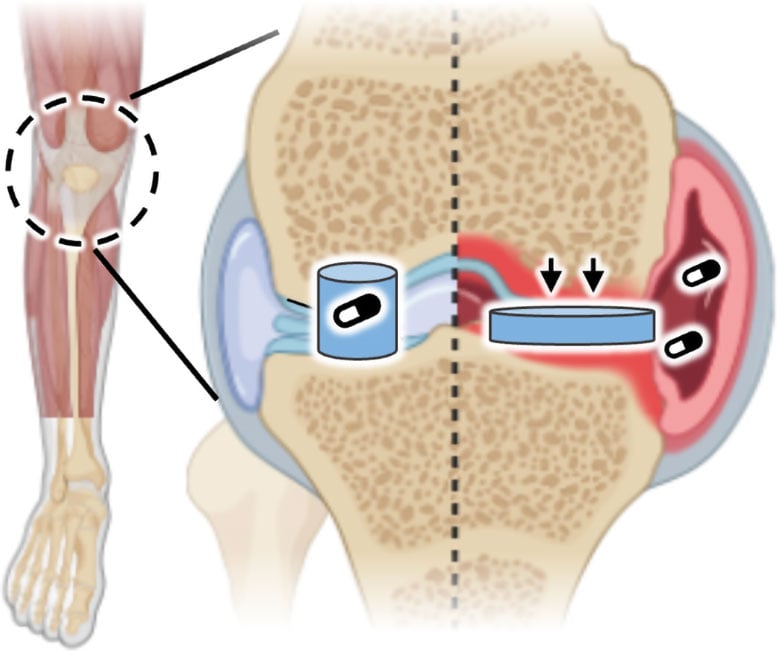
The material developed by the Cambridge team uses specially engineered and reversible crosslinks within a polymer network. The sensitivity of these links to changes in acidity levels gives the material highly responsive mechanical properties.
The material was developed in Professor Oren Scherman’s research group in Cambridge’s Yusuf Hamied Department of Chemistry. The group specializes in designing and building these unique materials for a range of potential applications.
Combining Cartilage-Like Properties with Drug Delivery
“For a while now, we’ve been interested in using these materials in joints, since their properties can mimic those of cartilage,” said Scherman, who is Professor of Supramolecular and Polymer Chemistry and Director of the Melville Laboratory for Polymer Synthesis. “But to combine that with highly targeted drug delivery is a really exciting prospect.”
“These materials can ‘sense’ when something is wrong in the body and respond by delivering treatment right where it’s needed,” said first author Dr Stephen O’Neill. “This could reduce the need for repeated doses of drugs, while improving patient quality of life.”
Unlike many drug delivery systems that require external triggers such as heat or light, this one is powered by the body’s own chemistry. The researchers say this could pave the way for longer-lasting, targeted arthritis treatments that automatically respond to flare-ups, boosting effectiveness while reducing harmful side effects.
In laboratory tests, researchers loaded the material with a fluorescent dye to mimic how a real drug might behave. They found that at acidity levels typical of an arthritic joint, the material released substantially more drug cargo compared with normal, healthy pH levels.
Tunable and Flexible Approach
“By tuning the chemistry of these gels, we can make them highly sensitive to the subtle shifts in acidity that occur in inflamed tissue,” said co-author Dr Jade McCune. “That means drugs are released when and where they are needed most.”
The researchers say the approach could be tailored to a range of medical conditions, by fine-tuning the chemistry of the material. “It’s a highly flexible approach, so we could in theory incorporate both fast-acting and slow-acting drugs, and have a single treatment that lasts for days, weeks, or even months,” said O’Neill.
The team’s next steps will involve testing the materials in living systems to evaluate their performance and safety in a physiological environment. The team says that if successful, their approach could open the door to a new generation of responsive biomaterials capable of treating chronic diseases with greater precision.
Reference: “Kinetic Locking of pH-Sensitive Complexes for Mechanically Responsive Polymer Networks” by Stephen J.K. O’Neill, Yuen Cheong Tse, Zehuan Huang, Xiaoyi Chen, Jade A. McCune and Oren A. Scherman, 8 September 2025, Journal of the American Chemical Society.
DOI: 10.1021/jacs.5c09897
The research was supported by the European Research Council and the Engineering and Physical Sciences Research Council (EPSRC), part of UK Research and Innovation (UKRI). Oren Scherman is a Fellow of Jesus College, Cambridge.
Never miss a breakthrough: Join the SciTechDaily newsletter.
Follow us on Google and Google News.
1 Comment
Subtle shifts in acidity underlie inflammatory processes, and might be interrogated in the ongoing search for relief from a number of diseases which haunt the biology of human beings.