
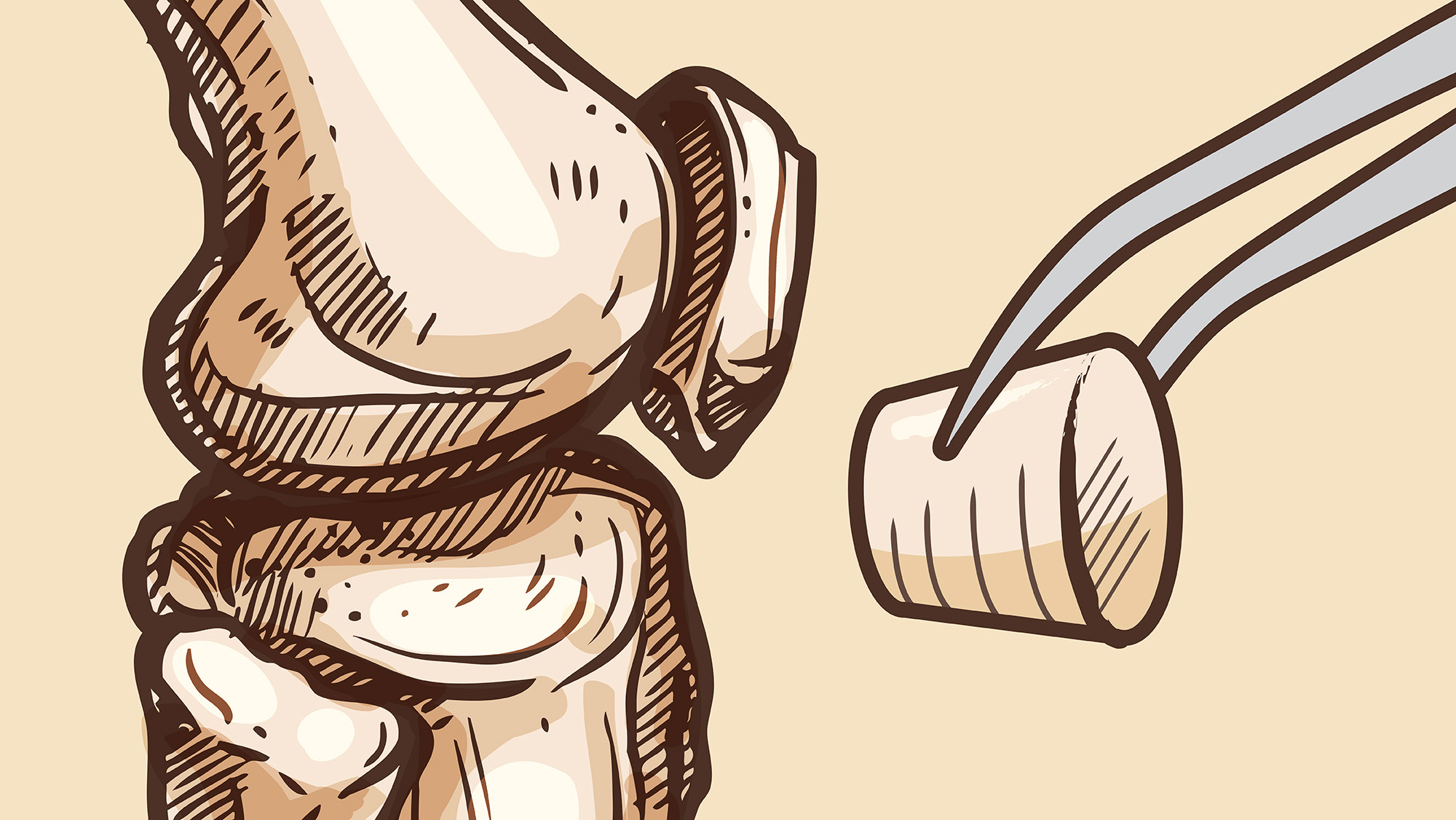
Dr. Melissa Grunlan is creating synthetic plugs to help patients with chronic knee pain or disabilities, potentially eliminating the need for total knee replacements.
Osteochondral defects (OCDs) can lead to damage in both cartilage and the underlying bone, resulting in chronic pain and impaired joint function. Depending on the severity of the damage, affected individuals may require surgical intervention, with the most comprehensive option being a total knee replacement—a procedure that over 800,000 Americans receive annually.
Dr. Melissa Grunlan, professor in the Department of Biomedical Engineering at Texas A&M University, received a grant from the National Institute of Arthritis and Musculoskeletal and Skin Disease, a suborganization of the National Institutes of Health, to develop synthetic cartilage-capped regenerative osteochondral plugs (CC-ROPs) — a potential off-the-shelf surgical device to treat OCDs and avoid total knee replacement.
“Chronic knee pain and disability are caused by cartilage loss and OCDs stemming from arthritis, including osteoarthritis and post-traumatic arthritis causing individuals pain that limits comfort and mobility,” said Grunlan. “This grant will allow us to maximize the potential of the CC-ROPs to heal OCDs, and to collect data demonstrating this efficacy.”
Current Treatments and Their Limitations
This technology could be an alternative to current treatment methods, such as autografting or total knee replacement.
Autografting requires small cylindrical specimens to be harvested from the non-damaged part of the patient’s knee and transferred into pre-drilled holes in the defect area. However, this method can be hindered by the patient’s age (less effective if older than 40) and the size of the defect.
If patients do not meet the autografting criteria, they are likely to need a total knee replacement. This is an extensive surgery where parts of the damaged knee joint are replaced by an artificial or prosthetic comprised of metal and plastic. Although a total knee replacement is sometimes a patient’s only option, the surgery can lead to post-operative complications.
In contrast, the proposed CC-ROPs are not restricted by age or the size of the defect while offering several other benefits. Firstly, they were designed to have the geometry of cylindrical autografts so they could be implanted with existing surgical tools and protocols. Additionally, it does not require pre-loading with cells or growth factors to induce healing, but instead leverages the unique features of the cap and scaffold base. Once implanted, the CC-ROP can provide immediate support for joint function, including knee articulation.
“Overall, this design represents a feasible approach for clinical translation,” said Grunlan.
Design and Collaboration
Created in her lab, the CC-ROP consists of two parts: a cartilage cap and an osseous (or bone) base. The cartilage cap is an ultra-strong hydrogel that uniquely mimics the mechanical properties of biological cartilage. The base is made of a porous, bioresorbable polymer. After implantation, the base is replaced by new bone tissue and continues to anchor the cartilage cap. Thus, the cylindrical implant stimulates the formation of new bone tissue and integration with host tissue while supplying synthetic cartilage necessary for joint function.
This grant will allow the research team to maximize the potential of the CC-ROPs to heal OCDs and perform necessary analyses to ensure the materials and devices are functional and ready for real-life applications. They will also evaluate the effectiveness of the device in pre-clinical studies.
This study is a collaborative effort between Dr. Michael Moreno, associate professor in the J. Mike Walker ’66 Department of Mechanical Engineering at Texas A&M, Dr. W. Brian Saunders, associate professor in the School of Veterinary Medicine and Biomedical Sciences at Texas A&M and Dr. Mariah Hahn, professor in the Department of Biomedical Engineering at Rensselaer Polytechnic Institute.
“This effort is one of several partnerships forged between the Department of Biomedical Engineering and the School of Veterinary Medicine and Biomedical Sciences to develop solutions that benefit both animals and humans,” said Dr. Mike McShane, biomedical engineering department head and James J. Cain Professor II.
The research was funded by the National Institute of Arthritis and Musculoskeletal and Skin Diseases.
Never miss a breakthrough: Join the SciTechDaily newsletter.
Follow us on Google and Google News.