
Close Menu
    Facebook X (Twitter) Instagram
    SciTechDaily
    • Biology
    • Chemistry
    • Earth
    • Health
    • Physics
    • Science
    • Space
    • Technology
    Facebook X (Twitter) Pinterest YouTube RSS
    SciTechDaily
    Home»Physics»Breakthrough in Muon Ionization Cooling Experiment – Building the World’s Most Powerful Particle Accelerator
    Physics

    Breakthrough in Muon Ionization Cooling Experiment – Building the World’s Most Powerful Particle Accelerator

    By Ulsan National Institute of Science and TechnologyMarch 11, 20201 Comment3 Mins Read
    Facebook Twitter Pinterest Telegram LinkedIn WhatsApp Email Reddit
    Share
    Facebook Twitter LinkedIn Pinterest Telegram Email Reddit
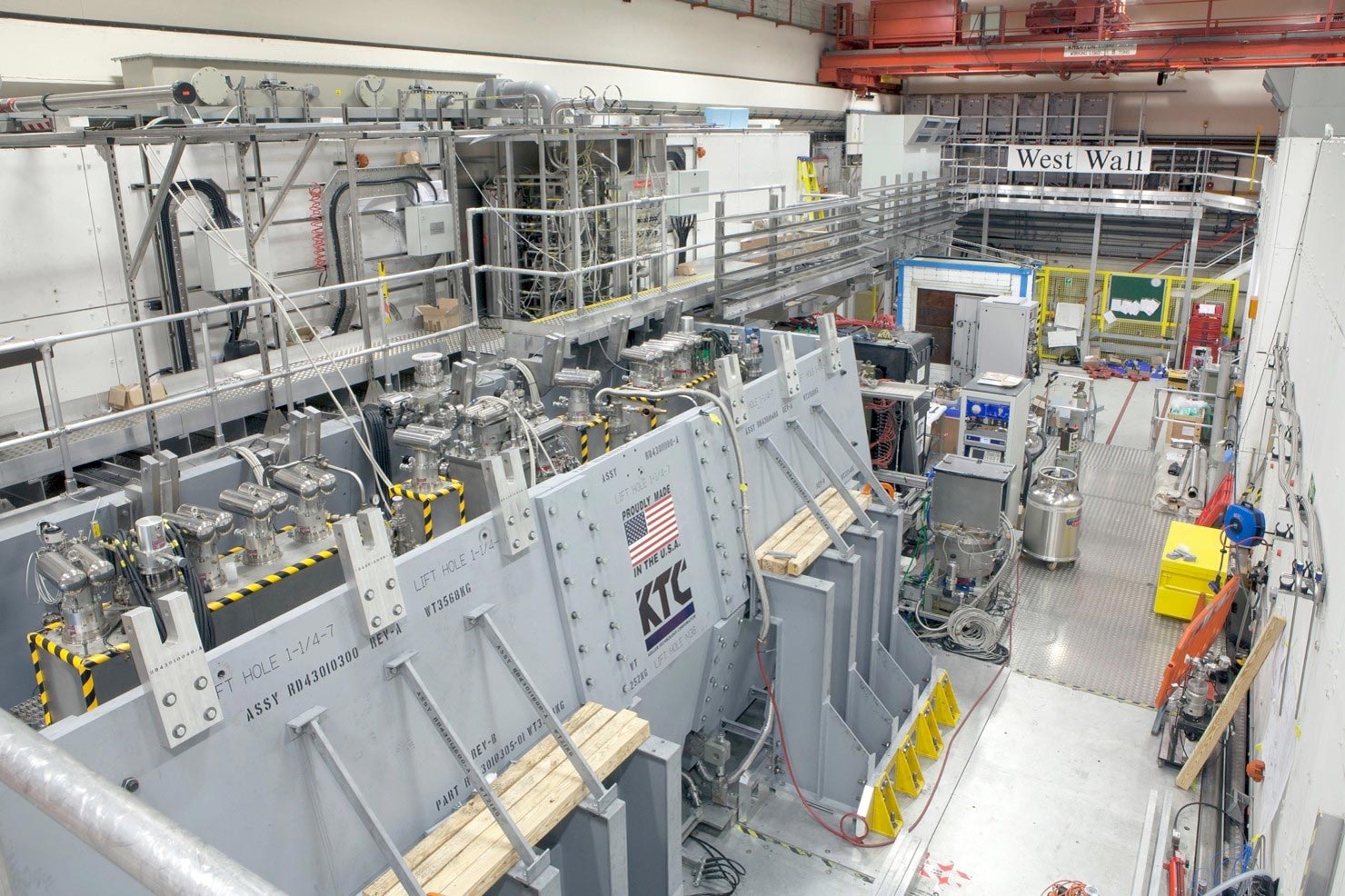
    MICE Muon Beam Line
    The MICE muon beam-line at the Science and Technology Facilities Council (STFC) ISIS Neutron and Muon Beam facility on the Harwell Campus in the UK. Credit: MICE Collaboration

    An international team of researchers, affiliated with UNIST has for the first time succeeded in demonstrating the ionization cooling of muons. Regarded as a major step in being able to create the world’s most powerful particle accelerator, this new muon accelerator is expected to provide a better understanding of the fundamental constituents of matter.

    This breakthrough has been carried out by the Muon Ionization Cooling Experiment (MICE) collaboration, which includes many UK scientists, as well as Professor Moses Chung and his research team in the School of Natural Sciences at UNIST. Their findings have been published in the online version of Nature on February 5, 2020.

    “We have succeeded in realizing muon ionization cooling, one of our greatest challenges associated with developing muon accelerators,” says Professor Chung. “Achievement of this is considered especially important, as it could change the paradigm of developing the Lepton Collider that could replace the Neutrino Factory or the Large Hadron Collider (LHC).”
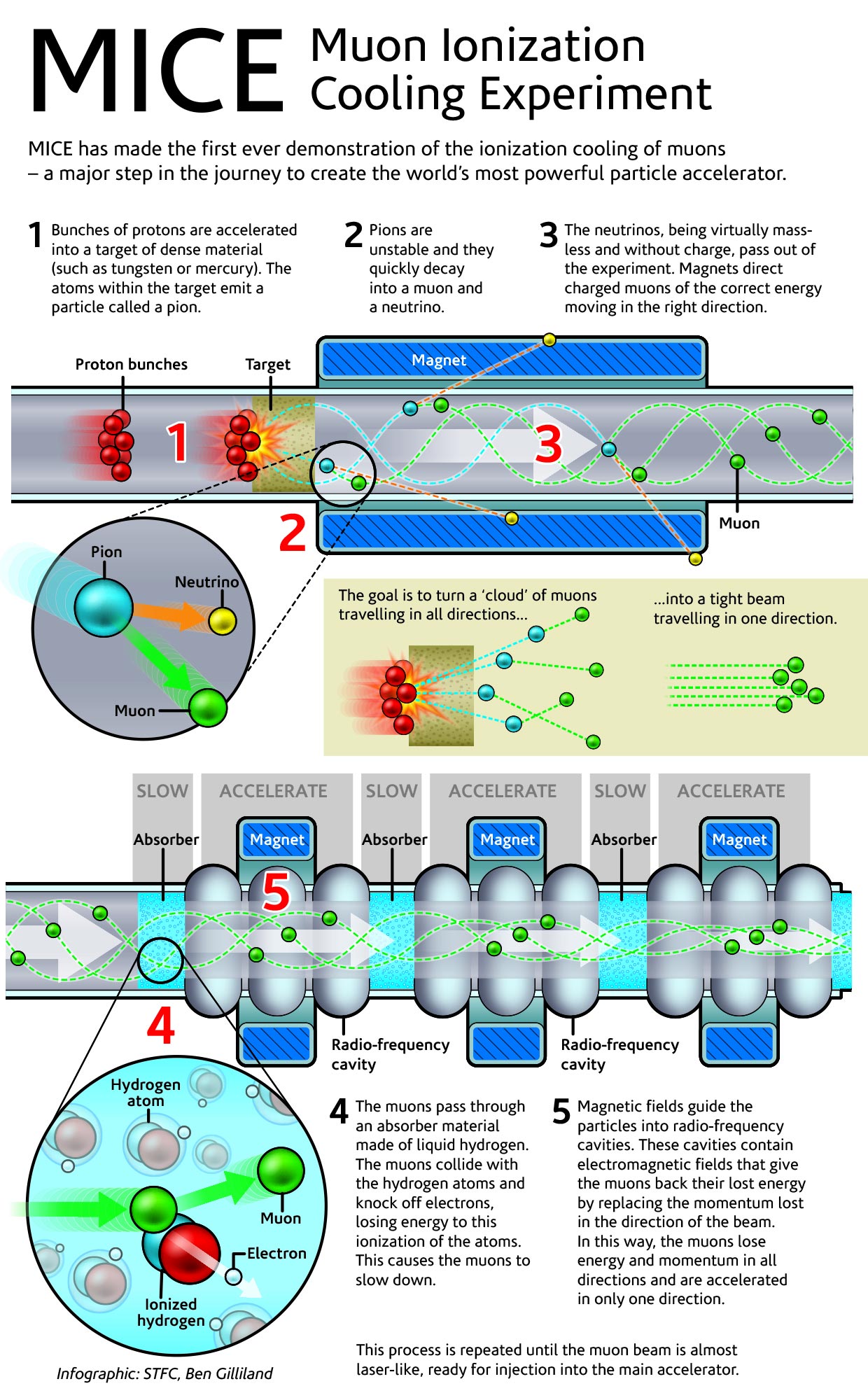
    Muon Ionization Cooling Experiment by the MICE collaboration. Credit: MICE Collaboration

    Muons are naturally occurring particles that are generated in the Earth’s upper atmosphere by cosmic rays collisions, thus are regarded as a follow-on particle accelerator to replace the LHC. Protons, a type of hardon, are primarily used by the LHC and they partake in strong interactions. Leptons, like the electron and the muon, are not subject to the strong interaction, rather they interact via the weak force.

    Muons have an extremely brief lifespan of two-millionths of a second. They are produced by smashing a beam of protons into a target. These muons form a diffuse cloud, meaning that they are difficult to accelerate and there is a low chance of them colliding and producing useful interesting physical phenomena. To make the cloud less diffuse, a process known as ‘Beam cooling’ was suggested. This involves getting the muons closer together and moving in the same direction. However, due to the ultra-short lifespan of muons, it has been impossible to cool the beam with the traditional methods.
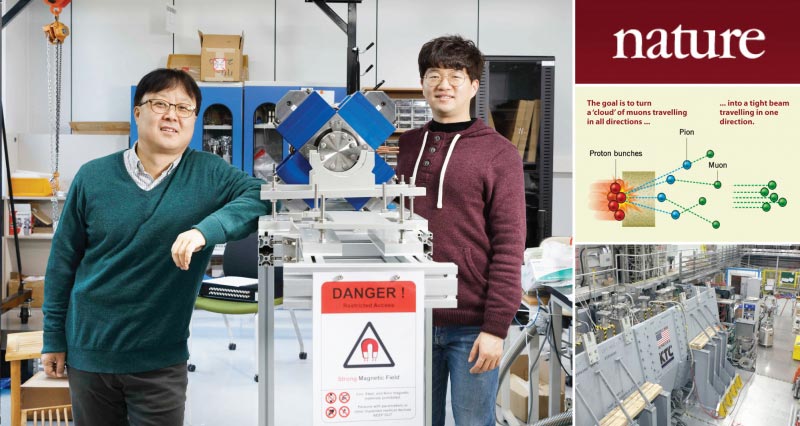
    Moses Chung ChangKyu Sung
    Professor Moses Chung and ChangKyu Sung in the School of Natural Sciences at UNIST were the only Korean researchers who partook in the MICE collaboration. Credit: UNIST

    To tackle this challenge, the MICE collaboration team succeeded in channeling muons into a small enough volume to be able to study physics in new systems via a method, known as Ionization Cooling, which was previously suggested and developed into theoretically operable schemes in the 1980s.

    The results of the experiment, carried out using the MICE muon beam-line at the Science and Technology Facilities Council (STFC) ISIS Neutron and Muon Beam facility on the Harwell Campus in the UK, clearly shows that the phase-space volume occupied by the muon beam can be controlled via the ionization cooling, as predicted by the theory.

    Read World’s Most Powerful Particle Accelerator One Big Step Closer for more on this development.

    Reference: “Demonstration of cooling by the Muon Ionization Cooling Experiment” by MICE collaboration, 5 February 2020, Nature.
    DOI: 10.1038/s41586-020-1958-9

    This achievement is the result of 20 years of hard work, involving 100 researchers throughout the world. Professor Chung and ChangKyu Sung (Department of Physics, UNIST) were the only Korean researchers who partook in this collaboration. This research has been supported by the SRC project via the National Research Foundation (NRF).

    Never miss a breakthrough: Join the SciTechDaily newsletter.
    Follow us on Google and Google News.

    Particle Physics Popular Quantum Physics Ulsan National Institute of Science and Technology
    Share. Facebook Twitter Pinterest LinkedIn Email Reddit

    Related Articles

    Physicists Chart the ‘Secret’ Movement of Quantum Particles

    Physicists Make First Ever Measurement of Antiproton Interactions

    New CERN Study Suggests Subatomic Particles Could Defy the Standard Model

    Experiment Using Photons Could Detect Quantum-Scale Black Holes

    Photons Traverse Optical Obstacles as Both a Wave and Particle Simultaneously

    Physicists Use Cheap Colliders to Probe for Heavy Photons

    Quantum Interference Shown Experimentally in Larger Molecules

    Evidence of Elusive Majorana Fermions Raises Possibilities for Quantum Computing

    Higgs Boson Signals Gain Strength at Large Hadron Collider

    1 Comment

    1. Howard Hammermann on March 11, 2020 7:10 am

      Protons, a type of hardon, are primarily used by the LHC and they partake in strong interactions.
      ^^^^^^^^^^

      yuk, yuk!

      Reply
    Leave A Reply Cancel Reply

    • Facebook
    • Twitter
    • Pinterest
    • YouTube

    Don't Miss a Discovery

    Subscribe for the Latest in Science & Tech!

    Trending News

    Millions Take These IBS Drugs, But a New Study Finds Serious Risks

    Scientists Unlock Hidden Secrets of 2,300-Year-Old Mummies Using Cutting-Edge CT Scanner

    Bread Might Be Making You Gain Weight Even Without Eating More Calories

    Scientists Discover Massive Magma Reservoir Beneath Tuscany

    Europe’s Most Active Volcano Just Got Stranger – Here’s Why Scientists Are Rethinking It

    Alzheimer’s Symptoms May Start Outside the Brain, Study Finds

    Millions Take This Popular Supplement – Scientists Discover a Concerning Link to Heart Failure

    The Universe Is Expanding Too Fast and Scientists Can’t Explain Why

    Follow SciTechDaily
    • Facebook
    • Twitter
    • YouTube
    • Pinterest
    • Newsletter
    • RSS
    SciTech News
    • Biology News
    • Chemistry News
    • Earth News
    • Health News
    • Physics News
    • Science News
    • Space News
    • Technology News
    Recent Posts
    • Doctors Surprised by the Power of a Simple Drug Against Colon Cancer
    • Why Popular Diabetes Drugs Like Ozempic Don’t Work for Everyone: The “Genetic Glitch”
    • Scientists Create Improved Insulin Cells That Reverse Diabetes in Mice
    • Scientists Stunned After Finding Plant Thought Extinct for 60 Years
    • A Common Diabetes Drug May Hold the Key to Stopping HIV From Coming Back
    Copyright © 1998 - 2026 SciTechDaily. All Rights Reserved.
    • Science News
    • About
    • Contact
    • Editorial Board
    • Privacy Policy
    • Terms of Use

    Type above and press Enter to search. Press Esc to cancel.