
Close Menu
    Facebook X (Twitter) Instagram
    SciTechDaily
    • Biology
    • Chemistry
    • Earth
    • Health
    • Physics
    • Science
    • Space
    • Technology
    Facebook X (Twitter) Pinterest YouTube RSS
    SciTechDaily
    Home»Space»Building the World’s Largest Eye: ESO’s Extremely Large Telescope Reaches Construction Milestone
    Space

    Building the World’s Largest Eye: ESO’s Extremely Large Telescope Reaches Construction Milestone

    By European Southern Observatory (ESO)July 16, 2023No Comments6 Mins Read
    Facebook Twitter Pinterest Telegram LinkedIn WhatsApp Email Reddit
    Share
    Facebook Twitter LinkedIn Pinterest Telegram Email Reddit
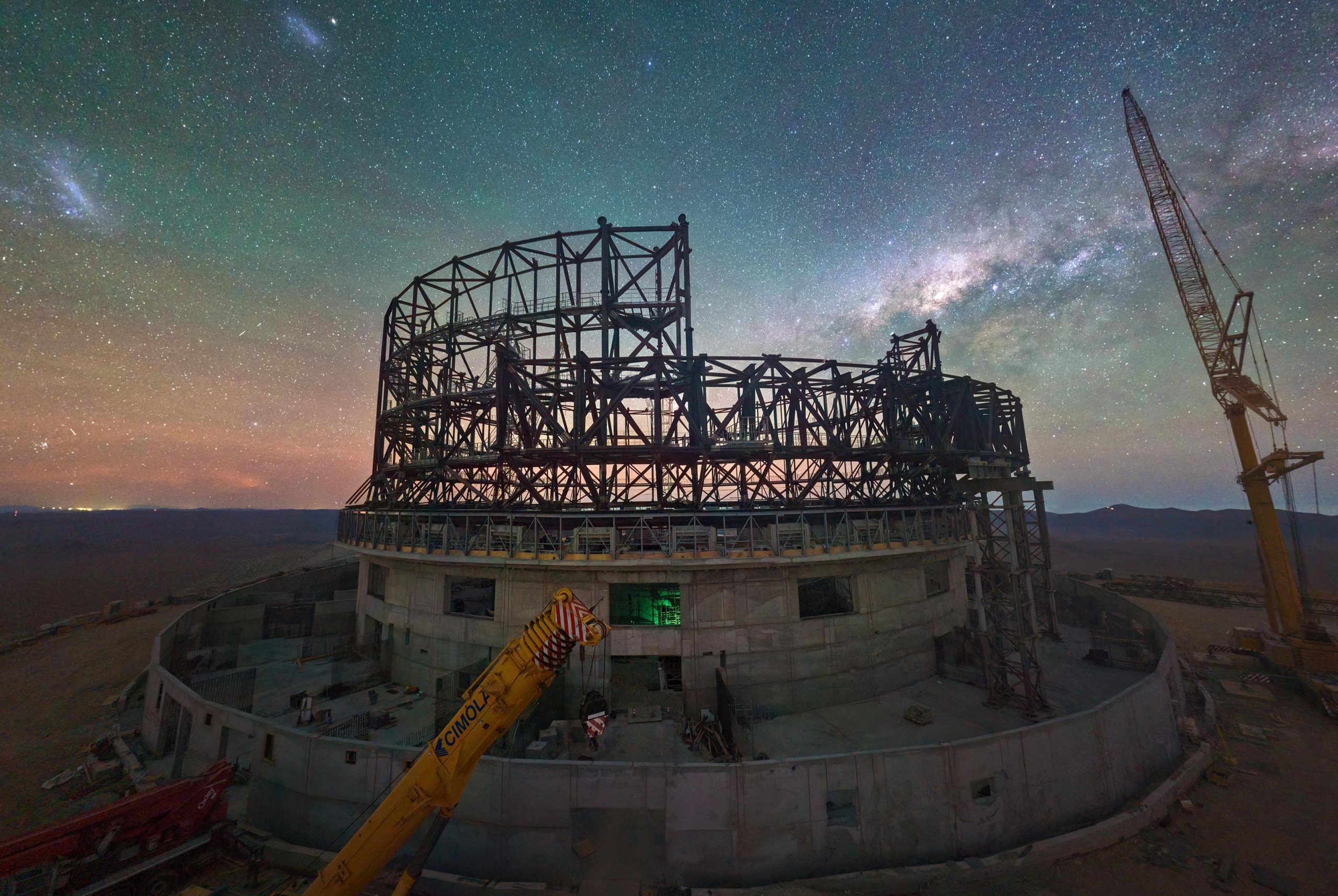
    Night View of the ELT Under Construction
    This image, taken in late June 2023, shows a webcam image of the construction site of ESO’s Extremely Large Telescope at Cerro Armazones, in Chile’s Atacama Desert. There, engineers and construction workers are currently assembling the structure of the telescope dome at a staggering pace. Visibly changing each day, the steel structure will soon acquire the familiar round shape typical of telescope domes. The starry background is dominated by the core of the Milky Way, our home galaxy, and the Large and Small Magellanic clouds, two dwarf galaxies that orbit our own. Credit: ESO

    The European Southern Observatory’s Extremely Large Telescope (ESO’s ELT) has reached the halfway mark in its construction. Once completed, it will be the world’s largest telescope for visible and infrared light, featuring a pioneering five-mirror optical design. Despite challenges posed by the pandemic, progress has been swift, with completion of the second half of the project expected to be significantly quicker. The telescope is set to begin scientific operations in 2028.

    The European Southern Observatory’s Extremely Large Telescope (ESO’s ELT) is a revolutionary ground-based telescope that will have a 39-meter main mirror and will be the largest telescope in the world for visible and infrared light: the world’s biggest eye on the sky. Construction of this technically complex project is advancing at a good pace, with the ELT now surpassing the 50% complete milestone.

    The telescope is located atop Cerro Armazones in Chile’s Atacama Desert, where engineers and construction workers are currently assembling the structure of the telescope dome at a staggering pace. Visibly changing each day, the steel structure will soon acquire the familiar round shape typical of telescope domes.

    Drone Shot of the ELT Under Construction
    This image, taken in late June 2023, shows a drone shot of the construction site of ESO’s Extremely Large Telescope at Cerro Armazones, in Chile’s Atacama Desert. There, engineers and construction workers are currently assembling the structure of the telescope dome at a staggering pace. Visibly changing each day, the steel structure will soon acquire the familiar round shape typical of telescope domes. People visible at the bottom of the frame give a sense of scale to the photo, showcasing just how big the dome of ELT will be. Behind the telescope, we see the shadow of Cerro Armazones, projected onto the desert landscape. Credit: ESO

    The telescope mirrors and other components are being built by companies in Europe, where work is also progressing well. ESO’s ELT will have a pioneering five-mirror optical design, which includes a giant main mirror (M1) made up of 798 hexagonal segments. More than 70% of the blanks and supports for these segments have now been manufactured, while M2 and M3 are cast and in the process of being polished. Progress on M4, an adaptive, flexible mirror that will adjust its shape a thousand times a second to correct for distortions caused by air turbulence, is particularly impressive: all six of its thin petals are fully finalised and being integrated into their structural unit. Further, all six laser sources, another key component of the ELT’s adaptive opticssystem, have been produced and delivered to ESO for testing.

    Top View of the ELT Under Construction
    This image, taken in late June 2023, shows a drone shot of the construction site of ESO’s Extremely Large Telescope at Cerro Armazones, in Chile’s Atacama Desert. There, engineers and construction workers are currently assembling the structure of the telescope dome at a staggering pace. Visibly changing each day, the steel structure will soon acquire the familiar round shape typical of telescope domes. The base of the telescope structure is visible in the center of the frame. Credit: ESO

    All other systems needed to complete the ELT, including the control system and the equipment needed to assemble and commission the telescope, are also progressing well in their development or production. Moreover, all four of the first scientific instruments the ELT will be equipped with are in their final design phase with some about to start manufacturing. In addition, most of the support infrastructure for the ELT is now in place at or near Cerro Armazones. For example, the technical building that, among other things, will be used for storage and coating of different ELT mirrors is fully erected and fitted out, while a photovoltaic plant that supplies renewable energy to the ELT site started operating last year.

    Construction of ESO’s ELT was kickstarted nine years ago with a groundbreaking ceremony. The top of Cerro Armazones was flattened in 2014 to allow for space for the giant telescope.


    ESO’s Extremely Large Telescope is now 50% complete. Credit: ESO

    Completing the remaining 50% of the project, however, is anticipated to be significantly quicker than building the first half of the ELT. The first half of the project included the lengthy and meticulous process of finalizing the design of the vast majority of components to be manufactured for the ELT. In addition, some of the elements, such as mirror segments and its supporting components and sensors, required detailed prototyping and significant testing before being produced en masse. Furthermore, construction was affected by the COVID-19 pandemic, with the site closing for several months and production of many of the telescope components suffering delays. With production processes now fully resumed and streamlined, finalizing the remaining half of the ELT is anticipated to take only five years. Nonetheless building such a large and complex telescope like the ELT is not free of risks until it’s finished and working.

    ESO Director General Xavier Barcons says: “The ELT is the largest of the next generation of ground-based optical and near-infrared telescopes and the one that is most advanced in its construction. Reaching 50% completion is no small feat, given the challenges inherent to large, complex projects, and it was only possible thanks to the commitment of everyone at ESO, the continued support of the ESO Member States and the engagement of our partners in industry and instrument consortia. I am extremely proud that the ELT has reached this milestone.”

    Planned to start scientific observations in 2028, ESO’s ELT will tackle astronomical questions such as: Are we alone in the Universe? Are the laws of physics Universal? How did the first stars and galaxies form? It will dramatically change what we know about our Universe and will make us rethink our place in the cosmos.

    Notes

    The percentage completion of the ELT is estimated based on its ‘earned value’, a project management metric used to evaluate progress on a project that accounts for schedule and cost. At present, the ELT is 50% through the project plan.

    Never miss a breakthrough: Join the SciTechDaily newsletter.
    Follow us on Google and Google News.

    Astronomy European Southern Observatory
    Share. Facebook Twitter Pinterest LinkedIn Email Reddit

    Related Articles

    Supermassive Black Holes on a Collision Course: Closest Pair of Supermassive Black Holes to Earth Ever Discovered

    Black Hole Discovered Lurking in Star Cluster Outside Our Galaxy

    Discovery in a Galaxy Over 12 Billion Light-Years Away – Reveals How Element Found in Our Bones Is Forged in the Universe

    Strange 160 Mile-Long “Dog-Bone” Asteroid Kleopatra Captured in Detailed Images

    Astronomers Find Small Rocky Planet – Just Half the Mass of Venus

    First Clear Detection of a Moon-Forming Disc Around a Planet Outside Our Solar System

    Mystery Solved: Astronomers Unravel the Puzzle of Betelgeuse’s “Great Dimming”

    Stunning Galactic Fireworks: New ESO Images Reveal Spectacular Features of Nearby Galaxies

    Astronomers Were Puzzled by “Great Dimming” of Betelgeuse – Now the Mystery Is Solved

    Leave A Reply Cancel Reply

    • Facebook
    • Twitter
    • Pinterest
    • YouTube

    Don't Miss a Discovery

    Subscribe for the Latest in Science & Tech!

    Trending News

    Scientists Discover How Coffee Impacts Memory, Mood, and Gut Health

    Why Did the Neanderthals Disappear? Scientists Reveal Humans Had a Hidden Advantage

    Physicists Propose Strange Experiment Where Time Goes Quantum

    Magnesium Magic: New Drug Melts Fat Even on a High-Fat, High-Sugar Diet

    Weight-Loss Drugs Like Ozempic May Come With an Unexpected Cost

    Mezcal “Worm” in a Bottle Mystery: DNA Testing Reveals a Surprise

    New Research Reveals That Your Morning Coffee Activates an Ancient Longevity Switch

    This Is What Makes You Irresistible to Mosquitoes

    Follow SciTechDaily
    • Facebook
    • Twitter
    • YouTube
    • Pinterest
    • Newsletter
    • RSS
    SciTech News
    • Biology News
    • Chemistry News
    • Earth News
    • Health News
    • Physics News
    • Science News
    • Space News
    • Technology News
    Recent Posts
    • Harvard Scientists Reveal Secret Structure Behind How You Smell
    • Scientists Just Discovered the Hidden Trick That Keeps Your Cells Alive
    • This Simple Movement Could Be Secretly Cleaning Your Brain
    • Male Birth Control Breakthrough: Scientists Find Way To Turn Sperm Production Off and Back On
    • A Common Vitamin Could Hold the Key to Treating Fatty Liver Disease
    Copyright © 1998 - 2026 SciTechDaily. All Rights Reserved.
    • Science News
    • About
    • Contact
    • Editorial Board
    • Privacy Policy
    • Terms of Use

    Type above and press Enter to search. Press Esc to cancel.