
Close Menu
    Facebook X (Twitter) Instagram
    SciTechDaily
    • Biology
    • Chemistry
    • Earth
    • Health
    • Physics
    • Science
    • Space
    • Technology
    Facebook X (Twitter) Pinterest YouTube RSS
    SciTechDaily
    Home»Space»Tertiary Mirror Allows World’s Biggest Eye on the Sky to Image With Unprecedented Quality
    Space

    Tertiary Mirror Allows World’s Biggest Eye on the Sky to Image With Unprecedented Quality

    By European Southern ObservatoryFebruary 2, 20201 Comment4 Mins Read
    Facebook Twitter Pinterest Telegram LinkedIn WhatsApp Email Reddit
    Share
    Facebook Twitter LinkedIn Pinterest Telegram Email Reddit
    Engineers Inspect ELT Tertiary Mirror
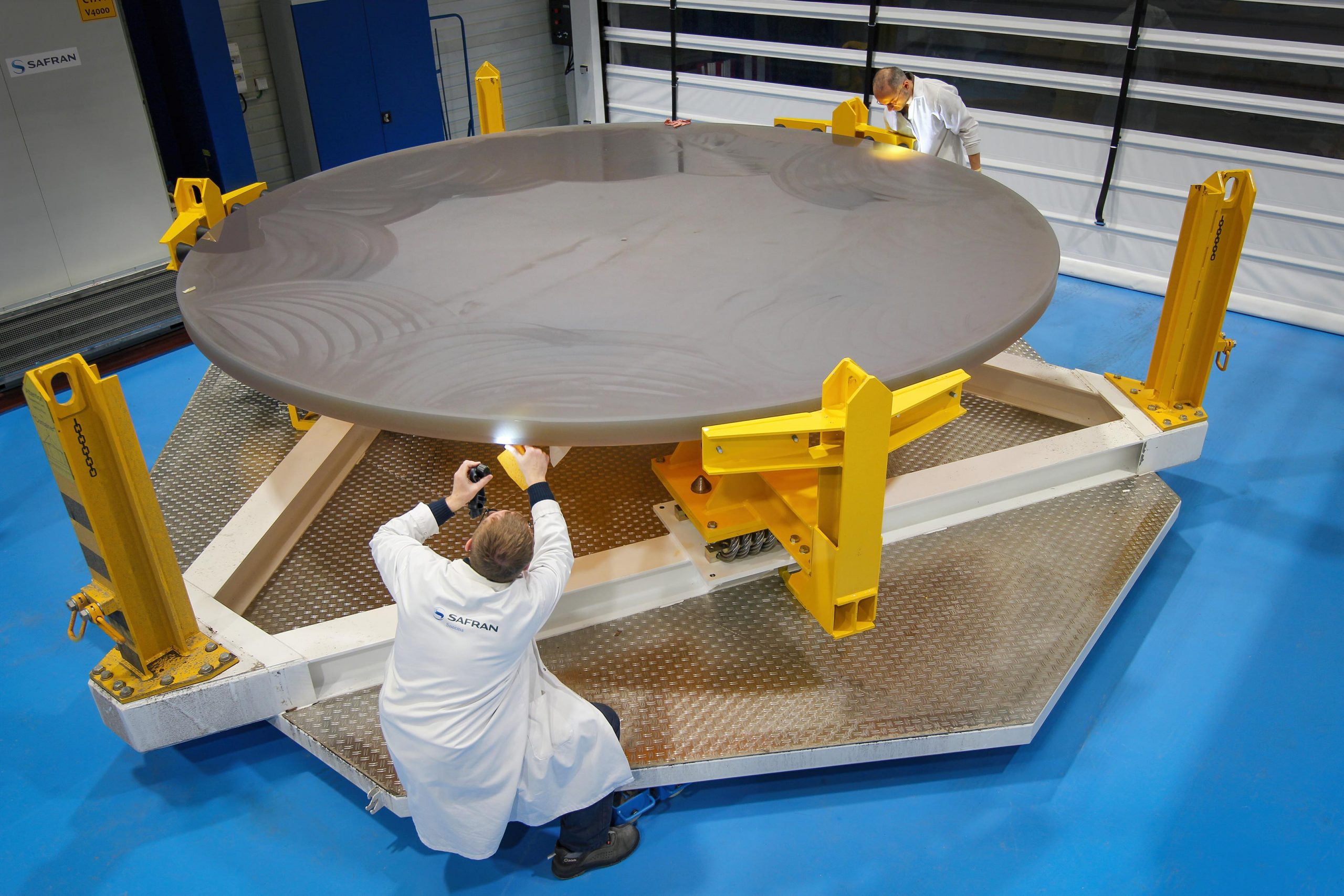
    Engineers inspect the blank for ELT’s tertiary mirror. Credit: ESO/M. Cayrel

    ESO’s Extremely Large Telescope (ELT), the world’s biggest eye on the sky, will have a pioneering five-mirror optical system that will allow it to unveil the Universe in unprecedented detail. The tertiary mirror in this system, M3, has completed a key production stage and has now been delivered to French company Safran Reosc for final polishing.

    M3 ELT Tertiary Mirror
    Rendering of ELT’s tertiary mirror, the so-called M3. Credit: ESO (L. Calçada)/SENER

    Each of the mirrors on the ELT presents a significant technological challenge, with extreme precision required at each production stage to ensure flawless optical quality. The German company SCHOTT produced the mirror blank for M3 — a cast block of a glass-ceramic material known as ZerodurⓇ measuring more than four meters from edge to edge and weighing in at over three tonnes. After casting and machining the M3 blank to its approximate shape, SCHOTT delivered the mirror to Safran Reosc, who will now grind and polish it to a precision of 15 nanometers across the entire optical surface.


    This animation beautifully visualizes the passage that light takes through the ELT telescope’s novel five-mirror design. Light first reflects from the innovatively designed main mirror (M1), a 39-meter array of 798 hexagonal pieces, and then onto the secondary mirror (M2) which at 4 meters dwarfs the primary mirrors of all of ESO’s instruments at the La Silla site. Two of the mirrors (M4 and M5) form part of the adaptive optics, and this unique collection of optics will produce images of incredible quality. Credit: ESO/L. Calçada/ACe Consortium

    M3 is a notable feature of the ELT. Most large telescopes, including ESO’s Very Large Telescope (VLT) and the NASA/ESA Hubble Space Telescope, use just two curved mirrors to form an image, with a small, flat, tertiary mirror sometimes introduced to divert the light to a convenient focus. However, in the ELT the tertiary mirror also has a curved surface, as the use of three curved mirrors delivers a better image quality over a larger field of view than would be possible with a two-mirror design. This design will allow the ELT to image the night sky with unprecedented quality.

    ELT Optical System Diagram
    This diagram shows the novel 5-mirror optical system of ESO’s Extremely Large Telescope (ELT). Before reaching the science instruments the light is first reflected from the telescope’s giant concave 39-meter segmented primary mirror (M1), it then bounces off two further 4-meter-class mirrors, one convex (M2) and one concave (M3). The final two mirrors (M4 and M5) form a built-in adaptive optics system to allow extremely sharp images to be formed at the final focal plane.
    Contracts for the casting of the M2 and M3 mirrors, their cells and sensors for the M1 segments were awarded at a ceremony at ESO’s Garching Headquarters in January 2017. Credit: ESO

    The five mirrors on the ELT all have different shapes, sizes and roles. The primary, M1, is the most spectacular, a giant 39-meter concave mirror made up of 798 hexagonal segments, which will collect light from the night sky and reflect it to the secondary mirror, M2. Measuring 4.2 meters across and hanging above M1, M2 will be the largest secondary mirror ever employed on a telescope, as well as the largest convex mirror ever produced. It will reflect light back down to M3, which in turn will relay it to an adaptive flat mirror (M4) above it. This fourth mirror, which will be the largest adaptive mirror ever made, will adjust its shape a thousand times a second to correct for distortions caused by atmospheric turbulence. M5, a flat tiltable mirror, will then stabilize the image and send it to the instruments.

    Never miss a breakthrough: Join the SciTechDaily newsletter.
    Follow us on Google and Google News.

    Astronomy ELT European Southern Observatory Popular
    Share. Facebook Twitter Pinterest LinkedIn Email Reddit

    Related Articles

    Mysterious Galactic Nomads: At Least 70 Rogue Planets Uncovered in Our Milky Way

    Astronomers Were Puzzled by “Great Dimming” of Betelgeuse – Now the Mystery Is Solved

    “Big Surprise!” – Heavy Metal Vapors Unexpectedly Found in Comets Throughout Our Solar System – and Beyond

    Mysterious Interstellar Visitor May Be the Most Pristine Comet Ever Found

    Event Horizon Telescope Images Magnetic Fields at the Edge of M87’s Supermassive Black Hole

    “Meteorological Beast in Our Solar System” – Powerful Stratospheric Winds Measured on Jupiter for the First Time

    Astronomers Have Discovered the Most Distant Source of Radio Emission Ever Known – 13 Billion Light-Years Away

    Distant Colliding Galaxy Dying Out As It Loses the Ability to Form Stars – Ejecting 10,000 Suns-Worth of Gas a Year

    Puzzling Six-Exoplanet System Discovered With Resonant Rhythmic Movement

    1 Comment

    1. David A. Warner on March 2, 2020 12:52 am

      II guess I have been asleep at the switch, as I have only just heard of the ELT. I believe that it should be a success, but do not believe it is the best way to get bright image of high resolution over largest field of view! Useful field will probably be on the order of 1.5 degrees if a Ritchey-Chretien Layout is used. Much larger all reflective fovs are possible without sacrificing high strehl ratio, over whole field!

      Reply
    Leave A Reply Cancel Reply

    • Facebook
    • Twitter
    • Pinterest
    • YouTube

    Don't Miss a Discovery

    Subscribe for the Latest in Science & Tech!

    Trending News

    The Universe Is Expanding Too Fast and Scientists Can’t Explain Why

    “Like Liquid Metal”: Scientists Create Strange Shape-Shifting Material

    Early Warning Signals of Esophageal Cancer May Be Hiding in Plain Sight

    Common Blood Pressure Drug Shows Surprising Power Against Deadly Antibiotic-Resistant Superbug

    Scientists Uncover Dangerous Connection Between Serotonin and Heart Valve Disease

    Scientists Discover a “Protector” Protein That Could Help Reverse Hair Loss

    Bone-Strengthening Discovery Could Reverse Osteoporosis

    Scientists Uncover Hidden Trigger Behind Stem Cell Aging

    Follow SciTechDaily
    • Facebook
    • Twitter
    • YouTube
    • Pinterest
    • Newsletter
    • RSS
    SciTech News
    • Biology News
    • Chemistry News
    • Earth News
    • Health News
    • Physics News
    • Science News
    • Space News
    • Technology News
    Recent Posts
    • Scientists Overcome Major Quantum Bottleneck, Potentially Transforming Teleportation and Computing
    • Quantum Physics’ Strangest Problem May Hold the Key to Time Itself
    • Scientists Create “Liquid Gears” That Spin Without Touching
    • The Simple Habit That Could Help Prevent Cancer
    • Forgotten Medicinal Plant Shows Promise in Fighting Dangerous Superbugs
    Copyright © 1998 - 2026 SciTechDaily. All Rights Reserved.
    • Science News
    • About
    • Contact
    • Editorial Board
    • Privacy Policy
    • Terms of Use

    Type above and press Enter to search. Press Esc to cancel.