
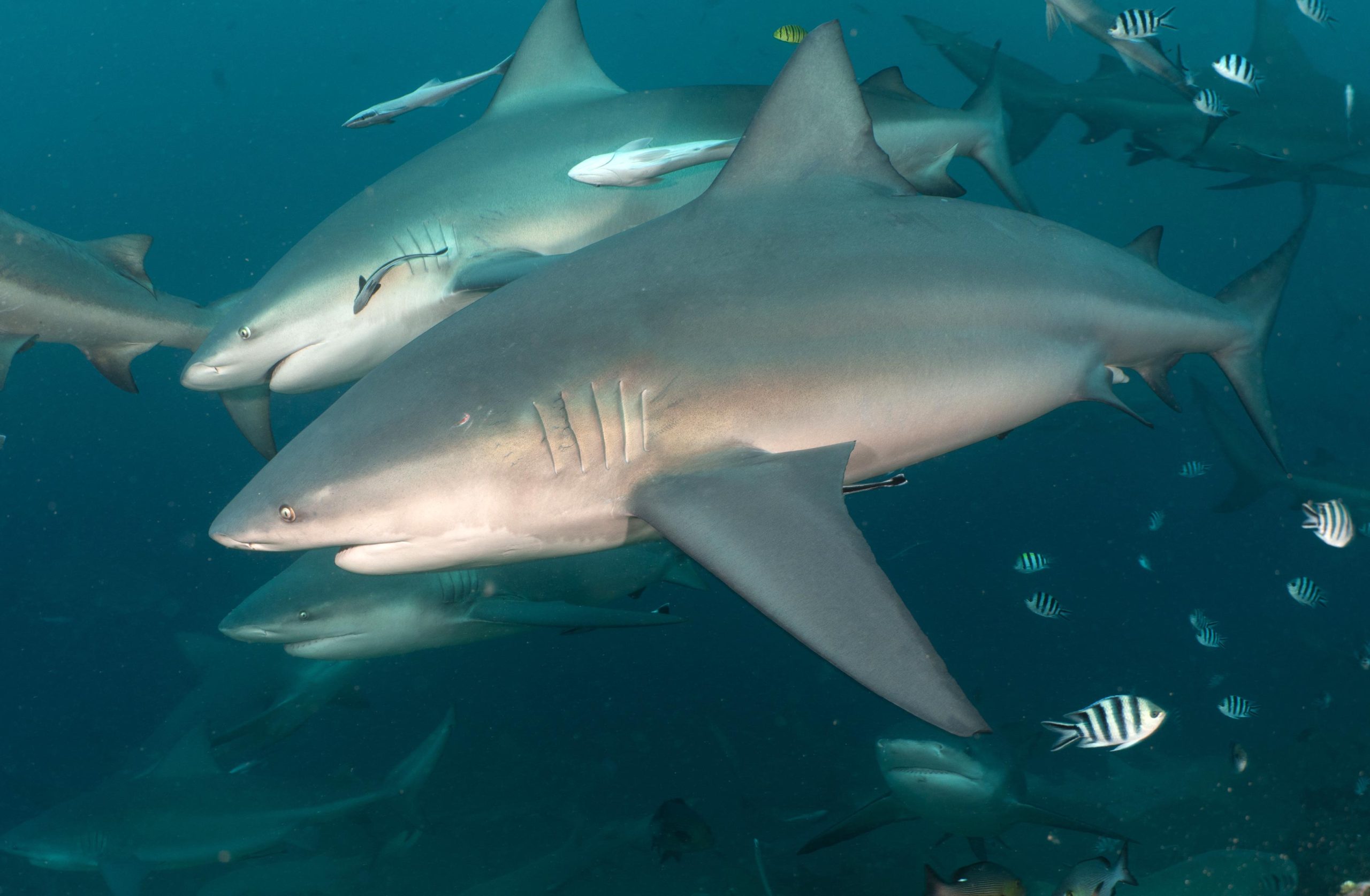
Bull sharks form social bonds and prefer certain companions, challenging the idea that they are solitary predators. These connections may help them learn, find food, and avoid conflict.
New research shows that bull sharks develop social relationships with specific “friends,” challenging the idea that these animals are mostly solitary.
The study – conducted at the Shark Reef Marine Reserve in Fiji – found that bull sharks do not interact randomly. Instead, they display “active social preferences,” choosing certain individuals to associate with while avoiding others.
The research team included scientists from the University of Exeter, University of Lancaster, Fiji Shark Lab, and Beqa Adventure Divers.
“As humans we cultivate a range of social relationships – from casual acquaintances to our best friends, but we also actively avoid certain people – and these bull sharks are doing similar things,” said lead author Natasha D. Marosi, an Exeter researcher and founder of Fiji Shark Lab.
Long-Term Study of Bull Shark Social Behavior
The findings come from six years of observations involving 184 bull sharks across three life stages: sub-adult (not yet sexually mature), adult, and advanced-adult (post-reproductive age).
Researchers analyzed both broad patterns of association – defined by sharks staying within one body length of each other – and more detailed behaviors such as “lead-follow” movements and parallel swimming.
Adult sharks were the most socially connected, and individuals tended to interact with others of similar size.
“Contrary to commonly held perceptions of sharks, our study shows they have relatively rich and complex social lives,” said Professor Darren Croft, from Exeter’s Centre for Research in Animal Behaviour.
“We are only just beginning to really understand the social lives of many shark species. Just like other animals, they likely gain benefits from being social – this may include learning new skills, finding food and potential mates while avoiding confrontations.”
Female Preference and Social Advantages
The study found that both male and female bull sharks are more often associated with females. However, males typically had a greater number of social connections overall.
“Male bull sharks are physically smaller than females, thus one potential benefit they may gain is by being more socially integrated; they are buffered from aggressive confrontations with larger individuals,” said Marosi.
Adult sharks formed the central “core” of the social network, while advanced adult and sub-adult sharks were generally less connected.
How Age Influences Shark Social Life
“This study capitalises on data and knowledge from one of the longest-running shark ecotourism dive sites in the world. This offered a unique opportunity to observe the detailed behavior of these individuals over many years, as they grow, develop, and manage their social relationships,” said Dr. David Jacoby, from Lancaster University’s Lancaster Environment Centre.
Marosi added: “The Shark Reef Marine Reserve is a protected area where large numbers of sharks gather year round, giving us the ability to study individual sharks repeatedly over time.
“Our results show that older sharks tend to be less social.
“These older individuals have many years of experience honing their skill sets, hunting and mating, and sociality may not be as integral to their survival as it is for an individual in their prime.
“Sub-adult bull sharks rarely visit the Reserve. Sub-adults usually occupy near-shore habitats, while juvenile bull sharks can be found in Fiji’s river and estuarine systems.
“During these early life stages, there is a need to avoid predation – including the threat posed by adult bull sharks.
“We do have some bolder sub-adults at the Reserve, and they have established social ties with some of the adult sharks. These older individuals may act as facilitators for inclusion within the social network, and also possibly provide pathways for social learning.”
Why Shark Social Behavior Matters
Marosi emphasized that gaining a deeper understanding of shark social behavior could help shape conservation policies and improve management strategies. Fiji Shark Lab is already working with Fiji’s Ministry of Fisheries to apply these findings in ongoing protection efforts.
Reference: “Rolling in the deep: drivers of social preferences and social interactions within a bull shark aggregation in Fiji” by Natasha D. Marosi, Samuel Ellis, David M.P. Jacoby, Juerg M. Brunnschweiler and Darren P. Croft, 17 March 2026, Animal Behaviour.
DOI: 10.1016/j.anbehav.2026.123511
The research was funded by the Fiji Shark Lab, Hai Stiftung Shark Foundation, and the Waitt Foundation.
Never miss a breakthrough: Join the SciTechDaily newsletter.
Follow us on Google and Google News.