
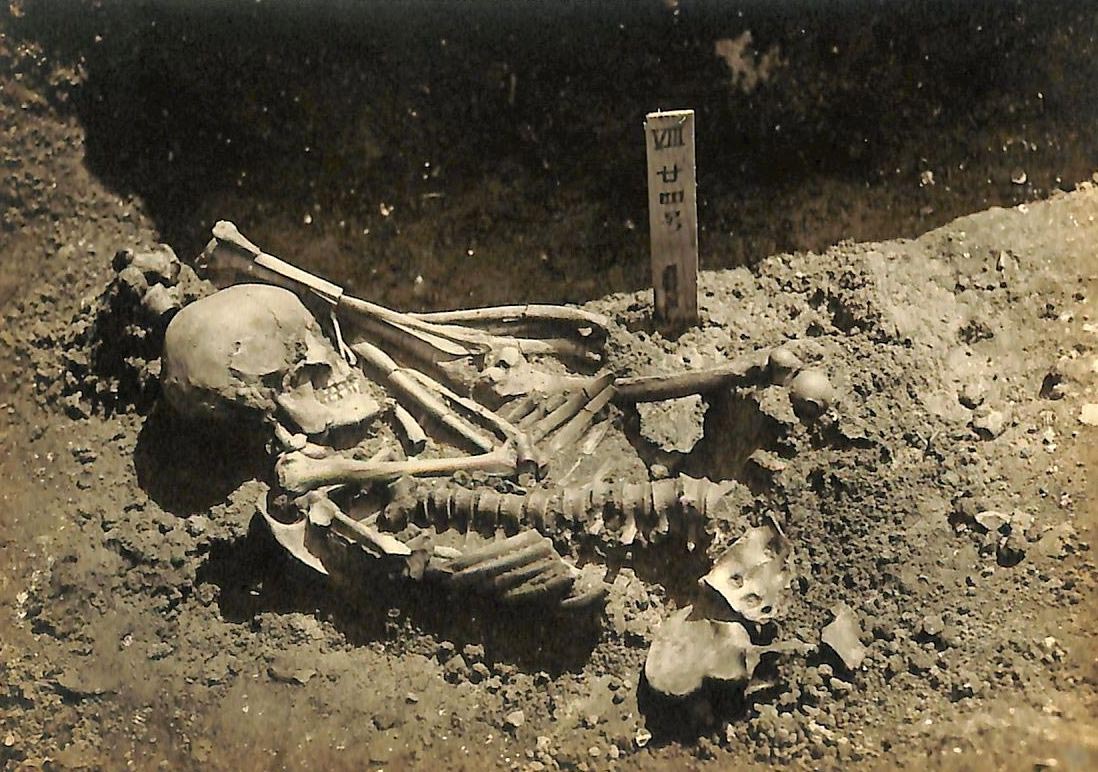
World’s oldest shark attack victim discovered in Japan
Newspapers regularly carry stories of terrifying shark attacks, but in a paper published today, Oxford-led researchers reveal their discovery of a 3,000-year-old victim — attacked by a shark in the Seto Inland Sea of the Japanese archipelago.
The research in the Journal of Archaeological Science: Reports shows that this body is the earliest direct evidence for a shark attack on a human and an international research team has carefully recreated what happened — using a combination of archaeological science and forensic techniques.
The grim discovery of the victim was made by Oxford researchers, J. Alyssa White and Professor Rick Schulting, while investigating evidence for violent trauma on the skeletal remains of prehistoric hunter-gatherers at Kyoto University. They came upon No24, from the previously excavated site of Tsukumo, an adult male riddled with traumatic injuries.
“We were initially flummoxed by what could have caused at least 790 deep, serrated injuries to this man,” said the Oxford pair. “There were so many injuries and yet he was buried in the community burial ground, the Tsukumo Shell-mound cemetery site.”
They continue, “The injuries were mainly confined to the arms, legs, and front of the chest and abdomen. Through a process of elimination, we ruled out human conflict and more commonly reported animal predators or scavengers.”
Expert Help and Shark Bite Analysis Confirm the Culprit
Since archaeological cases of shark reports are extremely rare, they turned to forensic shark attack cases for clues and worked with expert George Burgess, Director Emeritus of the Florida Program for Shark Research. And a reconstruction of the attack was put together by the international team.
The team concluded that the individual died more than 3,000 years ago, between 1370 to 1010 BC. The distribution of wounds strongly suggests the victim was alive at the time of the attack; his left hand was sheared off, possibly a defense wound.
Individual No. 24’s body had been recovered soon after the attack and buried with his people at the cemetery. Excavation records showed he was also missing his right leg and his left leg was placed on top of his body in an inverted position.
According to the pair, “Given the injuries, he was clearly the victim of a shark attack. The man may well have been fishing with companions at the time, since he was recovered quickly. And, based on the character and distribution of the tooth marks, the most likely species responsible was either a tiger or white shark.”
Co-author Dr. Mark Hudson, a researcher with the Max Planck Institute, says, “The Neolithic people of Jomon Japan exploited a range of marine resources… It’s not clear if Tsukumo 24 was deliberately targeting sharks or if the shark was attracted by blood or bait from other fish. Either way, this find not only provides a new perspective on ancient Japan, but is also a rare example of archaeologists being able to reconstruct a dramatic episode in the life of a prehistoric community.”
Reference: “3000-year-old shark attack victim from Tsukumo shell-mound, Okayama, Japan” by J. Alyssa White, George H. Burgess, Masato Nakatsukas, Mark J. Hudson, John Pouncett, Soichiro Kusaka, Minoru Yoneda, Yasuhiro Yamada and Rick J. Schulting, 23 June 2021, Journal of Archeological Science: Reports.
DOI: 10.1016/j.jasrep.2021.103065
A novel method of 3D analysis in development by Alyssa White, John Pouncett, and Rick Schulting was used to visualize the wounds found, which can be explored at Tsukumo 24 BodyMap 3D.
Authors: J. Alyssa White, George H. Burgess, Masato Nakatsukasa, Mark J. Hudson, John Pouncett, Soichiro Kusaka, Minoru Yoneda, Yasuhiro Yamada, Rick Schulting
Never miss a breakthrough: Join the SciTechDaily newsletter.
Follow us on Google and Google News.