
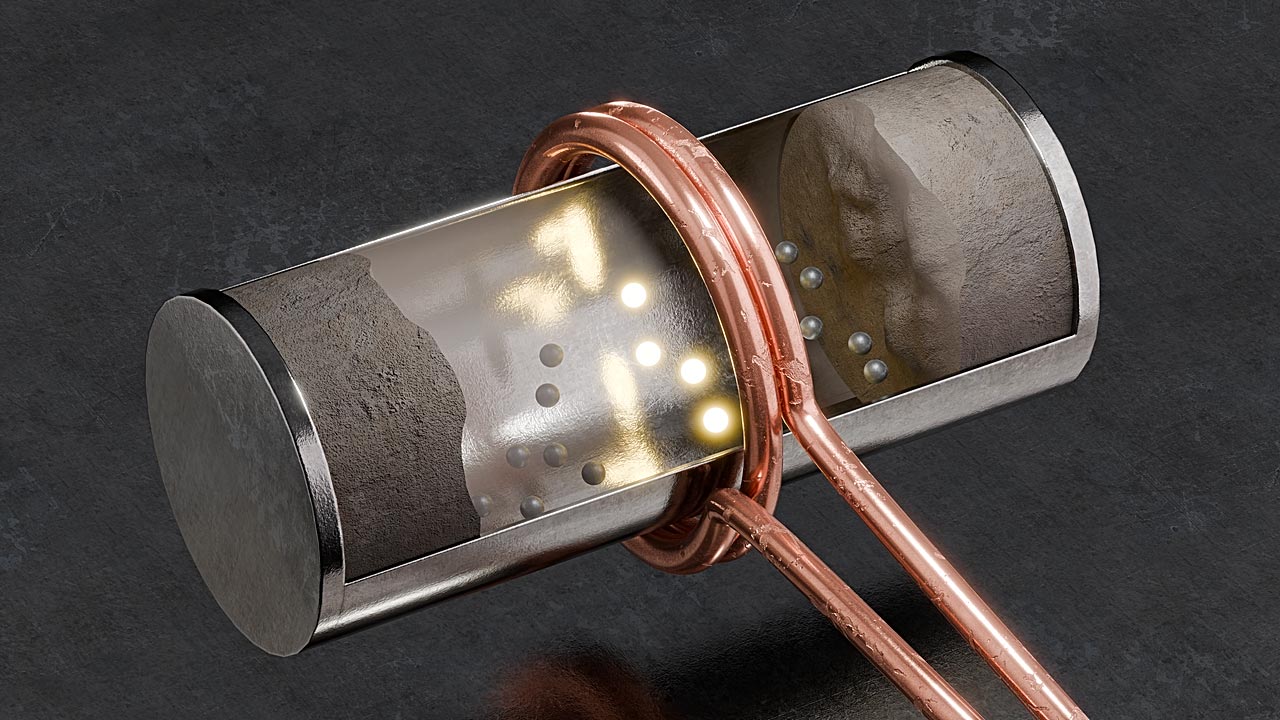
By replacing fossil-fuel-driven calcination with electric heating, the ECem project aims to revolutionize cement production, reducing CO2 emissions while improving efficiency.
The cement industry is one of the largest sources of carbon dioxide emissions, accounting for up to 8% of global human-made CO2 emissions — nearly three times that of the entire aviation sector. To cut its carbon footprint and move toward climate neutrality, the industry is turning to technological innovation.
A promising solution is being explored through the ECem project, an international collaboration that includes scientists from Helmholtz-Zentrum Dresden-Rossendorf (HZDR). The project focuses on using electric heating technologies to power the energy-intensive calcination process, aiming to significantly reduce CO2 emissions in cement production.
Launched in fall 2024, the project will run for three and a half years. It is supported by the Danish Innovation Fund, which has allocated 21 million Danish kroner (approximately $2.9 million) in funding.
Reinventing Cement Production with Electric Heating
Calcination is a crucial step in cement production. In this process, limestone is heated to about 1450°C in a large furnace, breaking it down into clinker — the key ingredient in cement — through thermal decomposition. This reaction is a major source of CO2 emissions in the cement industry. About two-thirds of the CO2 comes directly from the chemical breakdown of limestone, a process known as decarbonization, which is unavoidable. The remaining third results from the massive energy required to reach these high temperatures, typically supplied by burning fossil fuels like coal or gas.
The ECem project (Electric Calciner Technologies for Cement Plants of the Future) is working to develop a cleaner alternative. Led by the Danish cement company FLSmidth, the project brings together partners such as the Danish Institute of Technology, Aalborg University, European Energy, Cementos Argos, and HZDR. Their goal is to replace fossil fuel-based heating with two different electric heating technologies, making cement production more sustainable.
Metal Balls Give Limestone the Necessary Material Properties
While the Danish partners in the project are working on the development of an infrared radiant heating system, scientists at the HZDR Institute for Fluid Dynamics are researching an electrical solution based on inductive heating. The team first wants to set up a laboratory experiment in which induction coils generate a high-frequency field to heat the material in a container. In a later stage, a rotating kiln will be modeled in a further experimental setup with key data that closely approximates industrial conditions. The challenge is that materials such as limestone, which consists mainly of calcium carbonate, are actually unsuitable for induction heating due to their poor electrical conductivity.
To overcome this obstacle, the team wants to mix so-called susceptors into the raw material to be heated. These are components designed to efficiently convert the electric energy into heat and transfer it to the material. An important task is to find the right material that can function robustly as a susceptor at high temperatures and under harsh industrial conditions. Possible candidates must have a high melting point, must not react with the limestone, and should be abrasion-resistant. Forming the susceptors into a shape, for example as metal balls, would have the advantage of combining the calcination and grinding processes into a single step. Investments in the electrification of industrial processes could, in addition to avoiding CO2, have further positive effects such as increasing efficiency or improving product quality, thus giving the respective companies a competitive advantage in the global markets.
Optimization of Gas Flows Ensures Effective Heat Transport
“At first glance, this project has less to do with the fluid mechanics that we usually deal with at the institute,” explains HZDR engineer Dr. Sven Eckert, head of the Magnetohydrodynamics Department. “However, this is not just a matter of installing a heater in a reactor. Cement kilns usually process many tons of material, which is why the difficulty lies in creating a homogeneous temperature field throughout the entire kiln. An inductive heater could even exacerbate this problem if it does not guarantee sufficient heat transport that reaches not only the surface layers but also the interior of the huge volume. Therefore, we have to look at the process in principle, including an optimization of convective gas flows in the furnace, which must ensure effective heat transport.”
This is where the researchers around Sven Eckert can apply their expertise. At the HZDR, they also have access to unique measuring techniques such as magnetic field tomography, which is ideally suited for monitoring electrified industrial processes. The team also wants to benefit from the experience gained in the EU project CITADEL, which is coordinated by the HZDR and is already in progress.
From Lab to Industry: Scaling Up Electric Calcination
The aim of the ECem project is to validate the technology on a laboratory scale. The data obtained in the planned experiments will be an important input for accompanying computer simulations and the development of digital twins that will map the entire process, including energy and mass flows. On this basis, the scientists want to clarify whether the laboratory experiment can be scaled up to real industrial conditions. If the answer is positive, the partners could start building a pilot plant similar to the industrial version after the project ends in 2028. Depending on the research results, this plant could either include induction heating or radiation heating, which are being developed in parallel – or, which is not unlikely, a combination of both solutions.
Never miss a breakthrough: Join the SciTechDaily newsletter.
Follow us on Google and Google News.
5 Comments
None of these “breakthroughs” ever hits the market.
And even if this one did… I wonder how lasting will that cement turn out to be. Not very, methinks.
I don’t see any reason that the cement should be inferior to the present product. Even now, it is not uncommon to adulterate concrete with things like coal fly ash. As long as it meets the building spec’s, it can be used. However, I think you are right that laboratory “breakthroughs” have a poor commercialization track record. It is usually costs or difficulties in scaling the process to commercial volumes that is a barrier.
In this case, there is an additional problem that to reduce emissions from 8% to about 5%, it will be necessary to discard the existing rotary kilns, ball mills for pulverizing the clinker, manufacture the new induction kilns and install them, and manufacture and install upgraded electricity sources from other than fossil fuels.
The worldwide replacement of existing cement factories will probably cause a temporary increase in CO2 from using fossil fuels to manufacture all the new equipment. Then, there will probably be an increase in cement cost to amortize the upgrades. Therefore, they haven’t yet demonstrated that they can get over the cost barrier.
All too often, the focus on proving a process is technically possible, ignores the costs. The lowest cost should win out, but the legislators who control the purse strings don’t seem to think about that, and similarly don’t think about the inflation resulting from tax-subsidies making an approach appear cost competitive.
Coal ash is not really an adulterant. The strength of “fly ash cement” grows more slowly but the end result is as good which is why it is allowed.
Perhaps unrecognized in the coal ash research is that it is (slightly) moving towards a geopolymer. Alkali additives create polymerized minerals.
The way to eliminate cement altogether is to switch to geopolymers. At present the cement companies are desperately researching geopolymers and trying to patent the daylights out of everything they can discover. They are entering the market but as “very special” materials. One producer told me the cost is 1/5th that of cement. Geopolymers are an existential threat to their business model. You do not need limestone and you don’t necessarily have to fire the product.
Joseph Davidovits’ book Geopolymers contains all one needs to know about them and points out that this technology was well known in the Americas 2000 years ago.
Interesting
Usefull article
But is their really a chance to reduce carbon foot print in cement production with this new way…
What about electricity generation their we are leaving the carbon foot print again