
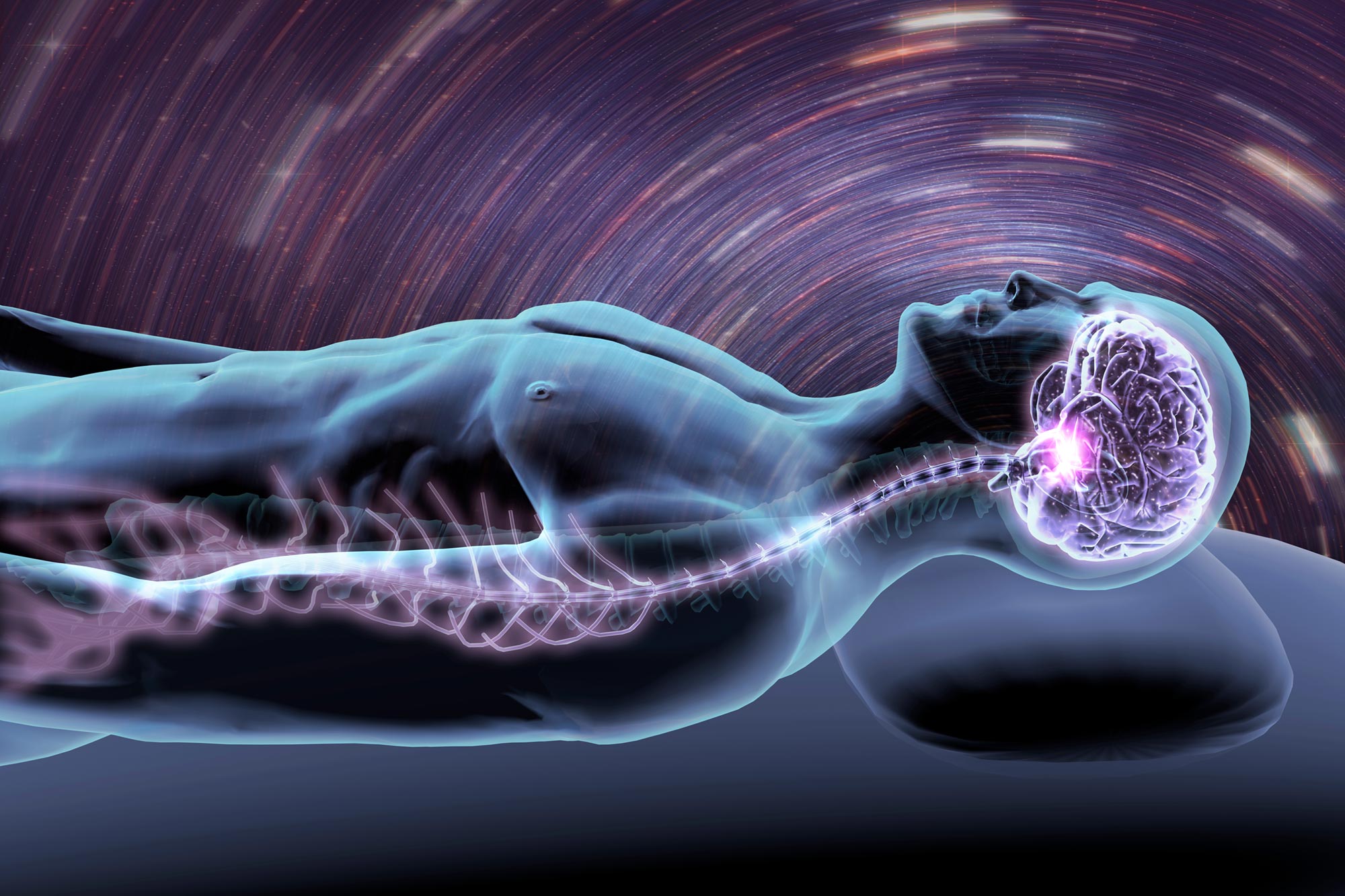
New research from Northwestern University suggests that dreams may play a more active role in creative problem-solving than previously demonstrated.
The advice to “sleep on it” has stuck around for a reason. Psychologists have long noted that stepping away from a hard problem can lead to sudden insight later, but dreams have been difficult to study scientifically because researchers rarely have a reliable way to steer what someone dreams about without waking them up.
A team of neuroscientists at Northwestern University reports evidence that dream content can be nudged in a controlled setting. Their work supports the idea that REM sleep, the rapid eye movement stage linked to vivid dreaming and occasional lucid awareness, may be a promising window for creative thinking to surface.
In the study, scientists used a technique called targeted memory reactivation (TMR). While participants slept, researchers played specific sounds linked to earlier attempts at solving puzzles. These sounds were intended to remind the brain of unfinished problems and prompt related dream content. The sounds were delivered only after brain activity confirmed that participants were fully asleep.
The approach proved effective. Seventy-five percent of participants reported dreams that contained elements related to the unsolved puzzles. Problems that appeared in dreams were later solved at a much higher rate than those that did not (42% vs 17%).
Interpreting the Findings
The researchers caution that these results do not prove that dreaming about a problem directly causes its solution. Other influences, such as increased interest in a puzzle, could make both dreaming and solving more likely. Still, the ability to deliberately guide dream content represents a meaningful advance in studying how sleep might contribute to creative thinking.
“Many problems in the world today require creative solutions. By learning more about how our brains are able to think creatively, think anew and generate creative new ideas, we could be closer to solving the problems we want to solve, and sleep engineering could help,” said senior author Ken Paller, the James Padilla Professor of Psychology and director of the cognitive neuroscience program in the Weinberg College of Arts and Sciences at Northwestern.
How the study was conducted
The research team recruited 20 volunteers who had prior experience with lucid dreaming, which involves being aware of dreaming while it is happening. After arriving at the laboratory, participants attempted a series of challenging brain teasers, with three minutes allotted for each puzzle. Every puzzle was paired with a distinct soundtrack. Because the puzzles were intentionally difficult, most were not solved during this initial session.
Participants then slept overnight in the lab while their brain activity and other physiological signals were monitored using polysomnography. During REM sleep, researchers played the soundtracks associated with half of the unsolved puzzles in order to selectively reactivate those memories. Some participants used prearranged signals, such as repeated in-and-out sniffs, to indicate that they recognized the sounds and were thinking about the related puzzles in their dreams.
Dream Content and Problem-Solving Outcomes
After awakening, participants told the researchers about their dreams. Many dreams included fragments or ideas from the puzzles, but in 12 of 20 participants, dreams referenced the specific puzzles prompted with sound cues more often than those that were not. These individuals subsequently came up with the correct solution to reactivated puzzles more often than the other puzzles, increasing their problem-solving ability from 20% to 40% — which was significant.
The lead author of the study is Karen Konkoly, a post-doctoral researcher in Paller’s Cognitive Neuroscience Laboratory. Konkoly, who received her Ph.D. from Northwestern, said the biggest surprise of the study was the extent to which the cues influenced non-lucid dreams.
“Even without lucidity, one dreamer asked a dream character for help solving the puzzle we were cueing. Another was cued with the ‘trees’ puzzle and woke up dreaming of walking through a forest. Another dreamer was cued with a puzzle about jungles and woke up from a dream in which she was fishing in the jungle thinking about that puzzle,” Konkoly said.
“These were fascinating examples to witness because they showed how dreamers can follow instructions, and dreams can be influenced by sounds during sleep, even without lucidity.”
Implications
The researchers say the next step is to apply the methods of targeted memory reactivation and interactive dreaming to study other proposed functions of dreaming, such as emotional regulation and generalized learning.
“My hope is that these findings will help move us towards stronger conclusions about the functions of dreaming,” Konkoly said. “If scientists can definitively say that dreams are important for problem solving, creativity, and emotion regulation, hopefully people will start to take dreams seriously as a priority for mental health and wellbeing.”
Reference: “Creative problem-solving after experimentally provoking dreams of unsolved puzzles during REM sleep” by Karen R Konkoly, Daniel J Morris, Kaitlyn Hurka, Alysiana M Martinez, Kristin E G Sanders and Ken A Paller, 5 February 2026, Neuroscience of Consciousness.
DOI: 10.1093/nc/niaf067
Never miss a breakthrough: Join the SciTechDaily newsletter.
Follow us on Google and Google News.
3 Comments
I often remember dreams when the dream is what is occurring just before I wake to urinate at night or just prior to waking in the morning. They are always WEIRD! They rarely have any connection to anything I have recently seen, read, watched or anywhere I have been or anyone I know. Which makes no sense to me.
Here’s a recent example:
I was driving and made a right turn onto some sort of highway. I was beneath an overpass or structure. I was in the left lane after the turn and there was a wall to my left. It was a large road and the structure I was under was large and it was somewhat dark with some bands of light breaking through. As I began to accelerate after the right turn, I saw someone standing in my lane with arms up and doing something on the wall, like writing something. I was panicked and thought I would swerve to the right but then suddenly, there was traffic on my right, so I braked hard. When I came to a stop, I saw this guy was in a yellowish, sand colored priest robe with sandals on his feet. He had a bald head. He had been writing something in shining gold on the wall, like some ancient Asian Indian writing. He also had a rope tied around his waist and a woman with the same colored dress and dark hair was tied to the other end and was pulling herself closer to him, as if she was fighting a force that was pushing against her, as I came to a stop. By the time I got out of my car and in all the other traffic mess that had occurred due to me suddenly braking and the 2 people in the road, the priest and woman were gone. And then I woke.
So what am I to make of this dream?
Keep a notebook at your bedside, and resolve to wake right after a dream to write it down. Your handwriting will be sloppy, but you’ll remember the dreams easier. I’ve kept dream notebooks for almost forty years, and when I read an old dream the images come back clearly.
I use my phone’s voice recorder to record all my waking dreams. They are typically a partial mumble, but clear enough to discern and remember most details of each dream. Some aren’t connected to recent past events and are more like movie vignettes.