
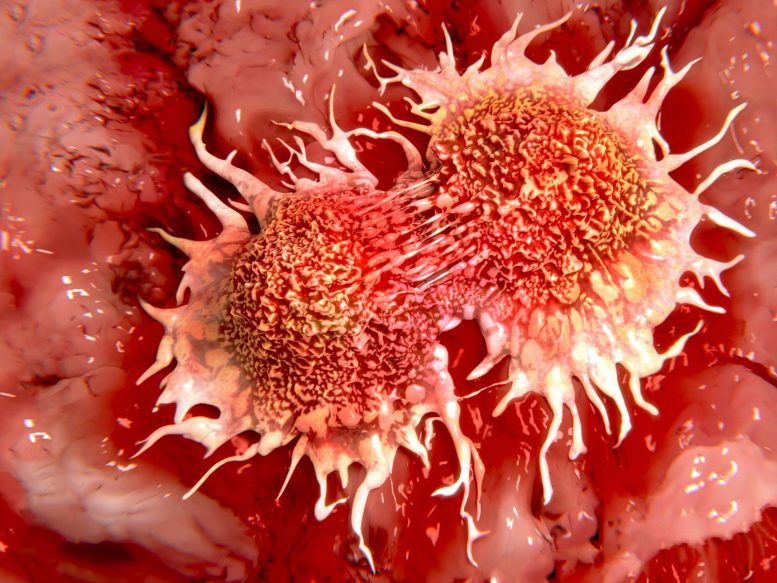
Cancer cells patch membrane holes using macropinocytosis. Disabling this process kills the cells, revealing a new potential target for therapy.
It is the membrane of cancer cells that is at the focus of the new research now showing a completely new way in which cancer cells can repair the damage that can otherwise kill them.
In both normal cells and cancer cells, the cell membrane acts as the skin of the cells. And damage to the membrane can be life-threatening. The interior of cells is fluid, and if a hole is made in the membrane, the cell simply floats out and dies — a bit like a hole in a water balloon.
Therefore, damage to the cell membrane must be repaired quickly, and now research from a team of Danish researchers shows that cancer cells use a technique called macropinocytosis. The technique, which is already a known tool for cells in other contexts, consists in the cancer cells pulling the intact cell membrane in over the damaged area and sealing the hole in a matter of minutes. Next, the damaged part of the cell membrane is separated into small spheres and transported to the cells’ “stomach” — the so-called lysosomes, where they are broken down.
Macropinocytosis
The technique is used by cells to absorb, for example, molecules or water outside the cell. It is also used by immune cells when they enclose and eat foreign bodies such as bacteria or viruses — a process that is important for the immune system’s ability to fight infections.
In the laboratory, the researchers damaged the membrane of the cancer cells using a laser that shoots small holes in the membrane and triggers macropinocytosis. Here they can see that if the process is inhibited with substances blocking the formation of the small membrane spheres, the cancer cell can no longer repair the damage and dies.
“Our research provides very basic knowledge about how cancer cells survive. In our experiments, we have also shown that cancer cells die if the process is inhibited, and this points towards macropinocytosis as a target for future treatment. It is a long-term perspective, but it is interesting,” says group leader Jesper Nylandsted from the Danish Cancer Society’s Research Center and the University of Copenhagen, who has headed the new research and who for many years has investigated how cancer cells repair their membranes.
Possibility of Recycling
One of the most dangerous properties of cancer is when the disease spreads in the body. If tumors occur in new parts of the body, the disease becomes more difficult to treat and typically requires more extensive forms of treatment. It is also when cancer cells spread through the body’s tissues that they are particularly prone to damage to their membrane.
Researchers at the Danish Cancer Society have previously shown how cancer cells can use another technique to repair the membrane, namely by tying off the damaged part, rather like when a lizard throws its tail.
However, the experiments in the laboratory could indicate that especially the aggressive cancer cells use macropinocytosis. This may be due to the fact that the cancer cell has the opportunity to reuse the damaged membrane when it is degraded in the lysosomes. This type of recycling will be useful for cancer cells because they divide frequently, requiring large amounts of energy and material for the new cells.
And although the researchers have now published the new results, their work is not over. This is explained by another member of the research team, postdoc Stine Lauritzen Sønder:
“We continue to work and investigate how cancer cells protect their membranes. In connection with macropinocytosis in particular, it is also interesting to see what happens after the membrane is closed. We believe that the first patching is a bit rough and that a more thorough repair of the membrane is needed afterward. It can be another weak point in the cancer cells, and is something we want to examine closer,” she says.
Reference: “Restructuring of the plasma membrane upon damage by LC3-associated macropinocytosis” by Stine Lauritzen Sønder, Swantje Christin Häger and Anne Sofie Busk Heitmann, Lisa B. Frankel, Catarina Dias, Adam Cohen Simonsen and Jesper Nylandsted, 2 July 2021, Science Advances.
DOI: 10.1126/sciadv.abg1969
The research team
The researchers behind the new results work at The Danish Cancer Society, The University of Copenhagen, The University of Southern Denmark and The Biotech Research and Innovation Centre at the University of Copenhagen.
Never miss a breakthrough: Join the SciTechDaily newsletter.
Follow us on Google and Google News.