
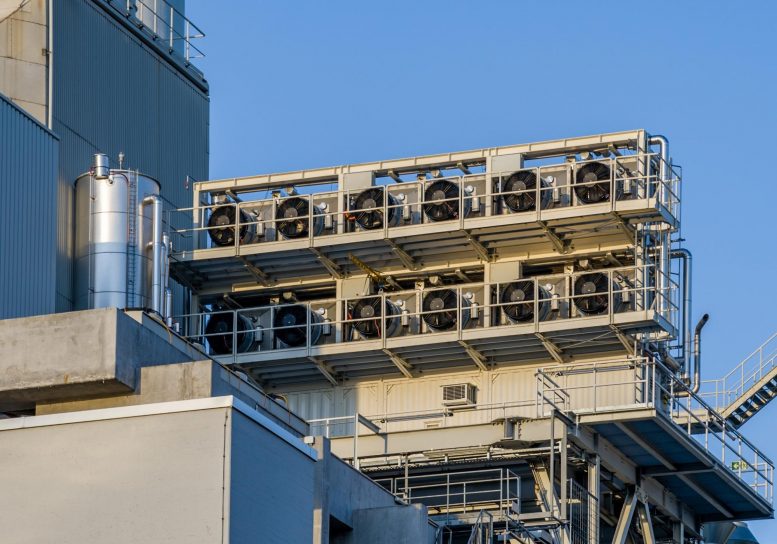
Handling salty brines from CO₂ storage presents a major energy and emissions hurdle. Optimizing brine disposal and reservoir choices will be critical for the success of carbon capture strategies.
Perhaps the best hope for slowing climate change — capturing and storing carbon dioxide emissions underground — has remained elusive due in part to uncertainty about its economic feasibility.
In an effort to provide clarity on this point, researchers at Stanford University and Carnegie Mellon University have estimated the energy demands involved with a critical stage of the process. Watch the video here:
Their findings, published April 8 in Environmental Science & Technology, suggest that managing and disposing of high salinity brines — a by-product of efficient underground carbon sequestration — will impose significant energy and emissions penalties. Their work quantifies these penalties for different management scenarios and provides a framework for making the approach more energy efficient.
“Designing massive new infrastructure systems for geological carbon storage with an appreciation for how they intersect with other engineering challenges — in this case the difficulty of managing high salinity brines — will be critical to maximizing the carbon benefits and reducing the system costs,” said study senior author Meagan Mauter, an associate professor of Civil and Environmental Engineering at Stanford University.
Getting to a clean, renewable energy future won’t happen overnight. One of the bridges on that path will involve dealing with carbon dioxide emissions — the dominant greenhouse gas warming the Earth — as fossil fuel use winds down. That’s where carbon sequestration comes in. While most climate scientists agree on the need for such an approach, there has been little clarity about the full lifecycle costs of carbon storage infrastructure.
Salty Challenge
An important aspect of that analysis is understanding how we will manage brines, highly concentrated salt water that is extracted from underground reservoirs to increase carbon dioxide storage capacity and minimize earthquake risk. Saline reservoirs are the most likely storage places for captured carbon dioxide because they are large and ubiquitous, but the extracted brines have an average salt concentration nearly three times higher than seawater.
These brines will either need to be disposed of via deep well injection or desalinated for beneficial reuse. Pumping it underground — an approach that has been used for oil and gas industry wastewater — has been linked to increased earthquake frequency and has led to significant public backlash. But desalinating the brines is significantly more costly and energy-intensive due, in part, to the efficiency limits of thermal desalination technologies. It’s an essential, complex step with a potentially huge price tag.
The Big Picture
The new study is the first to comprehensively assess the energy penalties and carbon dioxide emissions involved with brine management as a function of various carbon transport, reservoir management, and brine treatment scenarios in the U.S. The researchers focused on brine treatment associated with storing carbon from coal-fired power plants because they are the country’s largest sources of carbon dioxide, the most cost-effective targets for carbon capture and their locations are generally representative of the location of carbon dioxide point sources.
Perhaps unsurprisingly, the study found higher energy penalties for brine management scenarios that prioritize treatment for reuse. In fact, brine management will impose the largest post-capture and compression energy penalty on a per-tone of carbon dioxide basis, up to an order of magnitude greater than carbon transport, according to the study.
“There is no free lunch,” said study lead author Timothy Bartholomew, a former civil and environmental engineering graduate student at Carnegie Mellon University who now works for KeyLogic Systems, a contractor for the Department of Energy’s National Energy Technology Laboratory. “Even engineered solutions to carbon storage will impose energy penalties and result in some carbon emissions. As a result, we need to design these systems as efficiently as possible to maximize their carbon reduction benefits.”
The Road Forward
Solutions may be at hand.
The energy penalty of brine management can be reduced by prioritizing storage in low salinity reservoirs, minimizing the brine extraction ratio and limiting the extent of brine recovery, according to the researchers. They warn, however, that these approaches bring their own tradeoffs for transportation costs, energy penalties, reservoir storage capacity and safe rates of carbon dioxide injection into underground reservoirs. Evaluating the tradeoffs will be critical to maximizing carbon dioxide emission mitigation, minimizing financial costs and limiting environmental externalities.
“There are water-related implications for most deep decarbonization pathways,” said Mauter, who is also a fellow at the Stanford Woods Institute for the Environment. “The key is understanding these constraints in sufficient detail to design around them or develop engineering solutions that mitigate their impact.”
Reference: “Energy and CO2 Emissions Penalty Ranges for Geologic Carbon Storage Brine Management” by Timothy V. Bartholomew and Meagan S. Mauter, 25 March 2021, Environmental Science & Technology.
DOI: 10.1021/acs.est.0c06017
Funding: National Science Foundation, ARCS Foundation, US Department of Energy
Never miss a breakthrough: Join the SciTechDaily newsletter.
Follow us on Google and Google News.
5 Comments
“… carbon dioxide emissions — the dominant greenhouse gas warming the Earth …”
Actually, the dominant ‘greenhouse gas’ is water vapor. Water vapor and carbon dioxide share similar absorption regions for Infra-Red radiating into space. According to no less than Dr. William Happer, the 15 micron region (Where water and carbon dioxide absorption features overlap) is saturated, meaning that any increase in CO2 will have a minuscule impact on temperature.
Well the Germans figured out how to reduce CO2, shut down half the nuclear power plants and replace them with lots of new brown coal with some shiny solar and wind to greenwash it all. The effect was to not decrease CO2 at all. In fact from the infographics on EU CO2 emmisions, Germany has 2x the CO2 emmisions of the UK and about 1.25x the population. “Visual capitalist, All the worlds Carbon emmisions in one chart.”.
If we just built a 1000 new reactors (like MSRs), we wouldn’t need to bother with RE or CO2 sequesting. But if we had to take out all the CO2 to get back to 350ppm, the energy needed to do that would be equiv to all the fossil energy used to get us here in the first place. While combustion is not reversable, just getting CO2 from the oceans uses as much energy as a gas power plant produces with net zero CO2 out and in. More energy will be needed to do something useful with it. From US Navy research on nuclear powered ship to sequester CO2 from salt water for use in at sea jet fuel production.
… plants are nice and green…
Watch the Netflix video called “Kiss the Ground”, which describes the use of regenerative agriculture to restore topsoil, and new cropping methods to preserve it. Instead of cultivation, a layer of low ground cover is first planted. This has two functions: One is to keep soil from blowing away, and Two is to store carbon from C02 in it’s roots. Cropping is accomplished by injecting seed into the carbon rich layer that surrounds the roots of the ground cover plant. This method will salvage much damaged agricultural land, and will also strip C02 from the atmosphere and bury it in the ground, and act as an agent for global cooling, without the expensive and complicated equipment that is necessary to strip it straight from the air. I believe this is an idea whose time has come, by creating more agrarian land with which to feed the burgeoning
populations while reducing CO2 in the atmosphere by sequestering it in the ground, and helping cool our heating planet.
Regenerative agriculture plus Enhanced Weathering (applying pulverized basalt to cropland) will sequester carbon AND deliver bicarbonates to the ocean to de-acidify and restore coastal ecosystems. And yes, there is still a carbon negative benefit even with transporting basalt and crushing it in the future when existing reserves run out (millions of tons are available, just ask rockdustlocal). Economic by-products; plants with higher nutrient density, lower farm costs, soils that retain water. Haven’t heard the economic model that supports putting CO2 in the ground, as opposed to pulling it into nutrient management and turning that carbon into plants and shells.