
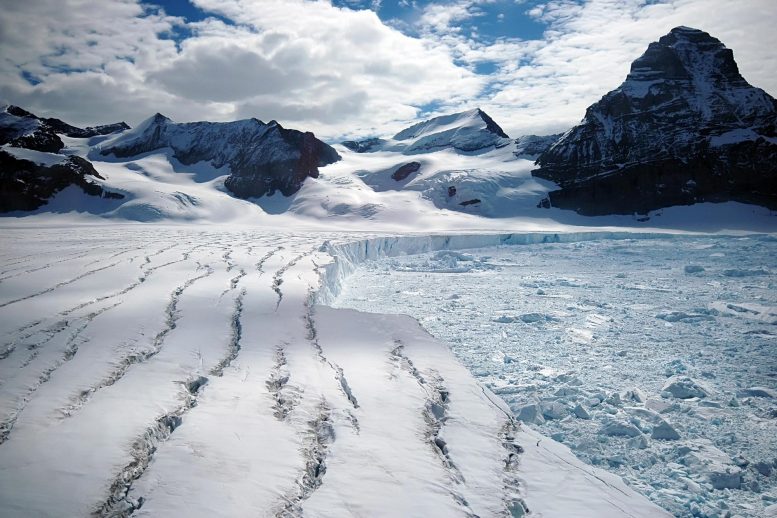
A study warns of substantial glacier loss by 2100, stressing immediate climate action to mitigate the severe ecological and societal impacts.
Assistant Professor David Rounce of Civil and Environmental Engineering led an international effort to produce new projections of glacier mass loss through the century under different emissions scenarios. The projections were aggregated into global temperature change scenarios to support adaptation and mitigation discussions, such as those at the recent United Nations Conference of Parties (COP 27). His work showed that the world could lose as much as 41 percent of its total glacier mass this century—or as little as 26 percent—depending on today’s climate change mitigation efforts.
Specifically, Rounce and his team found that in a future scenario with continued investment in fossil fuels, over 40 percent of the glacial mass will be gone within the century, and over 80 percent of glaciers by number could well disappear. Even in a best-case, low-emissions scenario, where the increase in global mean temperature is limited to +1.5° C relative to pre-industrial levels, over 25 percent of glacial mass will be gone and nearly 50 percent of glaciers by number are projected to disappear. A majority of these lost glaciers are small (less than one km2) by glacial standards, but their loss can negatively impact local hydrology, tourism, glacier hazards, and cultural values.
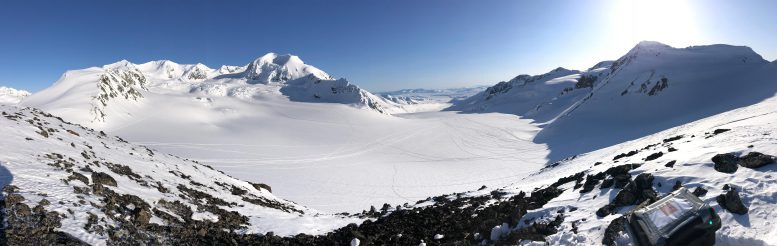
Regional Disparities and Vulnerable Glacial Regions
His work provides a better context for regional glacier modeling, and he hopes it will spur climate policymakers to lower temperature change goals beyond the 2.7° C (4.9° F) mark that pledges from COP-26 are projected to hit. Smaller glacial regions like Central Europe and Western Canada and the United States will be disproportionately affected by temperatures rising more than 2° C (3.6° F). At a 3° C (5.4° F) rise, glaciers in these regions almost disappear completely.
Rounce noted that the way in which glaciers respond to changes in climate takes a long time. He describes the glaciers as extremely slow-moving rivers. Cutting emissions today will not remove previously emitted greenhouse gasses, nor can it instantly halt the inertia they contribute to climate change, meaning even a complete halt to emissions would still take between 30 and 100 years to be reflected in glacier mass loss rates.
Many processes govern how glaciers lose mass and Rounce’s study advances how models account for different types of glaciers, including tidewater and debris-covered glaciers. Tidewater glaciers refer to glaciers that terminate in the ocean, which causes them to lose a lot of mass at this interface. Debris-covered glaciers refer to glaciers that are covered by sand, rocks, and boulders. Prior work by Rounce has shown that the thickness and distribution of debris cover can have a positive or negative effect on glacial melt rates across an entire region, depending on the debris thickness. In this newest work, he found that accounting for these processes had relatively little impact on the global glacier projections, but substantial differences in mass loss were found when analyzing individual glaciers.
The model is also calibrated with an unprecedented amount of data, including individual mass change observations for every glacier, which provide a more complete and detailed picture of glacier mass change. The use of supercomputers was thus essential to support the application of state-of-the-art calibration methods and the large ensembles of different emissions scenarios.
References:
“Global glacier change in the 21st century: Every increase in temperature matters” by David R. Rounce, Regine Hock, Fabien Maussion, Romain Hugonnet, William Kochtitzky, Matthias Huss, Etienne Berthier, Douglas Brinkerhoff, Loris Compagno, Luke Copland, Daniel Farinotti, Brian Menounos and Robert W. McNabb, 5 January 2023, Science.
DOI: 10.1126/science.abo1324
“Acting now will reduce glacier loss: Many of the world’s glaciers will disappear, but quick action will make a difference” by Guðfinna Aðalgeirsdóttir and Timothy D. James, 5 January 2023, Science.
DOI: 10.1126/science.ade2355
Never miss a breakthrough: Join the SciTechDaily newsletter.
Follow us on Google and Google News.
1 Comment
Wow, buffalo is really feeling great about this! They should call 60 minutes to get on their propoganda series, after all, they just put up Fidel Castro Ehrlich!
What a bunch of what comes out of the backside of Buffalo’s