
Close Menu
    Facebook X (Twitter) Instagram
    SciTechDaily
    • Biology
    • Chemistry
    • Earth
    • Health
    • Physics
    • Science
    • Space
    • Technology
    Facebook X (Twitter) Pinterest YouTube RSS
    SciTechDaily
    Home»Space»Cassini Views Mimas’ Mountain
    Space

    Cassini Views Mimas’ Mountain

    By SciTechDailyJanuary 10, 2017No Comments2 Mins Read
    Facebook Twitter Pinterest Telegram LinkedIn WhatsApp Email Reddit
    Share
    Facebook Twitter LinkedIn Pinterest Telegram Email Reddit
    New Cassini Image of Mimas' Mountain
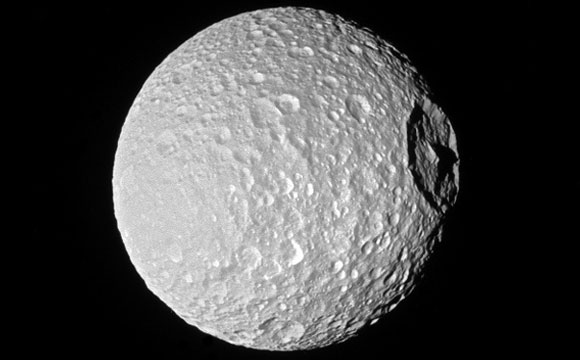
    Herschel Crater on Saturn’s Moon Mimas. Large impact craters often have peaks in their center. Herschel’s peak stands nearly as tall as Mount Everest on Earth. Credit: NASA/JPL-Caltech/Space Science Institute

    This newly released Cassini image shows Herschel Crater on Saturn’s Moon Mimas, revealing an indication of the size of the crater’s towering walls and central peak.

    Named after the icy moon’s discoverer, astronomer William Herschel, the crater stretches 86 miles (139 kilometers) wide — almost one-third of the diameter of Mimas (246 miles or 396 kilometers) itself.

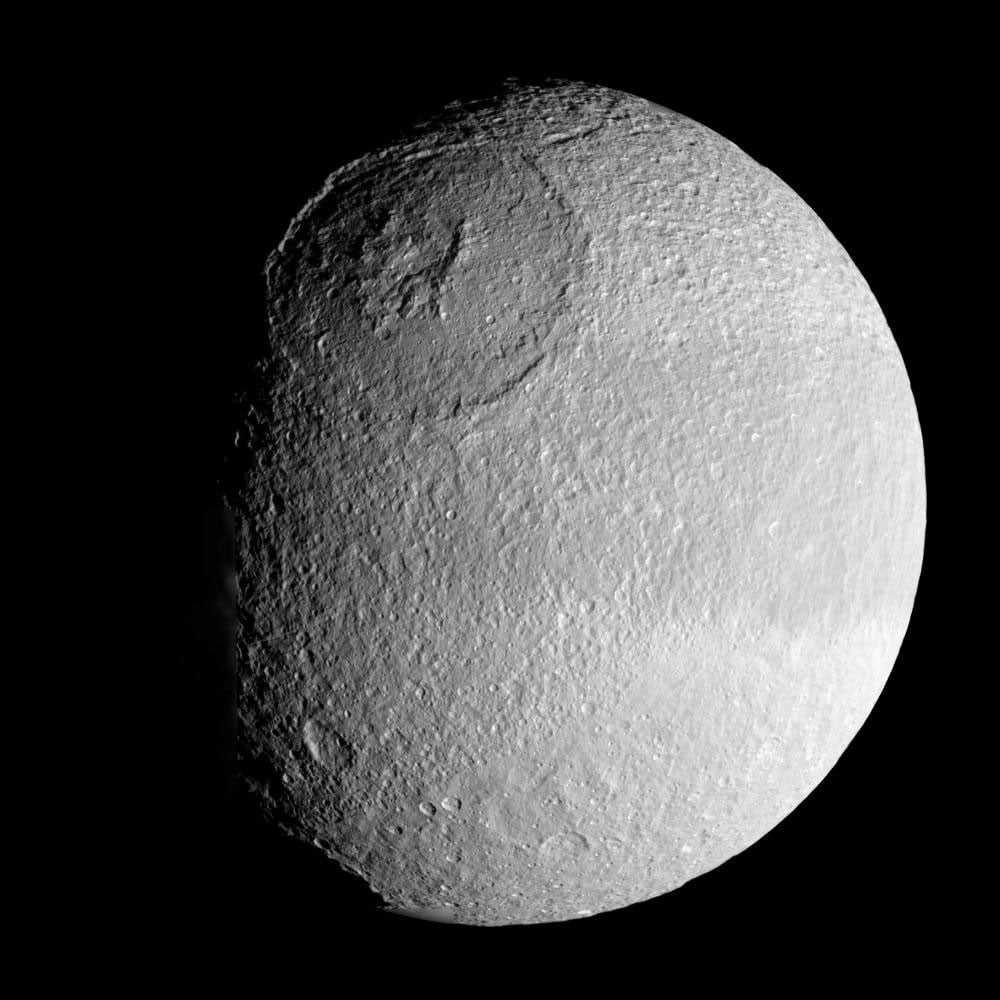
    Large impact craters often have peaks in their center — see Tethys’ large crater Odysseus in PIA08400. Herschel’s peak stands nearly as tall as Mount Everest on Earth.
    This view looks toward the anti-Saturn hemisphere of Mimas. North on Mimas is up and rotated 21 degrees to the left. The image was taken with the Cassini spacecraft narrow-angle camera on October 22, 2016, using a combination of spectral filters which preferentially admit wavelengths of ultraviolet light centered at 338 nanometers.

    The view was acquired at a distance of approximately 115,000 miles (185,000 kilometers) from Mimas and at a Sun-Mimas-spacecraft, or phase, angle of 20 degrees. The image scale is 3,300 feet (1 kilometer) per pixel.

    Never miss a breakthrough: Join the SciTechDaily newsletter.
    Follow us on Google and Google News.

    Astronomy Cassini-Huygens Mission Mimas Planetary Science Popular
    Share. Facebook Twitter Pinterest LinkedIn Email Reddit

    Related Articles

    New Cassini Image Shows a Tiny Mimas, Huge Saturn Rings

    Cassini Reveals Incomplete Cooling Down of Saturn’s A Ring at Solar Equinox

    Cassini Reveals Unusual Red Arcs on Saturn’s Moon Tethys

    Cassini Reveals Titan’s Atmosphere Even More Earth-like Than Previously Thought

    Activity on Enceladus Could Be ‘Curtain Eruptions’

    Scientists Pinpoint the Position of Saturn

    Saturn’s Moon Mimas May Have a Liquid Water Ocean Beneath the Surface

    Cassini Observations Reveal the Complexity of Hazy Exoplanets

    Storm Spawns the Largest Tropospheric Vortex Ever Seen on Saturn

    Leave A Reply Cancel Reply

    • Facebook
    • Twitter
    • Pinterest
    • YouTube

    Don't Miss a Discovery

    Subscribe for the Latest in Science & Tech!

    Trending News

    Don’t Miss: A Brilliant Venus and Glowing Harvest Moon Light Up the Sky

    New Twist on the Einstein Problem Reveals Unexpected Physics

    JWST Captures Stunning Evidence of How Supermassive Black Holes Feed

    Early Exercise May Permanently Change How Much Energy the Body Uses To Move

    New Molecule Wipes Out Aggressive Lymphoma Tumors in Mice in Just 11 Days

    The Human Family Tree May Need a Major Rewrite

    Scientists Find a Surprising Cancer-Fighting Effect in Dark Sweet Cherries

    New AI Detects Hidden Warning Signs of Solar Eruptions Hours Before They Emerge

    Follow SciTechDaily
    • Facebook
    • Twitter
    • YouTube
    • Pinterest
    • Newsletter
    • RSS
    SciTech News
    • Biology News
    • Chemistry News
    • Earth News
    • Health News
    • Physics News
    • Science News
    • Space News
    • Technology News
    Recent Posts
    • Africa’s Giant Herbivores Were Disappearing Millions of Years Before Humans Could Hunt Them
    • This Utah Mountain Is Hiding Enough Ice To Fill 600 Olympic Pools
    • Vagus Nerve Stimulation Could Unlock the Brain’s Hidden Learning Potential
    • Your Mother’s Age May Leave a Biological Mark That Lasts for Generations
    • Women Who Ate More Antioxidants Had Strikingly Lower Rates of Cervical Cancer
    Copyright © 1998 - 2026 SciTechDaily. All Rights Reserved.
    • Science News
    • About
    • Contact
    • Editorial Board
    • Privacy Policy
    • Terms of Use

    Type above and press Enter to search. Press Esc to cancel.