
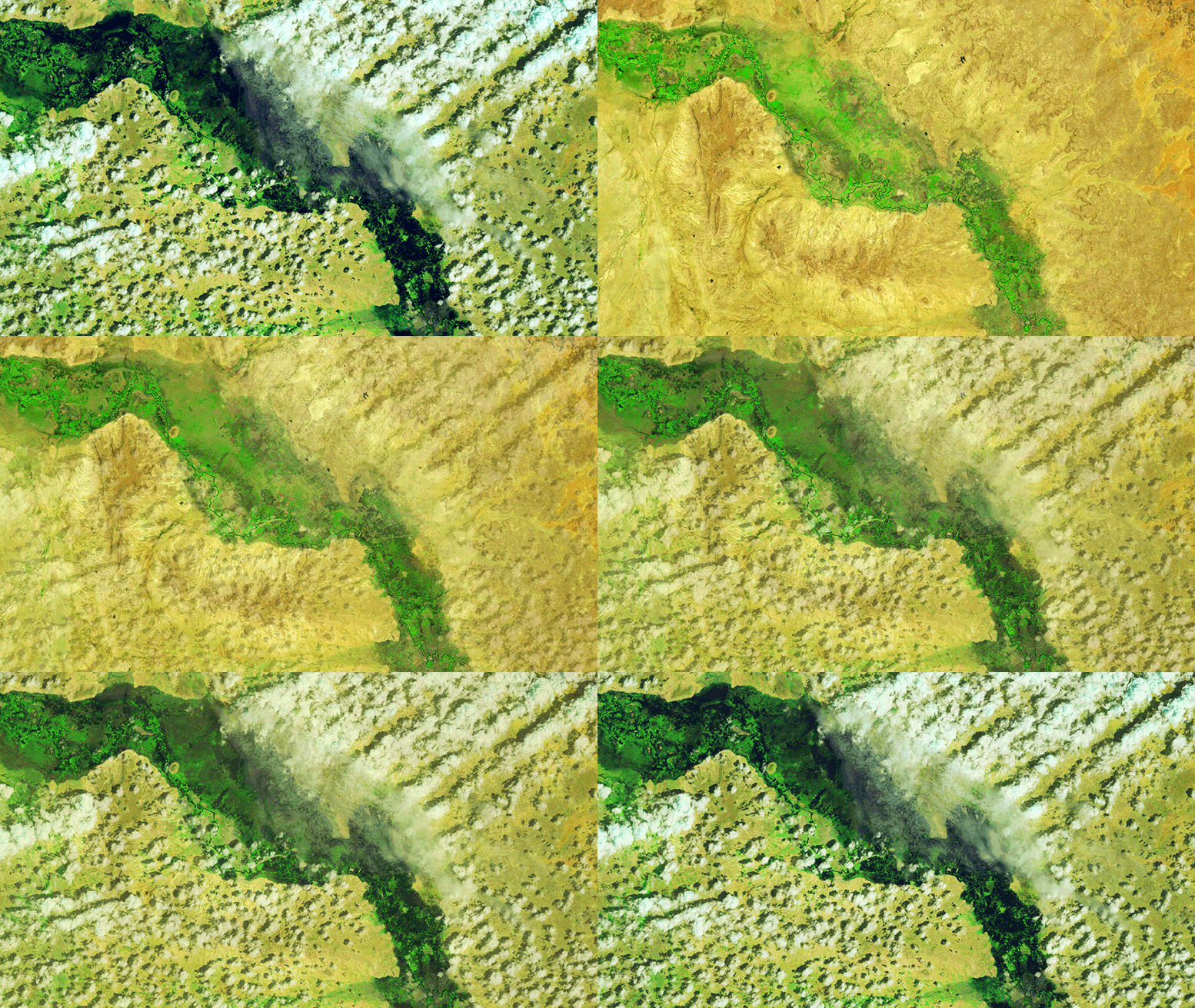
Heavy rainfall in the Horn of Africa submerged entire towns in floodwater.
Heavy rainfall led to extensive flooding in Somalia, Ethiopia, and Kenya in October and November 2023. The floods came in the wake of the most prolonged drought on record, which left millions of people food insecure between 2020 and 2023. Since October 1, flooding has killed more than 100 people and displaced more than 700,000, according to the United Nations Office for the Coordination of Humanitarian Affairs.
Countries within the Horn of Africa tend to have two rainy seasons: the October, November, and December (OND) “short rains” and the March, April, and May (MAM) “long rains.” Rainfall in the OND season through mid-November has been much heavier than usual. Since October 1, precipitation totals have been double to quadruple the average for southern and western Ethiopia, Somalia, and Kenya, according to the Famine Early Warning Systems Network (FEWS NET).
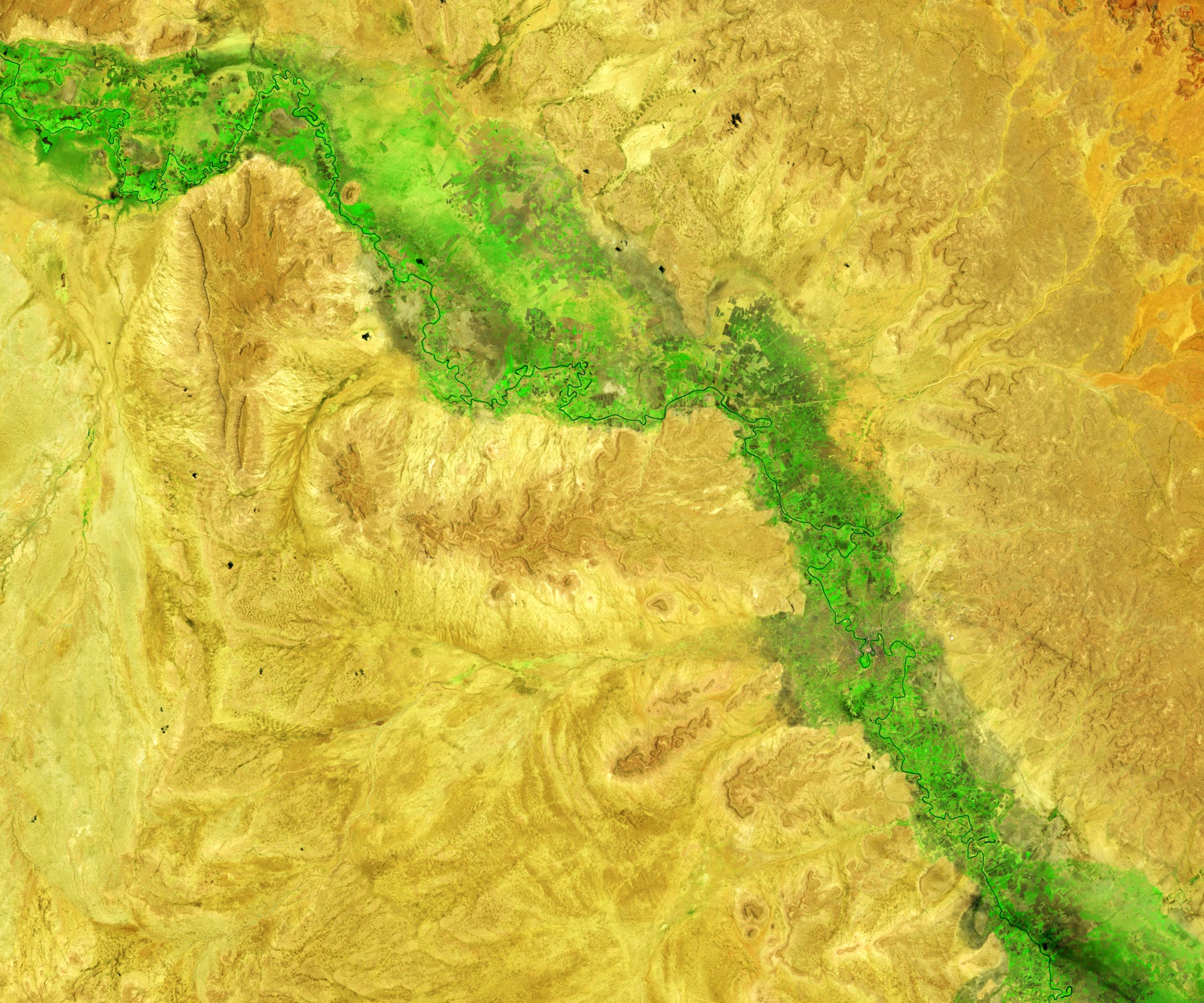
Excessive rainfall in the highlands of Ethiopia and Somalia in late October and early November raised the levels of the Shebelle River until it filled on November 11. Subsequent rain caused the river to spill out of its banks in central Somalia and submerge the surrounding area, including the town of Beledweyne (Belet Weyne). Flooding in the town forced an estimated 250,000 people (90 percent of the population) out of their homes.
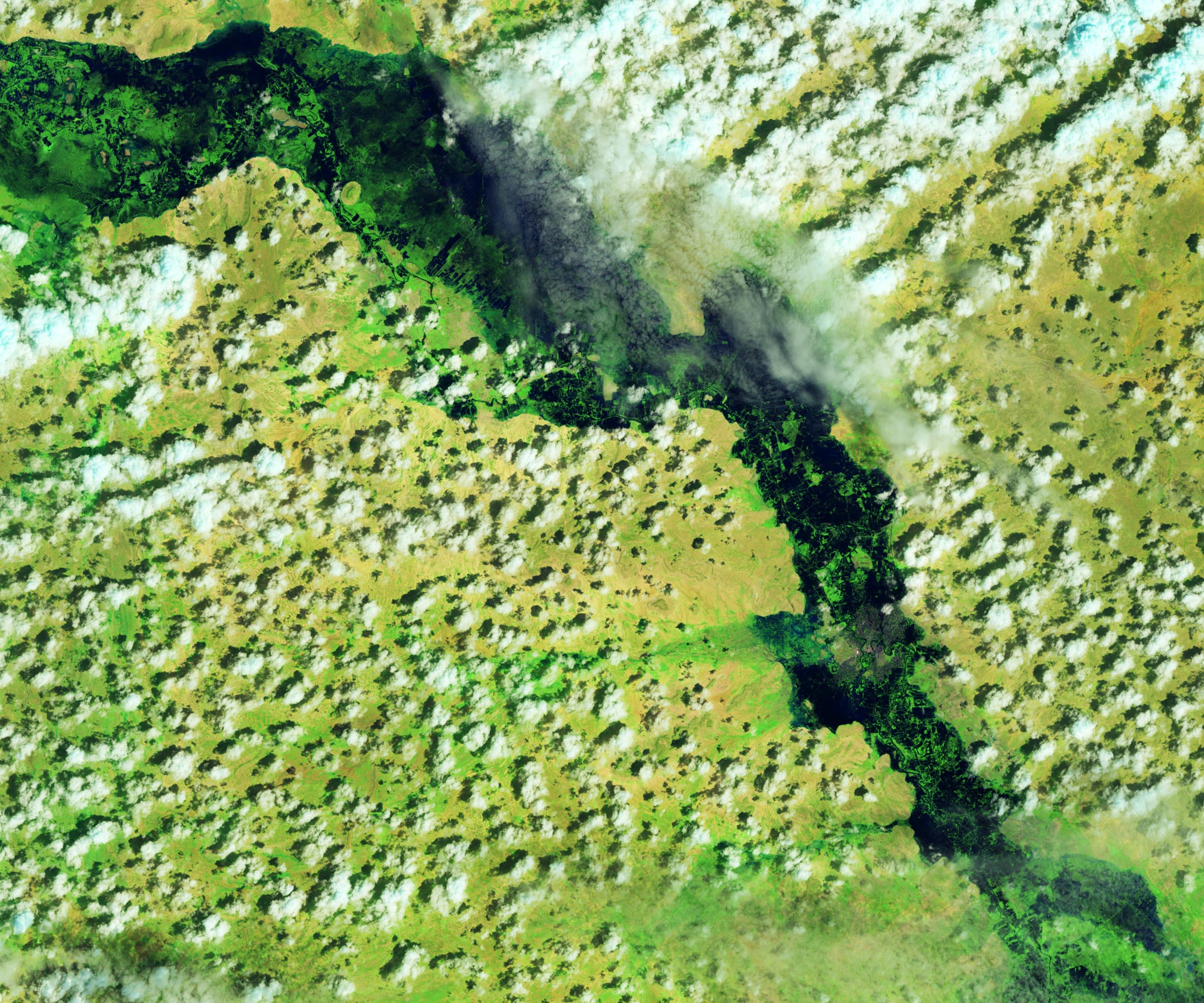
Beledweyne is shown in the upper image above on November 15, 2023. For comparison, the image on just above shows the same area on September 12, 2023. The images, acquired by the OLI (Operational Land Imager) on Landsat 8, are false color to emphasize the presence of water, which appears in shades of blue.
The video below shows a wider view of the Shebelle River.
The persistent heavy rain also caused the Juba River, located in western Somalia, to overflow, inundating croplands and roads in the town of Luuq. In Bardheere, a bridge was swept away, cutting off access to the town.
Back in July 2023, researchers at the Climate Hazards Center at the University of California, Santa Barbara, used climate models to provide early warning for rainfall and flooding in the Horn of Africa during the OND “short rains” season. The Climate Hazards Center provides rainfall data and forecasts to FEWS NET, a program supported by the U.S. Agency for International Development (USAID) in partnership with several other agencies, including NASA.
At the time, sea surface temperature patterns in the Indian and Pacific Oceans were forecast to bring abnormally high rainfall to East Africa. A positive Indian Ocean Dipole (IOD), characterized by warmer-than-normal sea surface temperatures in the western Indian Ocean and cooler-than-normal temperatures in the eastern equatorial Indian Ocean, typically favors a wet OND in eastern Africa. El Niño conditions (warmer-than-normal sea surface temperatures in the central and eastern tropical Pacific Ocean) also tend to amplify the influence of a positive IOD. These two forces are associated with flooding over East Africa and drought and fire in Australia.
“I think our forecasting was a good example of concern ratcheting up over time,” said Chris Funk, director of the Climate Hazards Center. “In July we predicted that a strong El Niño and IOD threatened East Africa. In September our forecasts became more concerning. Then in October we noted a big increase in the strength of the IOD, associated with rapid cooling over the eastern Indian Ocean, and that led to the expectation of an extremely wet season.”
Since October, unusually high rainfall has alleviated prolonged drought conditions in the Horn of Africa. But it may also contribute to increased cholera outbreaks and crop and livestock pests and diseases, on top of the loss of life that has already occurred.
Researchers at the Climate Hazards Center noted that the strength of the IOD this year looks similar to conditions in late 2019, when a positive IOD event contributed to exceptional rains, flooding, and displacement in the Horn of Africa. Unusually wet soils that year also contributed to an outbreak of desert locusts (Schistocerca gregaria) in early 2020, which infested and destroyed crops on at least 70,000 hectares (173,000 acres) of land in Kenya.
“Since late 2016, the eastern Horn of Africa has seen an almost unbroken string of either very wet or very dry rainy seasons,” Funk said. “Using recent advances in climate modeling—which can predict these droughts and deluges months in advance—the Climate Hazard Center is working to link these predictions to better inform risk management, agriculture, and livestock management practices.”
NASA Earth Observatory images by Lauren Dauphin, using Landsat data from the U.S. Geological Survey.
Never miss a breakthrough: Join the SciTechDaily newsletter.
Follow us on Google and Google News.