
A team from UNIGE has demonstrated that the production of dopamine, often referred to as the “happiness hormone,” is not linked to a higher risk of drug susceptibility.
Why do some people who try drugs struggle with substance abuse while others don’t? This question has long puzzled scientists. A team from the University of Geneva (UNIGE) explored the complex interplay between personality traits and brain chemistry.
The scientists studied the role of impulsivity and the production of dopamine – the so-called ‘‘happiness hormone’’ – in influencing the risk of cocaine abuse. These results, published in eNeuro, offer new keys to understanding vulnerability to drug abuse, which could lead to the development of more targeted interventions for people at risk.
When a person consumes an addictive drug, his or her dopamine release surges, creating a “high” feeling. With repeated drug use, this dopamine release drops, potentially driving the person to increase drug consumption. This mechanism varies between individuals, with some showing a greater propensity to consume the drug while others don’t. However, the reasons for these differences are unknown.
Cocaine does not affect dopamine production capacity
In a recent study, a UNIGE team explored the complex interaction between different impulsive behaviors, the production of dopamine, and the use of drugs, more specifically cocaine. Does an impulsive personality increase the vulnerability to drug abuse? Does an impulsive individual produce more or less dopamine? To find out, the scientists studied two groups of rats, one made up highly impulsive individuals, the other of less impulsive ones. These animals were trained to self-administer cocaine at a dose that triggers dopamine neuroadaptations without harming their health.
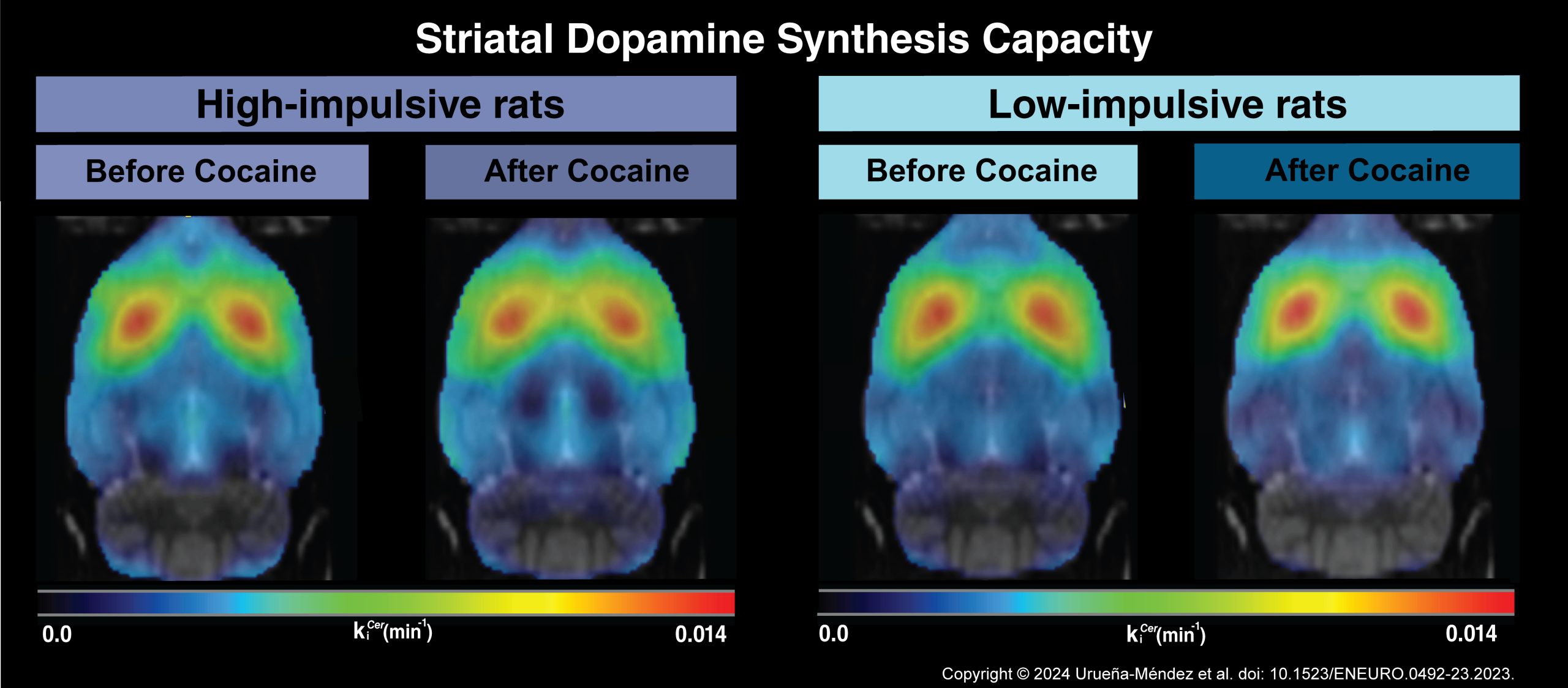
Scientists first trained the animals in a gambling task to measure two impulsive behaviors: impulsive action – the inability to control automatic actions – and risky decision-making – the acceptance of more risk when making decisions. Scientists then measured the level of dopamine synthesis using a non-invasive neuroimaging technique before and after cocaine intake in the two groups of rats. They found that impulsive action, but not risky decision-making, predicted a greater number of cocaine injections and faster cocaine use.
“However, we observed that there was no difference in the capacity to produce dopamine between the highly impulsive and less impulsive animals. In other words, impulsivity and vulnerability to cocaine abuse might not be linked to dopamine production, but to mechanisms controlling its release,’’ explains Ginna Paola Urueña-Méndez, PhD. student in the Department of Psychiatry and the Department of Basic Neurosciences in the Faculty of Medicine at the UNIGE, and first author of the study. The team then assessed repeated cocaine use and its impact on dopamine levels in the two groups of rodents. ‘‘Until now, the idea that regular cocaine consumption could reduce the ability to produce dopamine was accepted. Our results contradict this assumption as both populations of rats retained the same capacity to produce dopamine, despite chronic consumption,’’ explains Nathalie Ginovart, Associate Professor in the Department of Psychiatry and the Department of Basic Neurosciences at the UNIGE Faculty of Medicine, who led this research.
Identifying other mechanisms
These results suggest dopamine synthesis is probably not the main driver of impulsivity or vulnerability to cocaine use. They also contradict the hypothesis that cocaine use may directly reduce the capacity to produce dopamine.
This work represents a significant advance in research into the risk of drug abuse. It opens the door to exploring other mechanisms that could explain individual vulnerability to drugs. ‘‘This variation in vulnerability could be linked to differences in the relative reactivity of dopaminergic neurons, so that certain stimuli, including drugs, are more salient for more impulsive animals,’’ say the researchers. The team is currently continuing its research to assess how mechanisms controlling dopamine neuron reactivity influence vulnerability to abuse drugs.
Reference: “Decoupling Dopamine Synthesis from Impulsive Action, Risk-Related Decision-Making, and Propensity to Cocaine Intake: A Longitudinal [18F]-FDOPA PET Study in Roman High- and Low-Avoidance Rats” by Ginna Urueña-Méndez, Chloé Arrondeau, Lidia Bellés and Nathalie Ginovart, 22 January 2024, eNeuro.
DOI: 10.1523/ENEURO.0492-23.2023
Never miss a breakthrough: Join the SciTechDaily newsletter.
Follow us on Google and Google News.