
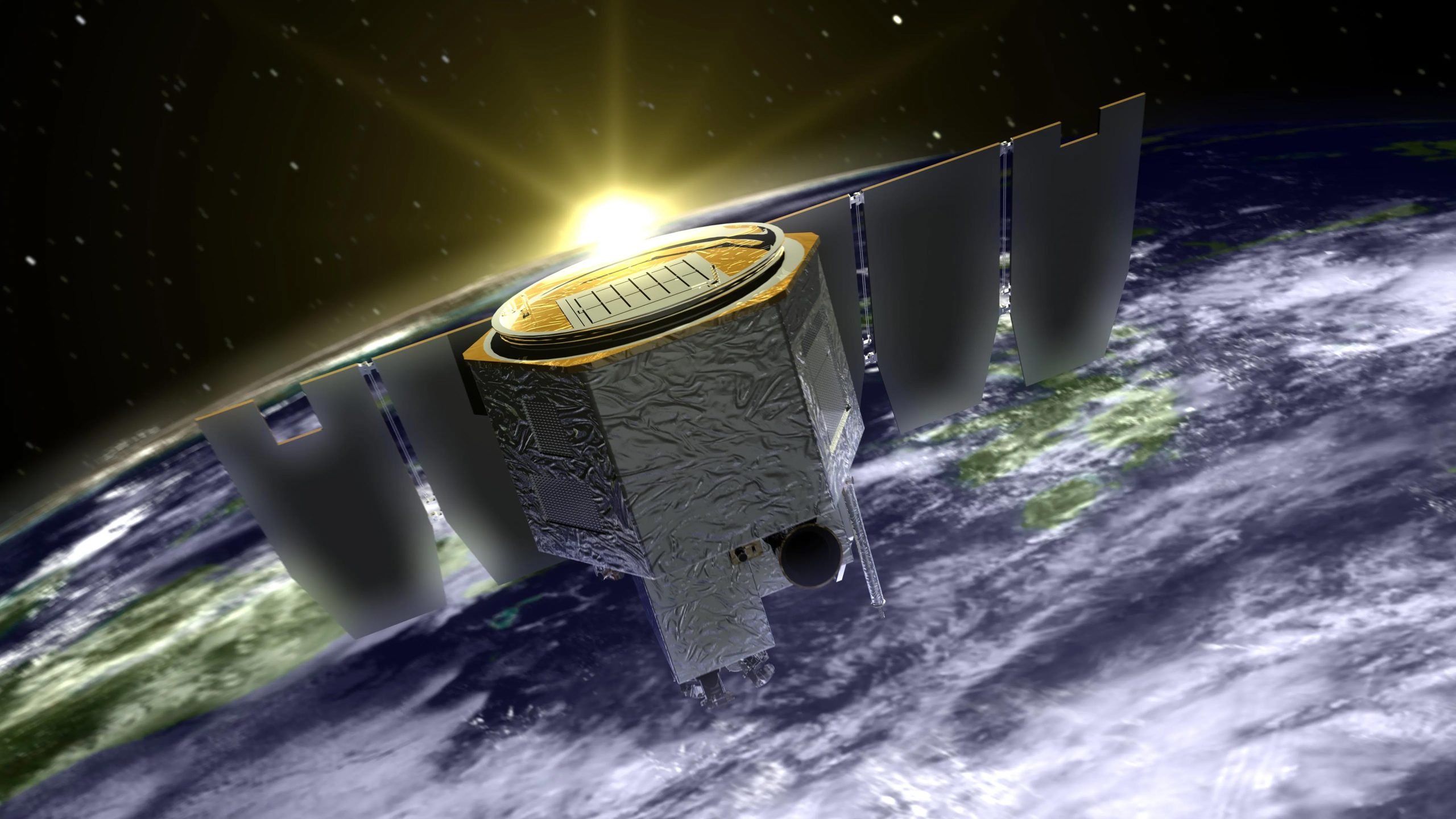
NASA’s AIM mission concluded after over a decade of groundbreaking research on Earth’s upper atmosphere, leaving behind a legacy of scientific discoveries and a wealth of data for future analysis.
After 16 years of studying Earth’s highest clouds for the benefit of humanity – polar mesospheric clouds – from its orbit some 350 miles above the ground, NASA’s Aeronomy of Ice in the Mesosphere, or AIM, mission has come to an end.
Initially slated for a two-year mission, AIM was extended numerous times due to its high science return. While AIM has faced hurdles over the years – from software hiccups to hardware issues – an incredibly dedicated team kept the spacecraft running for much longer than anyone could have anticipated. On March 13, 2023, the spacecraft’s battery failed following several years of declining performance. Multiple attempts to maintain power to the spacecraft were made, but no further data could be collected, so the mission has now ended.
Scientific Contributions and Discoveries
“AIM was dedicated to studying the atmospheric region that borders between our atmosphere and space,” said AIM mission scientist Diego Janches, of NASA’s Goddard Space Flight Center in Greenbelt, Maryland. “AIM’s help understanding this region has been of critical importance to providing insights on how the lower atmosphere affects space weather.”
Known as night-shining or noctilucent clouds, they are seen at twilight in the summer months, typically at high latitudes near the North and South Poles. Before the mission, scientists knew these types of clouds varied with latitude, season, and solar activity, but didn’t know why. This mission was launched to understand the variations and study why the clouds form and their links to climate change by measuring the thermal, chemical, and other properties of the environment in which the clouds form.

“NASA’s AIM has been an incredibly successful mission,” said Scott Bailey, AIM principal investigator and professor at Virginia Tech. “It has answered core questions that have helped us understand how noctilucent clouds and atmospheric gravity waves vary over time and location.”
Over the years, AIM made many big discoveries. Data from the mission has thus far led to nearly 400 peer-reviewed publications. This includes findings on how these clouds can be created by meteor smoke and water vapor from rocket exhaust, how events near Earth’s surface can trigger changes in the clouds, and how ice high in the atmosphere can cause mysterious radar echoes, which are created in certain regions of the atmosphere during the summer.
As the mission progressed, scientists realized AIM’s data could also be used to study undulations in the air called atmospheric gravity waves. These waves transfer momentum and energy as they travel through the atmosphere. They link weather events at Earth’s surface with atmospheric disturbances that occur far away from the initial event, including in the uppermost part of the atmosphere where they can disrupt GPS signals.
Challenges and Solutions
“We’ve had many difficulties, but we’ve still gotten an incredible amount of data from AIM because of our really excellent, heroic, and hardworking team that comes through every time,” Bailey said.
AIM’s first hurdles started only months after launch in 2007, when the telecommunication receiver started to malfunction intermittently. With a clever use of radio signals, the team was able to reprogram the spacecraft to communicate in Morse code, which allowed it to maintain communications even after the receiver stopped working. While communication with the spacecraft became thousands of times slower than planned, AIM was still able to make its measurements and send home 99% of the data it collected.
Shortly thereafter, the spacecraft again encountered a mission-threatening issue. The spacecraft repeatedly sent itself into safe mode, which effectively shut down the spacecraft and required a time-consuming series of tasks to reboot. But again, the engineers were able to upload new software to the spacecraft to circumvent the issue and keep AIM functional. The new software patch has prevented over a thousand such incidents on the spacecraft since.
In 2019, AIM’s battery started to decline, but through great effort and ingenuity, the mission operations team maintained the battery power, enabling the spacecraft to continue returning data. In early 2023, the battery experienced a significant drop-off in performance which meant the spacecraft could not regularly receive commands or collect data. Unfortunately, this hardware issue was not one that could be repaired remotely, and the satellite finally ceased collecting data in March 2023.
Legacy and Future Research
“We’re saddened to see AIM reach the end of its lifetime, but it’s been amazing how long it has lasted,” Bailey said. “It’s given us more data and insight into noctilucent clouds and atmospheric gravity waves than we could ever have hoped for.”
Though the spacecraft has seen its last night-shining clouds, scientists will continue to study AIM’s data for years to come. As for the spacecraft itself, it will slowly lose orbital height and burn up upon atmosphere re-entry in 2026.
“There are still gigabytes upon gigabytes of AIM data to study,” said Cora Randall, AIM deputy principal investigator and senior research scientist at the Laboratory for Atmospheric and Space Physics in Boulder, Colorado. “And as our models and computational capabilities continue to improve, people will make many more discoveries using the AIM datasets.”
Never miss a breakthrough: Join the SciTechDaily newsletter.
Follow us on Google and Google News.