
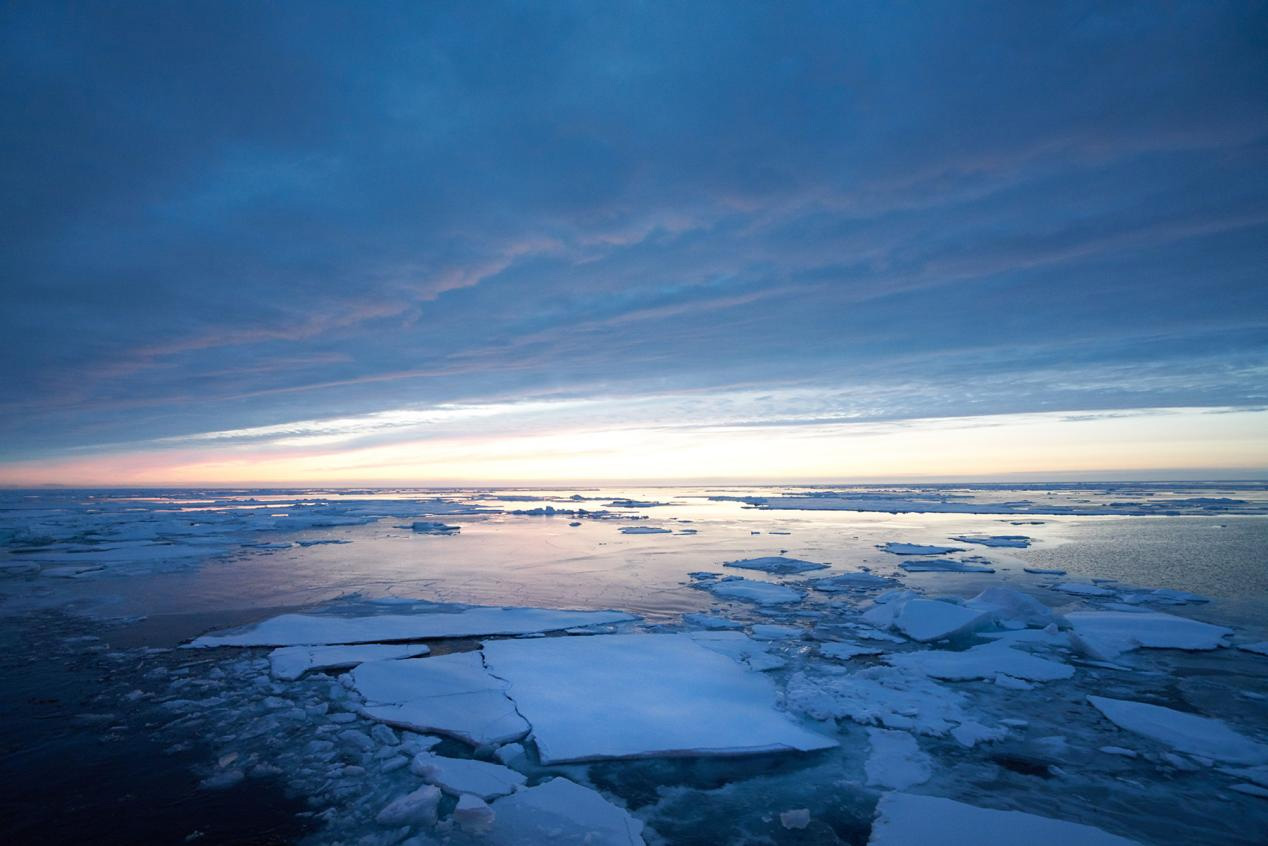
Recent research reveals that atmospheric rivers (ARs), narrow corridors transporting intense water vapor, contribute significantly to Arctic moisture, especially during summer. While ARs are linked to Arctic warming, a new study indicates that internal variability, rather than human-induced climate change, predominantly drives these changes, influencing long-term Arctic moisture patterns.
In recent years, the Arctic has experienced significant warming, a phenomenon referred to as Arctic amplification. This warming has affected the region’s ice-covered areas and ecosystems and has altered global weather patterns and climate by influencing atmospheric circulation. The Clausius-Clapeyron relationship explains that warmer temperatures result in higher levels of atmospheric water vapor. This increase in moisture not only acts as a greenhouse gas but also drives further warming in the Arctic through various feedback loops.
Atmospheric rivers (ARs) are narrow, transient corridors of intense water vapor transport, responsible for about 90% of poleward moisture movement despite only making up about 10% of atmospheric activity. Predominantly occurring in mid-latitudes, ARs transport warm, moist air toward polar regions. However, during summer, when Arctic moistening is most significant, the drivers behind changes in ARs and their contributions to long-term water vapor variability are not well understood.
A recent study published in Nature Communications by an international team of scientists from China, the USA, Chile, and Belgium has shed light on this issue. The study discovered a strong spatiotemporal connection between ARs and variables such as specific humidity, circulation, and temperature across different time scales, suggesting that similar physical mechanisms regulate them. Notably, long-term changes in Arctic summer moisture due to ARs cannot be entirely attributed to human-induced climate change, according to model responses. The study found that low-frequency large-scale atmospheric circulation in the Arctic significantly influences AR activity.
Study Insights on Arctic Moisture
“In recent decades, ARs have been transporting more water vapor to the Arctic, a phenomenon previously linked to global warming and Arctic amplification. However, this study found that internal variability, rather than anthropogenic forcing, is the primary driver of this change,” said Prof. Qinghua Ding from University of California, Santa Barbara, the study’s corresponding author.
After isolating the moisture changes attributed to ARs, the study revealed that since 1979, ARs have contributed to over 36% of the increase in Arctic summer water vapor trends. This contribution is particularly significant in areas where AR activity has markedly increased, such as western Greenland, northern Europe, and eastern Siberia, where it exceeds 50%.
“While ARs are generally seen as stochastic extreme atmospheric phenomena driven by synoptic-scale systems, they play a crucial role in modulating Arctic water vapor variability and shaping long-term changes in Arctic summer moisture,” said Dr. Zhibiao Wang from the Institute of Atmospheric Physics at the Chinese Academy of Sciences, the study’s lead author.
Reference: “Role of atmospheric rivers in shaping long term Arctic moisture variability” by Zhibiao Wang, Qinghua Ding, Renguang Wu, Thomas J. Ballinger, Bin Guan, Deniz Bozkurt, Deanna Nash, Ian Baxter, Dániel Topál, Zhe Li, Gang Huang, Wen Chen, Shangfeng Chen, Xi Cao and Zhang Chen, 29 June 2024, Nature Communications.
DOI: 10.1038/s41467-024-49857-y
Never miss a breakthrough: Join the SciTechDaily newsletter.
Follow us on Google and Google News.
5 Comments
“The Clausius-Clapeyron relationship explains that warmer temperatures result in higher levels of atmospheric water vapor.”
No! The Clausius-Clapeyron relationship does NOT predict automatically higher levels of water vapor with increasing temperature. It predicts how the water vapor concentration at saturation varies with temperature. That is, it predicts the potential, or upper-bound, for water vapor at a given temperature. To achieve saturation, there has to be adequate water available through evapotranspiration to saturate an air parcel. That explains why hot deserts have very low relative humidity, despite having very high temperatures. One can also have dry, cold deserts where the air is far from saturated because the water precipitates out as snow. The Clausius-Clapeyron relationship is just one of many factors that determines the humidity of air.
While methane is usually described in the news media reports as the “second most important greenhouse gas, after carbon dioxide,” it is evident from this article that water vapor plays an important role. Implicit in this story is that water vapor is behind the “Arctic [temperature] amplification.” While the role of water vapor is generally ignored with respect to global warming, being rationalized because it can (and does) precipitate out, it is also true that as an air parcel loses water through precipitation initiated at high altitude, it enhances the rate of evapotranspiration, which replenishes the water. The net result is that water vapor (absolute humidity) tends to regress around the seasonal mean for the particular Köppen–Geiger climate zone the air parcel occupies. In other words, water vapor is probably the most important greenhouse gas and it tends to be constant during any season for a particular region on Earth.
Does the saturation of our global enviroment with plastic particulates & so called ‘forever chemical’s’ interfere with the natural processes being recorded in Antarctica . . ?
As your informative story reported Antarctica is not fitting present climate models & as many I expect, I wonder if the man made particulates & chem’s have reached a level of ‘contamination’ within the enviroment,they might be aiding change by react differently to the natural structure of the enviroment, likely adding more heat or insulation to any observed ‘natural phanominom’ & skewing results with increasing time & continued adulteration . . ?
Developing multiple working hypotheses should be a part of the process of the Scientific Method. However, the working hypotheses should be the result of inductive reasoning based on the results of observations and/or experiments. Other than being anthropogenic in origin, what would lead you to believe that plastics or ‘forever chemical’s’ are a potential threat to the climate? The ‘forever chemical’s’ are basically inert to natural decomposition, which is why they are ‘forever.’ Because it is conceivable that they may interact in some manner, as is claimed with CFCs and ozone, perhaps your speculation should prompt an effort to look for problems.
However, research funds are not unlimited and there is no shortage of known problems that we need to learn more about, not the least of which is how to defeat cancer or prevent pandemics. Someone has to make the decision that ‘Knott’s Speculation’ is sufficiently concerning to divert funds away from known problems, to your speculation. How would the people controlling the purse strings make a rational decision about the best place to spend tax dollars? Is your speculative question sufficiently compelling to ignore things that are thought to be a problem already ?
Plastics are not truly ‘forever.’ Waste plastic is unsightly and offend some people’s sense of aesthetics. However, the problem is one of people not thinking about the consequences of tossing something overboard. It is a social problem that is potentially solvable. Mother Earth will take care of it long term though. The next time a lithospheric plate is subducted, the heat and pressure will cause the plastic-contaminated sediments to be broken down into simpler organic materials, much as was done the first time the dead organic components of sediments were turned into coal and crude oil.
Well, what do you know? The climate models are incomplete! Who knew?