
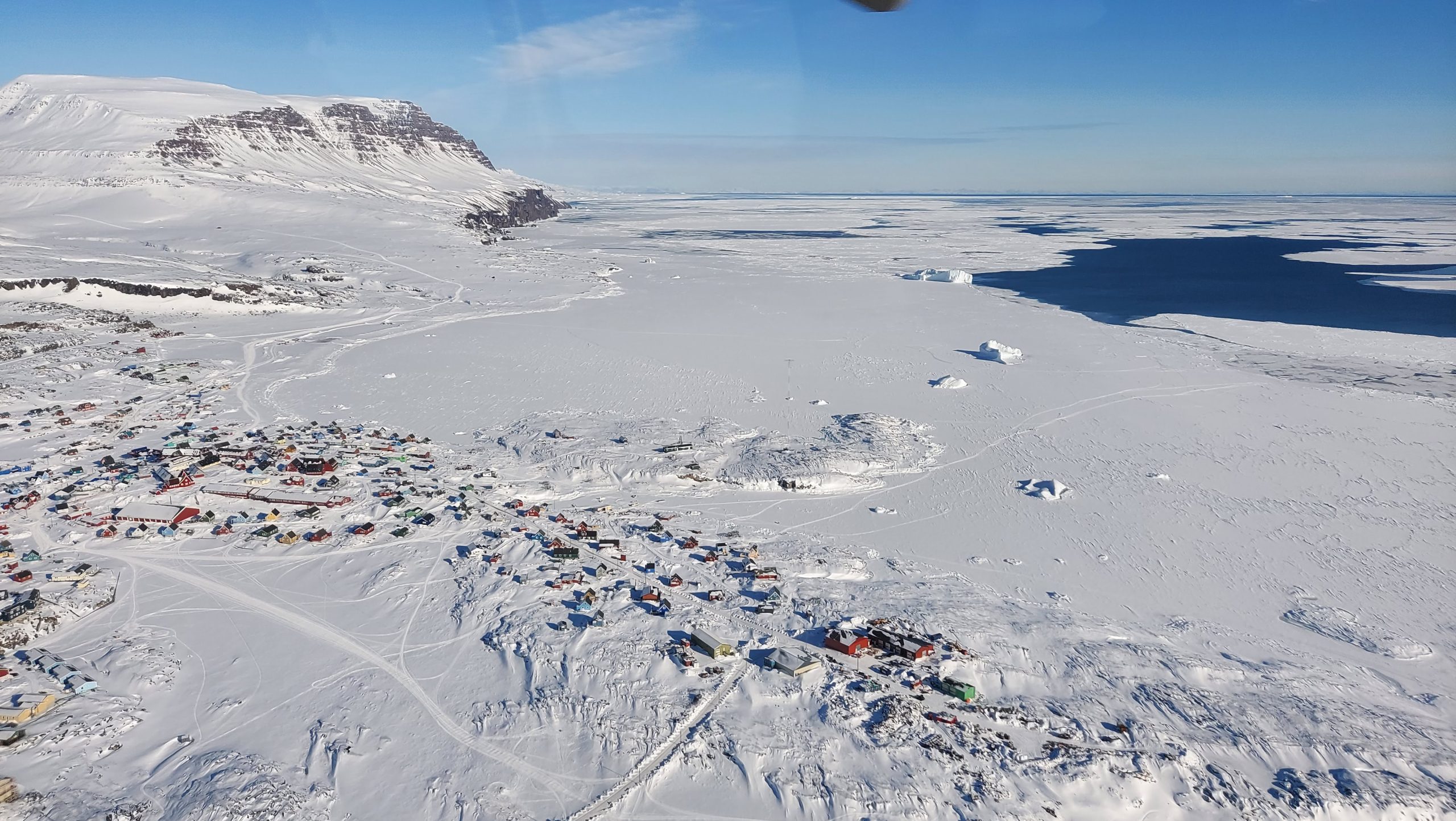
Dr. Shengping He from the University of Bergen has conducted research that highlights how Arctic sea ice influences winter temperatures in East Asia.
In recent decades, the Arctic climate has experienced rapid changes, with warming rates exceeding the global average by three to four times. This perplexing “Warm Arctic, Cold Eurasia” phenomenon has significant implications, prompting scientific inquiry into its underlying mechanisms.
Arctic sea ice has been rapidly declining, diminishing by about 12.2% in summer extent per decade over the past 40 years. Earlier studies suggested that diminishing Arctic sea ice played a key role in driving the “Warm Arctic, Cold Eurasia” climate mode. However, limitations in available observations raised questions about whether internal atmospheric variability might be masking the true impact of reduced sea ice.
Research on Arctic Sea Ice and Climate Patterns
Dr. Shengping He, Senior Researcher at the University of Bergen’s Geophysical Institute and corresponding author of the study published in Advances in Atmospheric Sciences , utilized large-scale experiments to untangle the influence of Arctic sea ice loss and internal atmospheric variability on this climate mode. In collaboration with various international institutions, the study revealed that diminishing sea ice can indeed trigger a “Warm Arctic, Cold East Asia” pattern. However, the cooling effect on East Asia due to reduced sea ice could easily be overshadowed by atmospheric variability, resulting in either more significant cold or warm anomalies.
The team also investigated future Arctic sea ice changes, focusing on newly formed winter ice. As the Arctic warms, the increase in open ocean areas in winter allows for more newly formed ice. This newer ice provides critical information about Arctic-air-sea interactions and broader atmospheric connections in the Northern Hemisphere. Their findings indicate that Arctic winter newly formed ice is expected to continue increasing until mid-century under various emissions scenarios, stabilizing thereafter in more moderate scenarios but decreasing under higher emissions.
These new studies not only quantified the direct impact of Arctic sea ice on winter temperatures but also unveiled the increasing trend in winter Arctic newly formed ice. The findings offer crucial insights into climate changes in the “new Arctic” era.
Reference: “Relative Impacts of Sea Ice Loss and Atmospheric Internal Variability on the Winter Arctic to East Asian Surface Air Temperature Based on Large-Ensemble Simulations with NorESM2” by Shengping He, Helge Drange, Tore Furevik, Huijun Wang, Ke Fan, Lise Seland Graff and Yvan J. Orsolini, 2 April 2024, Advances in Atmospheric Sciences.
DOI: 10.1007/s00376-023-3006-9
Never miss a breakthrough: Join the SciTechDaily newsletter.
Follow us on Google and Google News.
3 Comments
What gets me is science says we are reaching a TIPPING POINT but scientist can’t even reach a consensus to follow. My thoughts are two fold it’s a natural effect the earth goes through or nature is responding to the mass of humanities pressure on the environment, the only key word in my thoughts is on both sides in slightly different terms, NATURAL and NATURE both have the same connotation of life on earth science needs to get their act together. until then the battle will rage.
Global Warming is happening but dark matter is the chicken and Co2 is the egg.
Dark matter phase transitions could be a primary climate driver. If the solar system passes through an area of higher liquid dark matter content the planets cores would all receive more heat due to increased phase transitions thus heating the earth from the inside out.
Heating of the planet from the inside out would result in :
Increased ground temperatures
Increased sea temperatures
Increased nighttime temperatures
Increased seismic activity
Increased earthquakes
We are currently passing through the S1 dark Matter stream which, as it is going the opposite direction around the galaxy was described as a dark matter hurricane. From spring to fall the earth is downstream from the sun. And from July to December the earth is traveling with the S1 stream. There have also been peer reviewed papers about climate change that discuss dark matter annilhilation heating the earth from the inside, they did not mention any impact to climate change.
June-July 2020 Earth Mercury Venus Mars Jupiter Saturn conjunctions. This means that the earth passed through several consecutive dark matter streams
July 2020 Siberian heatwave and Antarctica temperature spike
Jan 9 2022 Venus Earth conjunction this resulted in an increase in the amount of dark matter leaving the sun and Venus
March 18 2022 Concordia Station spiked 39 C degrees due to unusual air patterns near Australia
North Pole regions hit 30C above normal
May 2022 mars crosses the dark matter stream to Saturn
May 4, 2022 a 4.7 magnitude Marsquake occurs due to tectonic activity.
March 26 2024 the Parker Solar Probe began its lap around the sun on April 4 it came out on the other side of the sun to start back towards Venus. In between it was actually inside of the Alfven Limit which is where I believe the surface of the dark matter sphere that surrounds the sun lies. This would be the equivalent of a speed boat sending a wake towards the earth.
April 11 mercury and earth are in an inferior conjunction which would also send a bit of extra dark matter in earths direction.
Mid June 2024 multiple heat waves.
Venus atmospheric temperatures from 2009-2017 also were higher after conjunctions and the atmospheric wind speeds have increased by 33% probably due to the increase in incoming dark matter.
Venus atmospheric temperatures from 2009-2017 also were higher after conjunctions
Venus atmospheric tsunami
If the dark matter spin off to the sun happens every 5 days on average and coincides with the wave facing the sun it may be proof of dark matter. During conjunctions if the tsunami is facing earth we get an extra surge of dark matter heading to the earth which also affects the time it takes for the tsunami to circle Venus. The gravity well fills up and dumps back to the sun but if it fills faster due to a conjunction it can spill toward the earth resulting in higher temperatures about 60 days later. The streams of liquid dark matter are constantly overflowing the suns dark matter sphere which extends to the Alfven radius. This distance varies dependant on how much dark matter reaches the point at which it vaporizes. (Velocity/gravity/temperature)
NASA issued a climate change warning for Mars after Mariner 9
Neptune has been heating up since 2018
cool now fix it, like co2, while your at it?