
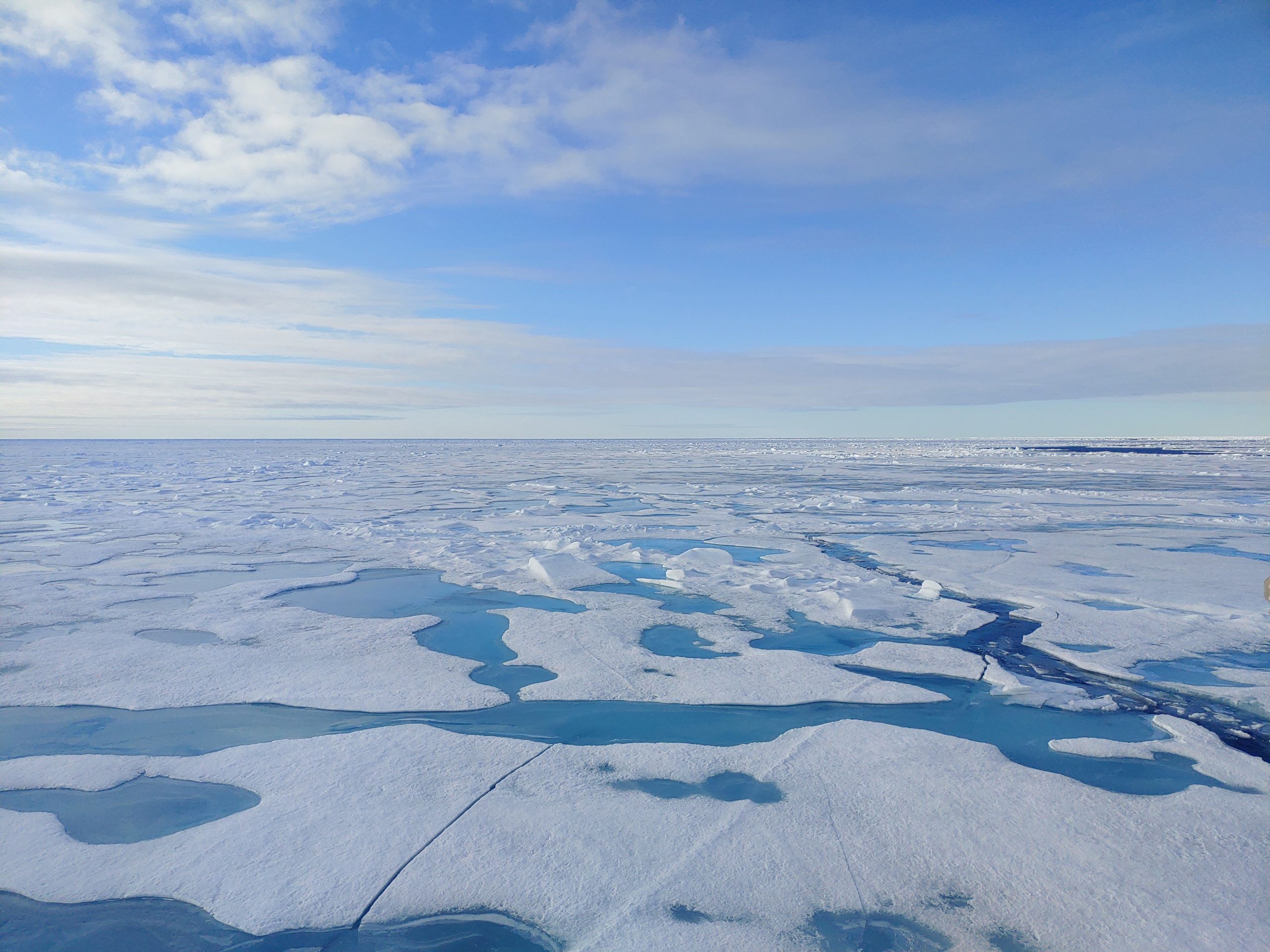
The Arctic may have its first ice-free summer day by 2027, intensifying global warming and extreme weather.
The Arctic could experience its first summer with nearly all sea ice melted—a troubling milestone for the planet—as soon as 2027.
For the first time, an international research team, including University of Colorado Boulder climatologist Alexandra Jahn and Céline Heuzé from the University of Gothenburg in Sweden, used computer models to predict when the first ice-free day could occur in the northernmost ocean. An ice-free Arctic could significantly impact the ecosystem and Earth’s climate by changing weather patterns.
“The first ice-free day in the Arctic won’t change things dramatically,” said Jahn, associate professor in the Department of Atmospheric and Oceanic Sciences and fellow at CU Boulder’s Institute of Arctic and Alpine Research. “But it will show that we’ve fundamentally altered one of the defining characteristics of the natural environment in the Arctic Ocean, which is that it is covered by sea ice and snow year-round, through greenhouse gas emissions.”
The findings were recently published in the journal Nature Communications. Jahn will also present the results on Dec. 9 at the American Geophysical Union annual meeting in Washington D.C.
A Blue Arctic
As the climate warms from increasing greenhouse gas emissions, sea ice in the Arctic has disappeared at an unprecedented speed of more than 12% each decade.
In September, the National Snow and Ice Data Center reported that this year’s Arctic sea ice minimum—the day with the least amount of frozen seawater in the Arctic—was one of the lowest on record since 1978.
At 1.65 million square miles, or 4.28 million square kilometers, this year’s minimum was above the all-time low observed in September 2012. But it still represents a stark decline compared to the average coverage of 6.85 million square kilometers between 1979 and 1992.
When the Arctic Ocean has less than 1 million square kilometers of ice, scientists say the Arctic is ice free.
Previous projections of Arctic sea ice change have focused on predicting when the ocean will become ice free for a full month. Jahn’s prior research suggested that the first ice-free month would occur almost inevitably and might happen by the 2030s.
As the tipping point approaches, Jahn wondered when the first summer day that melts virtually all of the Arctic sea ice will occur.
“Because the first ice-free day is likely to happen earlier than the first ice-free month, we want to be prepared. It’s also important to know what events could lead to the melting of all sea ice in the Arctic Ocean,” Heuzé said.
Non-zero possibility
Jahn and Heuzé projected/estimated the first ice-free Arctic day using output from over 300 computer simulations. They found that most models predicted that the first ice-free day could happen within nine to 20 years after 2023 regardless of how humans alter their greenhouse gas emissions. The earliest ice-free day in the Arctic Ocean could occur within three years.
It’s an extreme scenario but a possibility based on the models. In total, nine simulations suggested that an ice-free day could occur in three to six years.
The researchers found that a series of extreme weather events could melt two million square kilometers or more of sea ice in a short period of time: An unusually warm fall first weakens the sea ice, followed by a warm Arctic winter and spring that prevents sea ice from forming. When the Arctic experiences such extreme warming for three or more years in a row, the first ice-free day could happen in late summer.
Those kinds of warm years have already happened. For example, in March 2022, areas of the Arctic were 50°F warmer than average, and areas around the North Pole were nearly melting. With climate change, the frequency and intensity of these weather events will only increase, according to Heuzé.
Sea ice protects the Arctic from warming by reflecting incoming sunlight back into space. With less reflective ice, darker ocean waters will absorb more heat from the Sun, further increasing temperatures in the Arctic and globally. In addition, warming in the Arctic could change wind and ocean current patterns, leading to more extreme weather events around the world.
But there’s also good news: A drastic cut in emissions could delay the timeline for an ice-free Arctic and reduce the time the ocean stays ice-free, according to the study.
“Any reductions in emissions would help preserve sea ice,” Jahn said.
Reference: “The first ice-free day in the Arctic Ocean could occur before 2030” by Céline Heuzé, and Alexandra Jahn, 3 December 2024, Nature Communications.
DOI: 10.1038/s41467-024-54508-3
Never miss a breakthrough: Join the SciTechDaily newsletter.
Follow us on Google and Google News.
33 Comments
Greenhouse gases and oil drilling should be halted and banned forever or it could cause more of the ice to shrink and we can’t have gases to continue otherwise it’ll get worse. Save the Arctic!
Maybe they should… but are you ready for the end of the civilisation as we know it?
Previously, Polar bears in Greenland have suffered paw injuries. Researchers noticed that some of the bears in their study groups seemed to be having trouble with their feet and higher temperatures make for thinner sea ice. This allows seawater to seep into and thaw the snow on top which then clumps on the bears’ feet and refreezes. And climate change is responsible for this! We should reduce greenhouse gas emissions and try to limit climate warming. Read here https://www.discoverwildlife.com/environment/polar-bear-paws-ice-injuries
Polar bears walk on rocks.
Also, pollution in the Arctic should be cleared away to keep the Polar environment clean and healthy for all wildlife.
Just how do you propose to clear away the ‘pollution’ in the Arctic without creating more pollution?
There was a program on PBS TV the other night. It showed a river boatman delivering all kinds of modern equipment and fuel oil along the Yukon River before Winter set in. I was wondering how these people living off salmon and caribou could afford the vehicles, fuel oil, boats and motors, and home appliances. Then I remembered that the state of Alaska pays Native Americans from the proceeds of crude oil from the North Slope. Would you force those thousands of people to go back to living like their ancestors did so that the world could be as you think it should be? What gives you the wisdom to dictate how everyone should live and how that would be accomplished?
But we can’t let the ice shrink and disappear if we don’t halt the oil drillings and greenhouse gases and clear away the pollutions, or otherwise the Polar bears won’t walk on the frozen seas to hunt seals, that’s their favourite prey.
Are you saying that you are more concerned about bears than people?
The Polar bears. Previously, Polar bears in Greenland have suffered paw injuries. Researchers noticed that some of the bears in their study groups seemed to be having trouble with their feet and higher temperatures make for thinner sea ice. This allows seawater to seep into and thaw the snow on top which then clumps on the bears’ feet and refreezes. And climate change is responsible for this! We should reduce greenhouse gas emissions and try to limit climate warming. Read here https://www.discoverwildlife.com/environment/polar-bear-paws-ice-injuries
Are you saying polar bears are expendable?
Them bears were there long before people and are made to suffer because of people. If bears could talk I wonder what we could learn from them. It’s humans that are the cause of all this mess we’re in.
Ah well; if people (such as Arabs) are not politically correct in the way we would like them to behave, we drop bombs on them. What’s the difference between that and telling the Innuit to go back to living as did their ancestors (in harmony with nature etc) before Europeans met them?
The Arctic is changing. And not for the better, scientists say https://www.independent.co.uk/climate-change/arctic-tundra-shift-climate-change-b2662751.html
“It’s an extreme scenario but a possibility based on the models.”
And we should unquestionably accept the output of these models because they are generated by a computer?
I gather that Arrhenius pulled the same type of modelling thing back around 1894-1895. However, computers make it quicker, as long as one thinks about inputs. So no, we don’t really need computers to make mistakes. But we can make them more quickly and thus adjust the ouputs more effectively when we get improved stuff to input. Which is what science is truly all about; correcting outputs.
“With less reflective ice, darker ocean waters will absorb more heat from the Sun, further increasing temperatures in the Arctic and globally.”
The people who make such claims are demonstrating that they have a poor understanding of the physics of light. One needs to understand that the water looks dark compared to ice and snow because specular reflection (like a mirror) confines all the reflected light to a thin sheaf of rays, unlike snow, which is a diffuse reflector, and scatters light in all directions. Calm water can achieve 100% reflectance, which even snow never achieves. With the sun low on the horizon, photographs show that the specular reflection is brighter than the floating ice floes.
https://wattsupwiththat.com/2016/09/12/why-albedo-is-the-wrong-measure-of-reflectivity-for-modeling-climate/
Previously, Polar bears in Greenland have suffered paw injuries. Researchers noticed that some of the bears in their study groups seemed to be having trouble with their feet and higher temperatures make for thinner sea ice. This allows seawater to seep into and thaw the snow on top which then clumps on the bears’ feet and refreezes. And climate change is responsible for this! We should reduce greenhouse gas emissions and try to limit climate warming. Read here https://www.discoverwildlife.com/environment/polar-bear-paws-ice-injuries
What does your duplicate reply have to do with the so-called albedo effect?
Very urgent, if we don’t reduce the greenhouse gas emissions and oil drilling, the ice will be all gone by 2027, and they’ll be no ice for the Polar bears to hunt and for the seals to rest on. It has to be done now before it’s too late. Save the Arctic.
It is obvious that you believe the things that you are saying. However, you have not presented anything that would convince an objective observer to accept your claims.
2027 is a little over 2 years away. The extent of the minimum Arctic ice coverage has been increasing generally since maximum ice-free extent about 2012. Why would you believe that the trend for the last dozen years will suddenly change and create an ice-free situation in two years?
See the graph of ice extent at https://nsidc.org/sea-ice-today at top right. It should be obvious that the most recent minimum is greater than it was in 2012.
Save the seals!
Good luck getting Mexico, South America, Russia, China, India, Africa, and the Philippines to go along with that. lol!
Found out now, the Arctic is changing caused by human caused climate change https://www.independent.co.uk/climate-change/arctic-tundra-shift-climate-change-b2662751.html
What happens when the sun is not low on the horizon, which must occur from time to time? Has that been quantified, as it speaks to a former balance that might be changing. I don’t know the answer, which is why I ask.
I note that from more 300 computer simulations, 9 gave rather pessimistic results, with presumably the remainder giving a variety of results to write papers about in the future.
Basically, specular reflectance is a function of the angle of incidence. Go to the link I provided and read it.
Some researchers have pointed out that RCP8.5, the Business as Usual scenario, is improbable based on best estimates of available fossil fuel resources.
I understand the angle of incidence stuff, which was not taken into account by Captain Scott and friends when trying drag their sledge across the Ross Ice Shelf after getting to he South Pole and off the Beadmore Glacier 1 month too late.
Whilst not harking to the idea of dragging a sledge across the Arctic ice, or sea, too soon in my life, I would imagine there is a critcal angle at which water reflects sunlight more readily than ice/snow depending on condition of said ice/snow. Naturally this will vary with time of year, and one would imagine that in the high latitudes around the Arctic this would both calculable and thus graphable against latitude and time of year and therefor predictable, which should be a factor surely flourishing amongst assorted computer modellings of when the sea-ice will disappear at whatever latitude one chooses. Therefore one could also model assorted percentages of sea-ice cover in the Arctic, and the assorted concentrations of the assorted percentages of said ice, and then to further complicate the story feed in variations of both wet and dry snow cover on said ice to come up with a great many assorted simulations (computers are marvellous!) to pick and choose from according to one’s prejudice and publishability.
I wonder is if this has been done?
I have done it and present the results at the link I suggested that you read. Why are you asking questions from a position of ignorance when you could read the article and get your answers there?
But we can’t let the ice shrink and disappear if we don’t halt the oil drillings and greenhouse gases and clear away the pollutions, or otherwise the Polar bears won’t walk on the frozen seas to hunt seals, that’s their favourite prey.
Thanks. You’ve been busy. I’ll take a look. If one does not ask questions from a position of ignorance, how can one learn? What appear to be random links quoted on the internet often turn out to be a waste of space, but since you’ve done it, it may be worthwhile.
Nice thoughtful exposition; given that one can simulate a great many things with adequate computing power one might wonder if there is not a Bell curve distribution to the validity of simulations but no doubt that would not account for one’s feeling for/prejudice for/knowledge of the variables. Assuming the Earth is warming then one could well expect Arctic sea-ice to disappear at some time, but when is still the question depending on the rate of warming. I’ll toss the coin of ignorance and say 2048, though 2054 came to mind for some reason.
The symmetry of the outputs of simulations is assumed and is the basis for the current popularity of what are called “ensembles.” The problem is, it appears that only the Russian models are actually close to reality; all the rest run too warm.
Logically, there can only be one ‘best’ simulation. If it is averaged with all the others, then the average will be less accurate than the best model! Yet despite that, the modelers still recommend the average of the ensembles, which would only be useful if the average was close to reality and the distribution was symmetrical (not skewed) about the average.
Wasn’t this already supposed to have happened? Algore said so.
Previously, Polar bears in Greenland have suffered paw injuries. Researchers noticed that some of the bears in their study groups seemed to be having trouble with their feet and higher temperatures make for thinner sea ice. This allows seawater to seep into and thaw the snow on top which then clumps on the bears’ feet and refreezes. And climate change is responsible for this! We should reduce greenhouse gas emissions and try to limit climate warming. Read here https://www.discoverwildlife.com/environment/polar-bear-paws-ice-injuries