
Close Menu
    Facebook X (Twitter) Instagram
    SciTechDaily
    • Biology
    • Chemistry
    • Earth
    • Health
    • Physics
    • Science
    • Space
    • Technology
    Facebook X (Twitter) Pinterest YouTube RSS
    SciTechDaily
    Home»Biology»Challenging Viral Biology: Researchers Discover Mysterious Virus With Ribosomal Protein
    Biology

    Challenging Viral Biology: Researchers Discover Mysterious Virus With Ribosomal Protein

    By Marcie Grabowski, University of Hawaii at ManoaDecember 30, 2024No Comments4 Mins Read
    Facebook Twitter Pinterest Telegram LinkedIn WhatsApp Email Reddit
    Share
    Facebook Twitter LinkedIn Pinterest Telegram Email Reddit
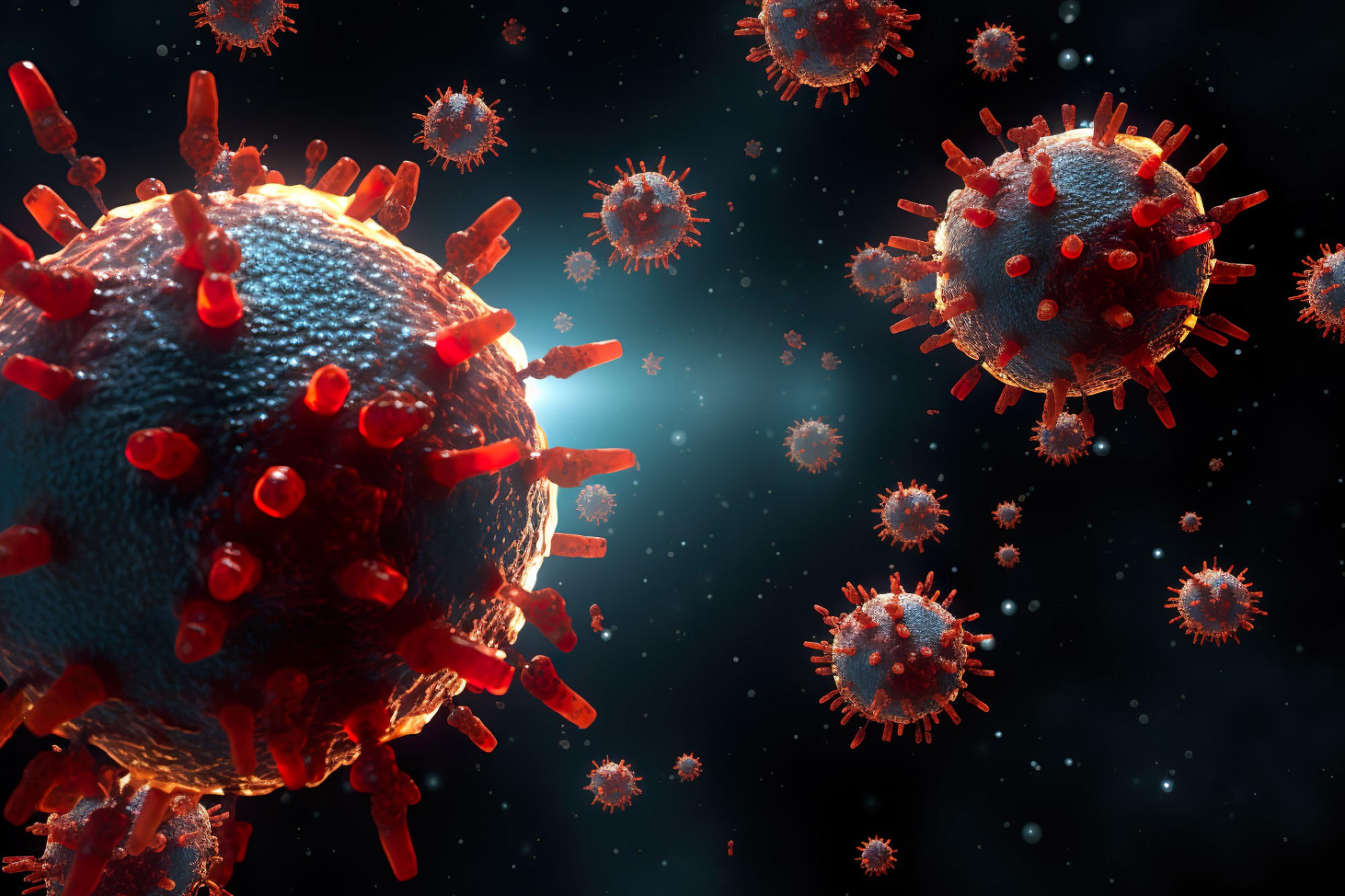
    Virus Particles COVID
    Researchers at the University of Hawai‘i at Mānoa discovered that the virus FloV-SA2 encodes a ribosomal protein, eL40, essential for the production of ribosomes, which translate genetic information into proteins. This marks the first time a eukaryotic virus has been found to possess such a capability, shedding new light on the complexity of virus-host interactions. Credit: SciTechDaily.com

    A virus that infects ocean phytoplankton was found to encode a ribosomal protein, a first for eukaryotic viruses. Researchers believe this aids the virus in replication.

    Researchers at the University of Hawai‘i at Mānoa have identified a virus, FloV-SA2, that encodes one of the essential proteins needed for ribosome production. Ribosomes are critical cellular structures that convert genetic information into proteins—the fundamental building blocks of life. This marks the first discovery of a eukaryotic virus (a virus that infects organisms such as plants, animals, or fungi) capable of encoding such a protein.

    Viruses are essentially packets of genetic material encased in a protein shell. They reproduce by invading a host cell and commandeering its replication machinery to produce more viruses. While simpler viruses rely almost entirely on the host cell for this process, larger and more complex viruses often produce a variety of proteins to assist in their replication.
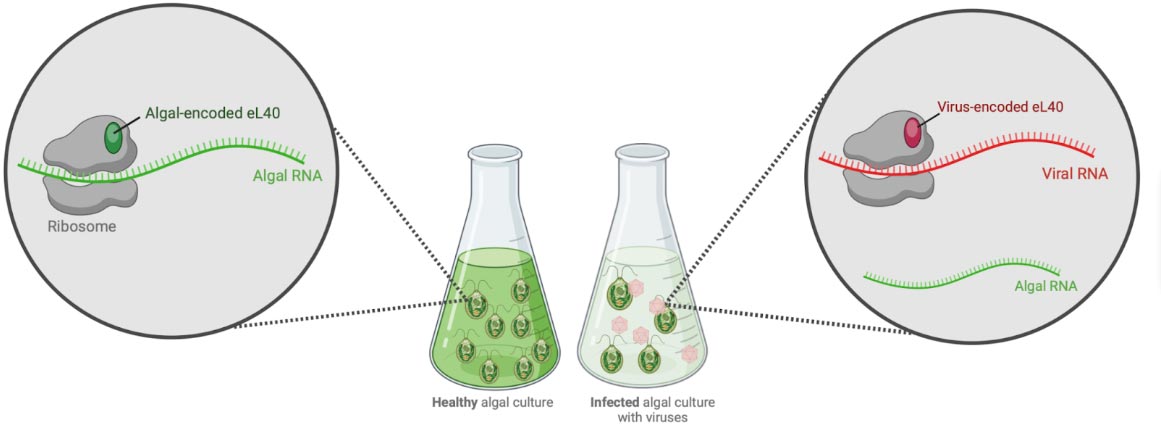
    Virus Encoded eL40
    In cells, ribosomes (shown as grey blobs) read RNA messages and convert the information into proteins. The researchers hypothesize that during infection, one component of the ribosome, eL40 (green oval) that is normally provided by the algal cell is replaced by a similar protein produced by the virus (red oval), and this changes the specificity of the ribosome so that it preferentially reads messages produced by the virus. Credit: Thomy/ UH Mānoa

    “We were excited to discover that this virus encodes a ribosomal protein called eL40,” said Julie Thomy, lead author of the study and postdoctoral researcher in the Daniel K. Inouye Center for Microbial Oceanography: Research and Education (C-MORE) and Department of Oceanography in the UH Mānoa School of Ocean and Earth Science and Technology (SOEST). “It makes sense that a virus could benefit from altering this critical piece of cell machinery, but there was just no evidence for it in any eukaryotic virus.”

    The virus was discovered as part of a larger effort by members of the Marine Viral Ecology Laboratories (MarVEL) in SOEST to isolate and characterize new viruses that live in the ocean. A former Oceanography graduate student, Christopher Schvarcz, sampled water from Station ALOHA 60 miles north of O’ahu, Hawai‘i, and subsequently isolated dozens of viruses. Among them was FloV-SA2, which infects a species of phytoplankton called Florenciella.

    FloV-SA2 Virus Particle
    Transmission electron micrograph of negatively stained FloV-SA2 virus particles. Scale bar: 100 nm. Credit: Thomy/ UH Mānoa

    “Chris was so productive at isolating viruses, he could not analyze them all before he left,” said Grieg Steward, Oceanography faculty member overseeing the project. “Detailed analysis of this virus had to wait until Dr. Thomy joined the lab, but it was worth the wait!”

    Preferential production of virus proteins?

    Previous discoveries have shown that, like FloV-SA2, other so-called ‘giant’ viruses code for proteins involved in a wide range of metabolic processes. Some, such as those involved in fermentation or sensing light, seem like surprising functions to find in a virus. These genes must help the virus replicate, but, as is the case with the ribosomal protein, it is not always clear how. The researchers are now focused on figuring out the details of how and when this protein is used by the virus.
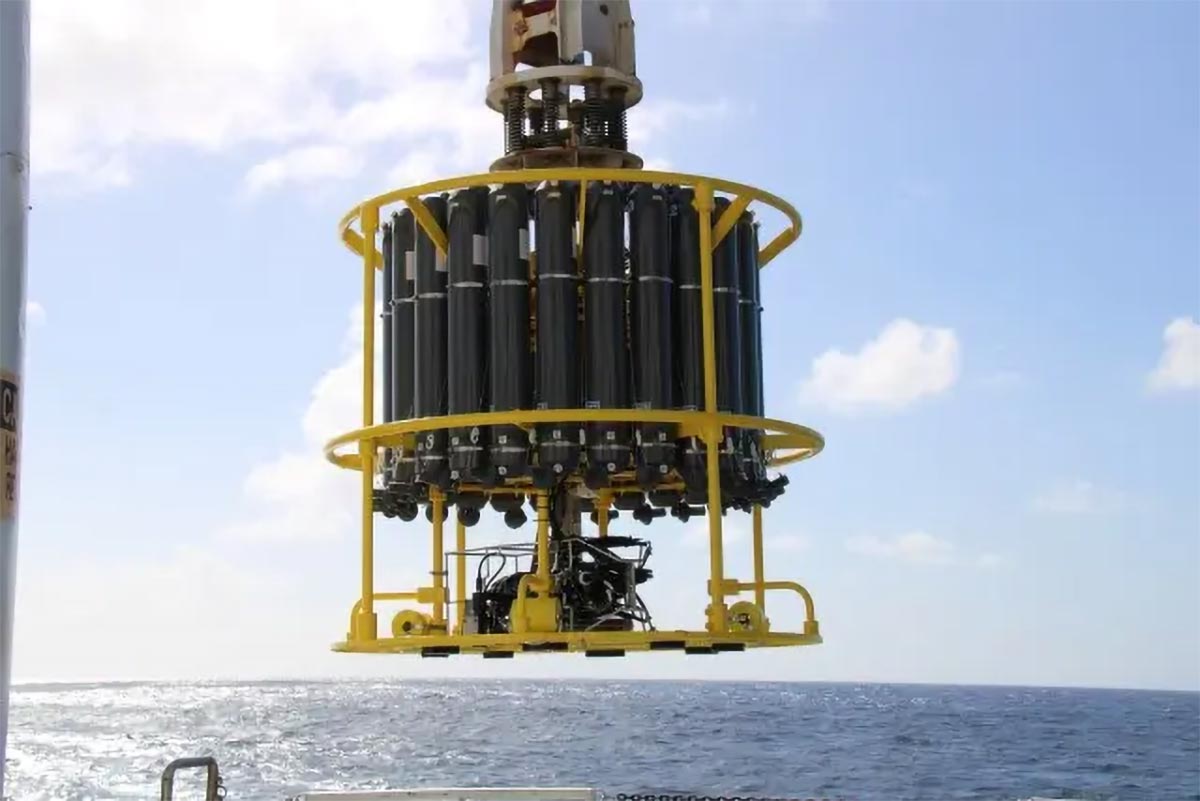
    CTD Water Sampler
    CTD water sampler prepared for deployment. Credit: Kelsey Maloney

    “Our working hypothesis is that by inserting one of its own proteins into the ribosome, the virus alters this key piece of machinery to favor the production of virus proteins, over the usual cell proteins,” said Thomy.

    “Viruses are integral to the functioning of ocean ecosystems, influencing biological productivity, shifting community interactions, and driving evolutionary change,” said Steward. “This discovery reveals new details about the complex ways viruses in the ocean interact with phytoplankton, which are the foundation of ocean ecosystems, but it also opens new avenues in our understanding of the fundamentals of viral biology.”

    The scientists expect that FloV-SA2 will be a valuable model system for investigating new mechanisms by which viruses manipulate cell metabolism and redirect host resources and energy.

    Reference: “Eukaryotic viruses encode the ribosomal protein eL40” by Julie Thomy, Christopher R. Schvarcz, Kelsey A. McBeain, Kyle F. Edwards and Grieg F. Steward, 23 October 2024, npj Viruses.
    DOI: 10.1038/s44298-024-00060-2

    Never miss a breakthrough: Join the SciTechDaily newsletter.
    Follow us on Google and Google News.

    Cell Biology Molecular Biology Oceanography University of Hawaii at Manoa Virology
    Share. Facebook Twitter Pinterest LinkedIn Email Reddit

    Related Articles

    A New Hope for Protection Against Flu Damage Inside the Lungs

    A Coronavirus Epidemic Broke Out in East Asia More Than 20,000 Years Ago

    Researchers Find COVID-19 Virus Was “Highly Human Adapted” – Exact Origins Still a Mystery

    Scientists Have Discovered an Achilles Heel of the Coronavirus

    New Discovery Helps Explain How COVID-19 Overpowers the Immune System

    Live Capture: Researchers Develop Virus Live Stream to Study Viral Infections

    Xenophyophores: Four Freaky New Species of Giant Single-Celled Organisms Discovered on Pacific Seafloor

    Key Differences in Seemingly Synonymous Parts of the Genetic Code

    SSRL Validates Anti-Flu Protein Design

    Leave A Reply Cancel Reply

    • Facebook
    • Twitter
    • Pinterest
    • YouTube

    Don't Miss a Discovery

    Subscribe for the Latest in Science & Tech!

    Trending News

    The Universe Is Expanding Too Fast and Scientists Can’t Explain Why

    “Like Liquid Metal”: Scientists Create Strange Shape-Shifting Material

    Early Warning Signals of Esophageal Cancer May Be Hiding in Plain Sight

    Common Blood Pressure Drug Shows Surprising Power Against Deadly Antibiotic-Resistant Superbug

    Scientists Uncover Dangerous Connection Between Serotonin and Heart Valve Disease

    Scientists Discover a “Protector” Protein That Could Help Reverse Hair Loss

    Bone-Strengthening Discovery Could Reverse Osteoporosis

    Scientists Uncover Hidden Trigger Behind Stem Cell Aging

    Follow SciTechDaily
    • Facebook
    • Twitter
    • YouTube
    • Pinterest
    • Newsletter
    • RSS
    SciTech News
    • Biology News
    • Chemistry News
    • Earth News
    • Health News
    • Physics News
    • Science News
    • Space News
    • Technology News
    Recent Posts
    • A Common Diabetes Drug May Hold the Key to Stopping HIV From Coming Back
    • Ancient “Syphilis-Like” Disease in Vietnam Challenges Key Scientific Assumptions
    • Drinking Alcohol To Cope in Your 20s Could Damage Your Brain for Life
    • Scientists Crack Alfalfa’s Chromosome Mystery After Decades of Debate
    • Ancient Ant-Plant Alliance Collapses As Predatory Wasps Move In
    Copyright © 1998 - 2026 SciTechDaily. All Rights Reserved.
    • Science News
    • About
    • Contact
    • Editorial Board
    • Privacy Policy
    • Terms of Use

    Type above and press Enter to search. Press Esc to cancel.