
Close Menu
    Facebook X (Twitter) Instagram
    SciTechDaily
    • Biology
    • Chemistry
    • Earth
    • Health
    • Physics
    • Science
    • Space
    • Technology
    Facebook X (Twitter) Pinterest YouTube RSS
    SciTechDaily
    Home»Space»Chandra Reveals Black Holes Gorging at Excessive Rates
    Space

    Chandra Reveals Black Holes Gorging at Excessive Rates

    By Chandra X-ray ObservatoryMay 1, 2015No Comments4 Mins Read
    Facebook Twitter Pinterest Telegram LinkedIn WhatsApp Email Reddit
    Share
    Facebook Twitter LinkedIn Pinterest Telegram Email Reddit
    Black Holes Gorging at Excessive Rates
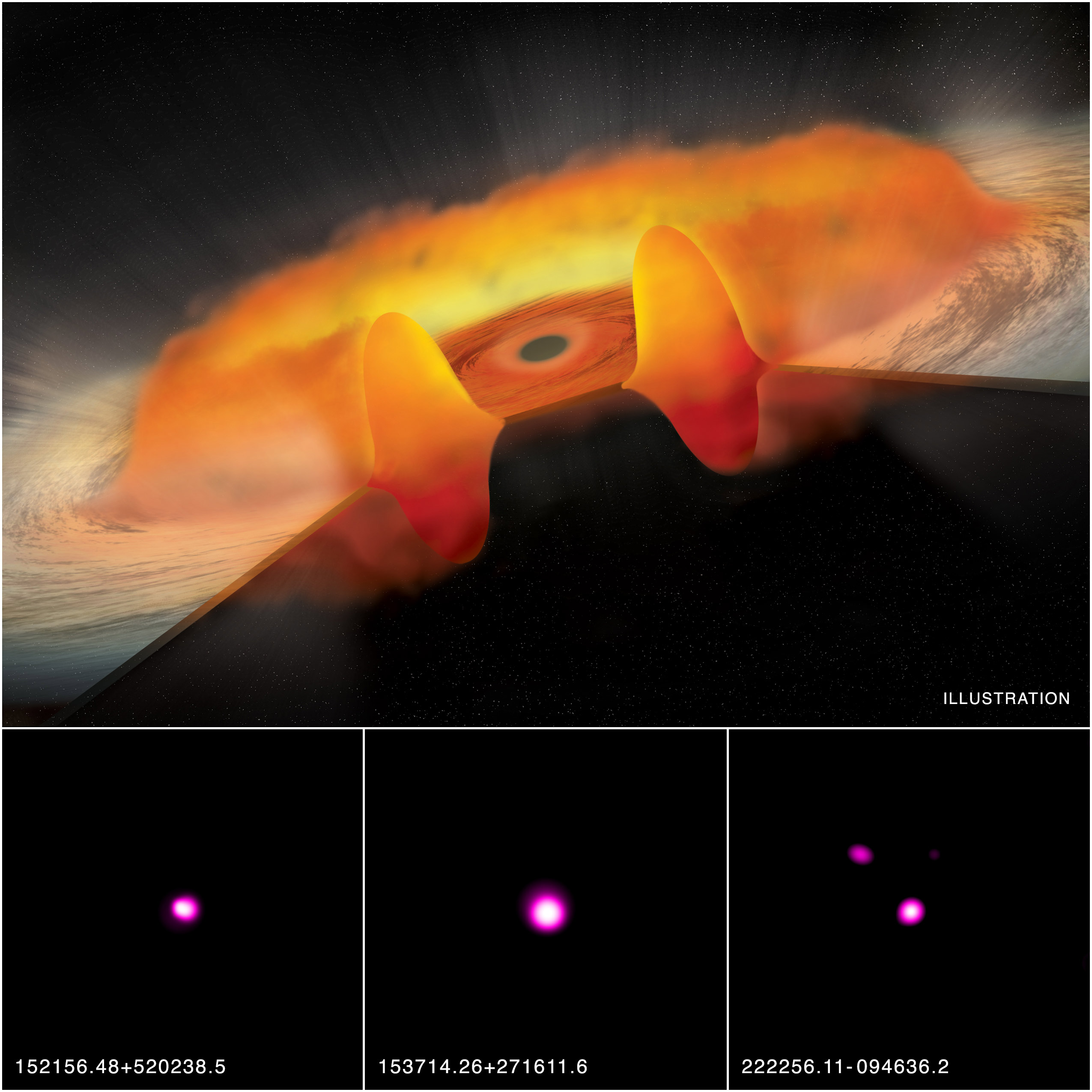
    The artist’s illustration at the top shows X-rays blocked near the black hole, making the quasar faint in X-rays and causing fainter ultraviolet emission from elements like carbon. The three Chandra images of quasars at the bottom of the graphic are situated approximately 5 billion to 11.5 billion light-years away from Earth. These quasars were selected for the study due to their remarkable lack of emission of specific atoms, especially carbon, at ultraviolet wavelengths. Credit: X-ray: NASA/CXC/Penn State/B.Luo et al.; Illustration: NASA/CXC/M.Weiss

    New research from NASA’s Chandra X-ray Observatory reveals the existence of a population of black holes that is consuming extremely large amounts of material, possibly allowing the black holes in these quasars to grow at an extraordinarily rapid rate.

    Astronomers have studied 51 quasars with NASA’s Chandra X-ray Observatory and found they may represent an unusual population of black holes that consume excessive amounts of matter, as described in our latest press release. Quasars are objects that have supermassive black holes that also shine very brightly in different types of light. By examining the X-ray properties with Chandra, and combining them with data from ultraviolet and visible light observations, scientists are trying to determine exactly how these large black holes grow so quickly in the early Universe.

    The quasars in this study – including the three shown as Chandra images in the bottom of the graphic – are located between about 5 billion and 11.5 billion light-years from Earth. These quasars were selected because they had unusually weak emission from certain atoms, especially carbon, at ultraviolet wavelengths. Also, about 65% of the quasars in this new study were found to be much fainter in X-rays, by about 40 times on average, than typical quasars.

    The weak ultraviolet atomic emission and X-ray fluxes from these objects could be an important clue to the question of how a supermassive black hole pulls in matter. Computer simulations show that, at low inflow rates, matter swirls toward the black hole in a thin disk. However, if the rate of inflow is high, the disk can puff up dramatically into a torus or donut that surrounds the inner part of the disk.

    This is shown in the artist’s illustration in the top part of the main graphic. X-rays, produced in the white region very near to the black hole, are substantially blocked by the thick, donut-shaped part of the disk, making the quasar unusually faint in X-rays. The X-rays are also prevented from striking the particles that are being blown away from the outer parts of the disk in a wind. This results in fainter ultraviolet emission from elements like carbon.

    The important implication is that these “thick-disk” quasars may harbor black holes growing at an extraordinarily rapid rate. The current study and previous ones by different teams suggest that such quasars might have been more common in the early Universe, only about a billion years after the Big Bang. Such rapid growth might also explain the existence of huge black holes at even earlier times.

    A paper describing these results appears in an upcoming issue of The Astrophysical Journal and is available online. The authors are Bin Luo (Penn State University), Niel Brandt (Penn State), Patrick Hall (York University), Jianfeng Wu (Harvard-Smithsonian Center for Astrophysics), Scott Anderson (University of Washington), Gordon Garmire (Penn State), Robert Gibson (University of Washington), Richard Plotkin (University of Michigan), Gordon Richards (Drexel University), Don Schneider (Penn State), Ohad Shemmer (University of North Texas), and Yue Shen (Carnegie Observatories).

    NASA’s Marshall Space Flight Center in Huntsville, Alabama, manages the Chandra program for the agency’s Science Mission Directorate in Washington. The Smithsonian Astrophysical Observatory in Cambridge, Massachusetts, controls Chandra’s science and flight operations.

    Reference: “X-ray Insights into the Nature of PHL 1811 Analogs and Weak Emission-Line Quasars: Unification with a Geometrically Thick Accretion Disk?” by B. Luo, W. N. Brandt, P. B. Hall, Jianfeng Wu, S. F. Anderson, G. P. Garmire, R. R. Gibson, R. M. Plotkin, G. T. Richards, D. P. Schneider, O. Shemmer and Yue Shen, 28 May 2015, The Astrophysical Journal.
    DOI: 10.1088/0004-637X/805/2/122
    arXiv: 1503.02085

    Never miss a breakthrough: Join the SciTechDaily newsletter.
    Follow us on Google and Google News.

    Astronomy Astrophysics Black Hole Chandra X-ray Observatory Popular Pulsars
    Share. Facebook Twitter Pinterest LinkedIn Email Reddit

    Related Articles

    The Hunt for the Gravitational Wave Background: NASA’s FERMI Searches for Ripples in Spacetime

    Feasting Black Holes Caught in Galactic Spiderweb

    “Mini” Monster Black Hole Discovery May Provide Clues to Astonishing Supermassive Growth

    Astronomers Spy Quartet of Enormous Cavities From Giant Black Holes

    Astronomers Use “X-Ray Magnifying Glass” To Enhance View of Distant Black Holes

    Astronomers Spot Unusual, Enormous Rings Around a Black Hole

    World’s Most Powerful Telescopes Unite in Unprecedented Observations of Famous Black Hole

    Massive X-ray Jet – Extending for 160,000 Light-Years – Spied From Supermassive Black Hole in Early Universe

    Deepening Astronomical Mystery: On the Hunt for a Missing Giant Black Hole

    Leave A Reply Cancel Reply

    • Facebook
    • Twitter
    • Pinterest
    • YouTube

    Don't Miss a Discovery

    Subscribe for the Latest in Science & Tech!

    Trending News

    Scientists Discover 132-Million-Year-Old Dinosaur Tracks on South Africa’s Coast

    Scientists Uncover the Secret Ingredient Behind the Spark That May Have Started Life on Earth

    Physicists Observe Matter in Two Places at Once in Mind-Bending Quantum Experiment

    Stanford Scientists Discover Hidden Brain Circuit That Fuels Chronic Pain

    New Study Reveals Why Ozempic Works Better for Some People Than Others

    Climate Change Is Altering a Key Greenhouse Gas in a Way Scientists Didn’t Expect

    New Study Suggests Gravitational Waves May Have Created Dark Matter

    Scientists Discover Why the Brain Gets Stuck in Schizophrenia

    Follow SciTechDaily
    • Facebook
    • Twitter
    • YouTube
    • Pinterest
    • Newsletter
    • RSS
    SciTech News
    • Biology News
    • Chemistry News
    • Earth News
    • Health News
    • Physics News
    • Science News
    • Space News
    • Technology News
    Recent Posts
    • Groundbreaking Enzyme Atlas Rewrites Decades of Biology Research
    • New “Nanozyme Hypothesis” Could Rewrite the Story of Life’s Origins
    • Anatomy Isn’t Finished: The Human Body Still Holds Secrets
    • Researchers Discover Long-Lost Words of Ancient Greek Philosopher After 2,000 Years
    • New Study Warns: Asia’s Lifeline Water Source Is Rapidly Draining
    Copyright © 1998 - 2026 SciTechDaily. All Rights Reserved.
    • Science News
    • About
    • Contact
    • Editorial Board
    • Privacy Policy
    • Terms of Use

    Type above and press Enter to search. Press Esc to cancel.