
Close Menu
    Facebook X (Twitter) Instagram
    SciTechDaily
    • Biology
    • Chemistry
    • Earth
    • Health
    • Physics
    • Science
    • Space
    • Technology
    Facebook X (Twitter) Pinterest YouTube RSS
    SciTechDaily
    Home»Space»Chandra Reveals Pulsar Punching Hole in Stellar Disk
    Space

    Chandra Reveals Pulsar Punching Hole in Stellar Disk

    By Janet Anderson, Marshall Space Flight CenterJuly 23, 2015No Comments4 Mins Read
    Facebook Twitter Pinterest Telegram LinkedIn WhatsApp Email Reddit
    Share
    Facebook Twitter LinkedIn Pinterest Telegram Email Reddit
    Chandra Views Pulsar Punching Hole in Stellar Disk
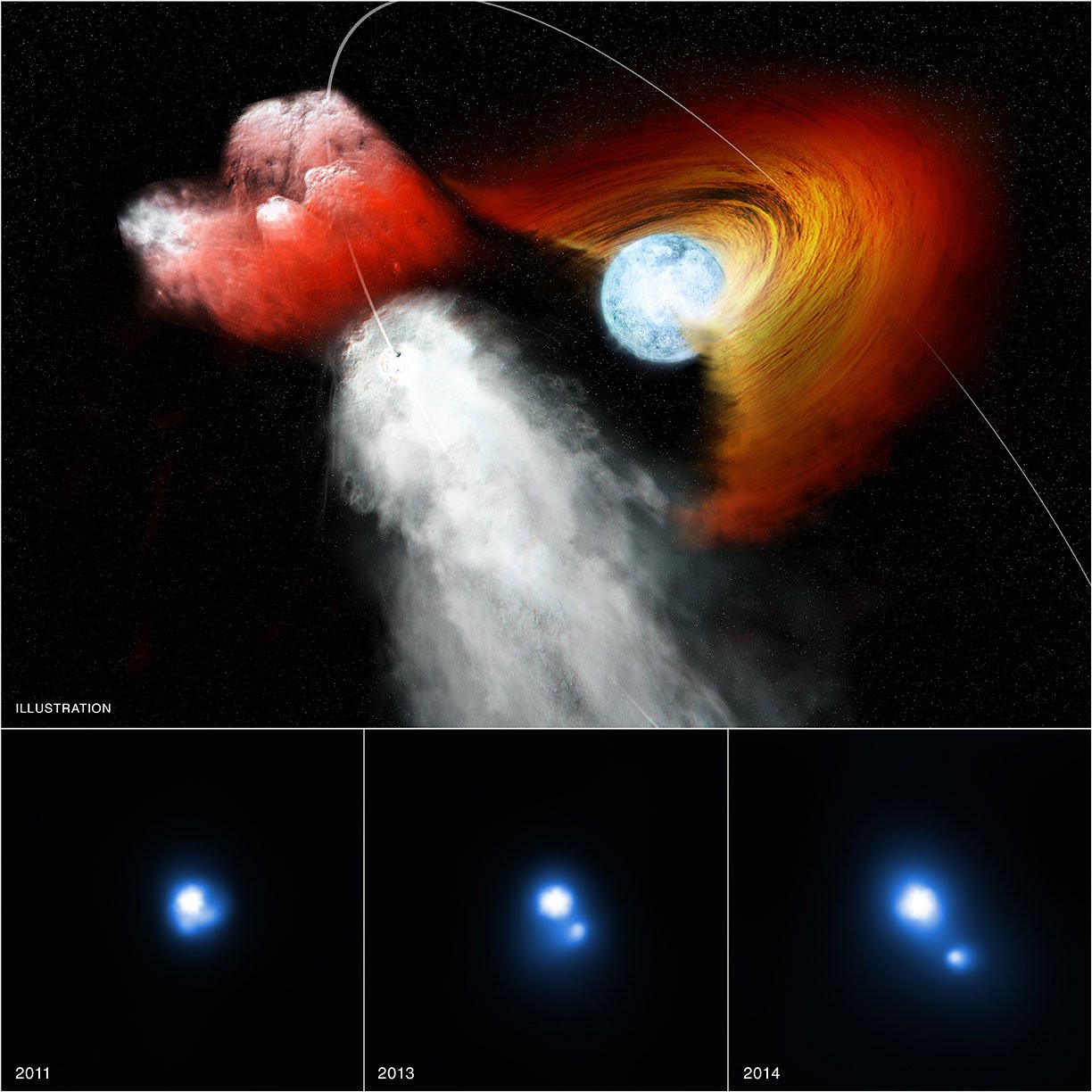
    This trio of images contains evidence from NASA’s Chandra X-ray Observatory that a clump of stellar material has been jettisoned away from a double star system at incredibly high speeds. This system, known as PSR B1259-63/LS 2883 – or B1259 for short – is comprised of two objects in orbit around one another. The first is a star about 30 times as massive as the Sun that has a disk of material swirling around it. The other is a pulsar, an ultra-dense neutron star left behind when an even more massive star underwent a supernova explosion. Credit: NASA/CXC/PSU/G.Pavlov et al

    Data from Chandra reveal that a pulsar in orbit around a massive star punched through a circumstellar disk of material, jettisoning a clump of material from the double star system at incredibly high speeds.

    A fast-moving pulsar appears to have punched a hole in a disk of gas around its companion star and launched a fragment of the disk outward at a speed of about 4 million miles (6.4 million kilometers) per hour. NASA’s Chandra X-ray Observatory is tracking this cosmic clump, which appears to be picking up speed as it moves out.

    The double star system PSR B1259-63/LS 2883 – or B1259 for short – contains a star about 30 times as massive as the Sun and a pulsar, an ultra-dense neutron star left behind when an even more massive star underwent a supernova explosion.

    The pulsar emits regular pulses as it spins 20 times a second, and moves in a highly elliptical orbit around its companion star. The combination of rapid rotation and intense magnetic field of the pulsar has generated a strong wind of high-energy particles moving away from the pulsar at near the speed of light.

    The massive companion star, meanwhile, is rotating close to break-up speed and is spinning off a disk of material. As the pulsar makes its closest approach to the star every 41 months, it passes through this disk

    “These two objects are in an unusual cosmic arrangement and have given us a chance to witness something special,” said George Pavlov of Penn State University in State College, Pennsylvania, lead author of a paper describing these results. “As the pulsar moved through the disk, it appears that it punched a clump of material out and flung it away into space.”

    Even though the clump is rather large, spanning a hundred times the size of our Solar System, it is also quite thin. The material in it has the mass equivalent to all the water in the Earth’s oceans.

    “After this clump of stellar material was knocked out, the pulsar’s wind appears to have accelerated it, almost as if it had a rocket attached,” said co-author Oleg Kargaltsev of George Washington University (GWU) in Washington, DC.

    Astronomers observed B1259, which is located about 7,500 light-years from Earth, three times with Chandra between December 2011 and February 2014. These observations show the clump moving away from B1259 at an average speed of about 7% of the speed of light. The data also indicate that the clump has been accelerated to 15% of the speed of light between the second and third observations.

    “This just shows how powerful the wind blasting off a pulsar can be,” said co-author Jeremy Hare, also of GWU. “The pulsar’s wind is so strong that it could ultimately eviscerate the entire disk around its companion star over time.”

    The X-ray emission observed by Chandra is likely produced by a shock wave created as the pulsar’s wind rams into the clump of material. The ram pressure generated by this interaction could also accelerate the clump.

    Chandra will continue monitoring B1259 and its moving clump with observations scheduled for later this year and in 2016.

    Reference: “An extended X-ray object ejected from the PSR B1259-63/LS 2883 binary” by George G. Pavlov, Jeremy Hare, Oleg Kargaltsev, Blagoy Rangelov and Martin Durant, 18 June 2015, The Astrophysical Journal.
    DOI: 10.1088/0004-637X/806/2/192
    arXiv: 1505.07155

    Never miss a breakthrough: Join the SciTechDaily newsletter.
    Follow us on Google and Google News.

    Astronomy Astrophysics Chandra X-ray Observatory Pulsars
    Share. Facebook Twitter Pinterest LinkedIn Email Reddit

    Related Articles

    The Cosmic “Hand of God” Just Got Even Stranger

    Over a Million Miles per Hour: NASA’s Chandra Catches Pulsar in X-Ray Speed Trap

    Tiny Star Unleashes Monstrous Beam of Matter and Anti-Matter

    Tiny Star Unleashes Gargantuan Beam of Matter and Anti-Matter That Stretches for 40 Trillion Miles

    Astronomers Detect Young Magnetar in Supernova Remnant, Likely the Slowest Pulsar Ever Discovered

    Chandra Reveals a Pulsar on the Southern Edge the Jellyfish Nebula

    Chandra Reveals Black Holes Gorging at Excessive Rates

    IGR J11014-6103: A Supersonic Pulsar with a Tail 37 Light Years Long

    New Chandra Video Shows the Vela Pulsar in Action

    Leave A Reply Cancel Reply

    • Facebook
    • Twitter
    • Pinterest
    • YouTube

    Don't Miss a Discovery

    Subscribe for the Latest in Science & Tech!

    Trending News

    Enormous Prehistoric Insects Puzzle Scientists

    Scientists Develop Bioengineered Chewing Gum That Could Help Fight Oral Cancer

    After 37 Years, the World’s Longest-Running Soil Warming Experiment Uncovers a Startling Climate Secret

    NASA Satellite Captures First-Ever High-Res View of Massive Pacific Tsunami

    ADHD Isn’t Just a Deficit: Study Reveals Powerful Hidden Strengths

    Scientists Discover Stem Cells That Could Regrow Teeth and Bone

    Early Cannabis Use May Stall Key Brain Skills in Teens

    Popular Vitamin D Supplement Has “Previously Unknown” Negative Effect, Study Finds

    Follow SciTechDaily
    • Facebook
    • Twitter
    • YouTube
    • Pinterest
    • Newsletter
    • RSS
    SciTech News
    • Biology News
    • Chemistry News
    • Earth News
    • Health News
    • Physics News
    • Science News
    • Space News
    • Technology News
    Recent Posts
    • Darwin’s Islands Still Evolving: Giant Daisies Rewrite the Rules of Evolution
    • Ancient Document Confirms “Legendary” African King Actually Existed
    • First-of-Its-Kind Discovery: Homer’s Iliad Found Embedded in a 1,600-Year-Old Egyptian Mummy
    • Beyond Inflammation: Scientists Uncover New Cause of Persistent Rheumatoid Arthritis
    • Cancer-Like Mutations Found in the Brain May Be Driving Alzheimer’s Disease
    Copyright © 1998 - 2026 SciTechDaily. All Rights Reserved.
    • Science News
    • About
    • Contact
    • Editorial Board
    • Privacy Policy
    • Terms of Use

    Type above and press Enter to search. Press Esc to cancel.