
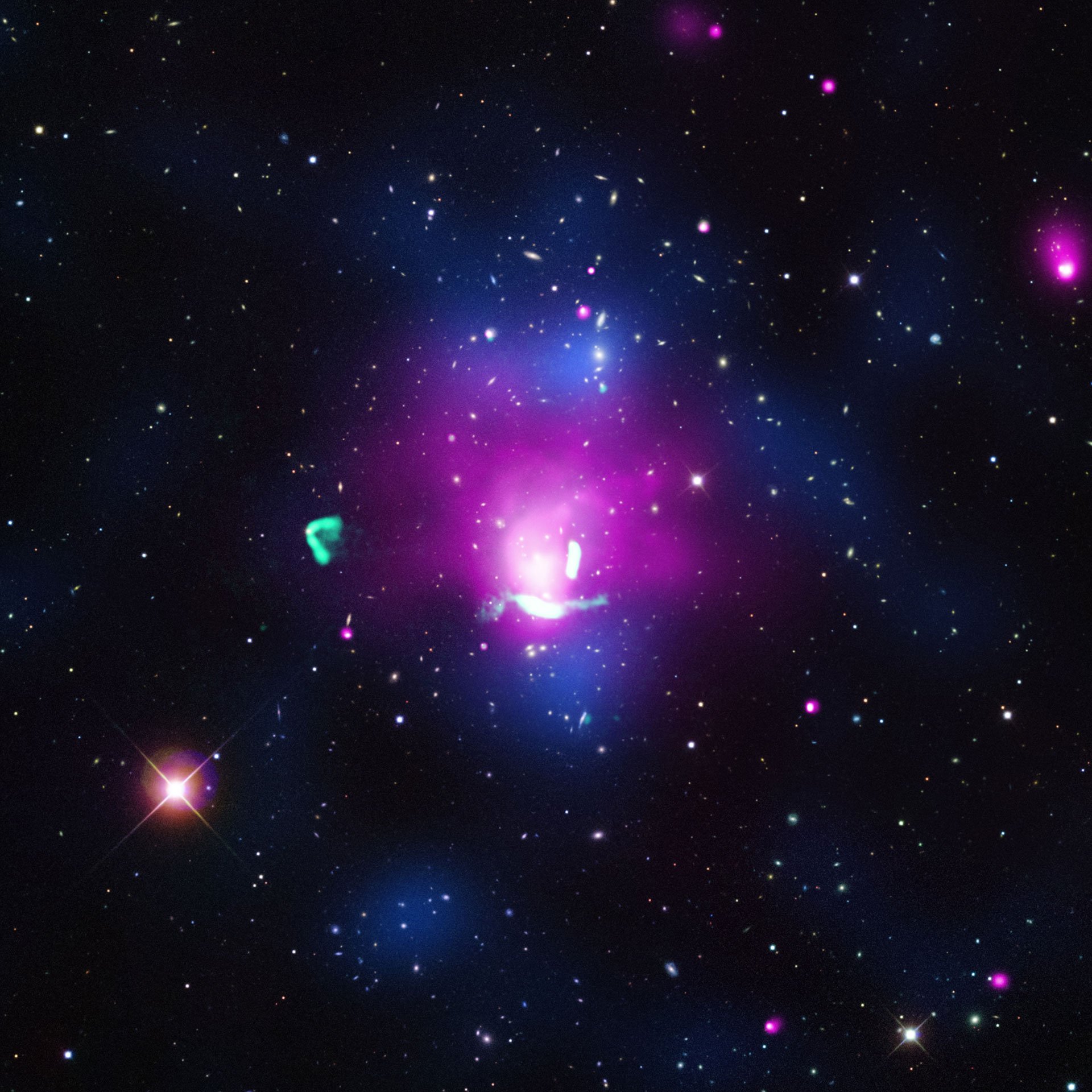
Using X-ray, radio, and optical data, a team of astronomers has discovered a “radio phoenix” in Abell 1033. This system contains the collision of two galaxy clusters located about 1.6 billion light-years from Earth.
Astronomers have found evidence for a faded electron cloud “coming back to life,” much like the mythical phoenix, after two galaxy clusters collided. This “radio phoenix,” so-called because the high-energy electrons radiate primarily at radio frequencies, is found in Abell 1033.
By combining data from NASA’s Chandra X-ray Observatory, the Westerbork Synthesis Radio Telescope in the Netherlands, NSF’s Karl Jansky Very Large Array (VLA), and the Sloan Digital Sky Survey (SDSS), astronomers were able to recreate the scientific narrative behind this intriguing cosmic story of the radio phoenix.
Galaxy clusters are the largest structures in the Universe held together by gravity. They consist of hundreds or even thousands of individual galaxies, unseen dark matter, and huge reservoirs of hot gas that glow in X-ray light. Understanding how clusters grow is critical to tracking how the Universe itself evolves over time.
Astronomers think that the supermassive black hole close to the center of Abell 1033 erupted in the past. Streams of high-energy electrons filled a region hundreds of thousands of light-years across and produced a cloud of bright radio emission. This cloud faded over a period of millions of years as the electrons lost energy and the cloud expanded.
The radio phoenix emerged when another cluster of galaxies slammed into the original cluster, sending shock waves through the system. These shock waves, similar to sonic booms produced by supersonic jets, passed through the dormant cloud of electrons. The shock waves compressed the cloud and re-energized the electrons, which caused the cloud to once again shine at radio frequencies.
A new portrait of this radio phoenix is captured in this multiwavelength image of Abell 1033. X-rays from Chandra are in pink and radio data from the VLA are colored green. The background image shows optical observations from the SDSS. A map of the density of galaxies, made from the analysis of optical data, is seen in blue. Mouse over the image to see the location of the radio phoenix.
The Chandra data show hot gas in the clusters, which seems to have been disturbed during the same collision that caused the re-ignition of radio emission in the system. The peak of the X-ray emission is seen to the south (bottom) of the cluster, perhaps because the dense core of gas in the south is being stripped away by surrounding gas as it moves. The cluster in the north may not have entered the collision with a dense core, or perhaps its core was significantly disrupted during the merger. On the left side of the image, a so-called wide-angle tail radio galaxy shines in the radio. The lobes of plasma ejected by the supermassive black hole in its center are bent by the interaction with the cluster gas as the galaxy moves through it.
Astronomers think they are seeing the radio phoenix soon after it had reborn, since these sources fade very quickly when located close to the center of the cluster, as this one is in Abell 1033. Because of the intense density, pressure, and magnetic fields near the center of Abell 1033; a radio phoenix is only expected to last a few tens of millions of years.
A paper describing these results was published in a recent issue of the Monthly Notices of the Royal Astronomical Society. The authors are Francesco de Gasperin from the University of Hamburg, Germany; Georgiana Ogrean and Reinout van Weeren from the Harvard-Smithsonian Center for Astrophysics; William Dawson from the Lawrence Livermore National Lab in Livermore, California; Marcus Brüggen and Annalisa Bonafede from the University of Hamburg, Germany, and Aurora Simionescu from the Japan Aerospace Exploration Agency in Sagamihara, Japan.
NASA’s Marshall Space Flight Center in Huntsville, Alabama, manages the Chandra program for NASA’s Science Mission Directorate in Washington. The Smithsonian Astrophysical Observatory in Cambridge, Massachusetts, controls Chandra’s science and flight operations.
Reference: “Abell 1033: birth of a radio phoenix” by F. de Gasperin, G. A. Ogrean, R. J. van Weeren, W. A. Dawson, M. Brüggen, A. Bonafede and A. Simionescu, 26 February 2015, MNRAS.
DOI: 10.1093/mnras/stv129
arXiv: 1501.00043
Never miss a breakthrough: Join the SciTechDaily newsletter.
Follow us on Google and Google News.