
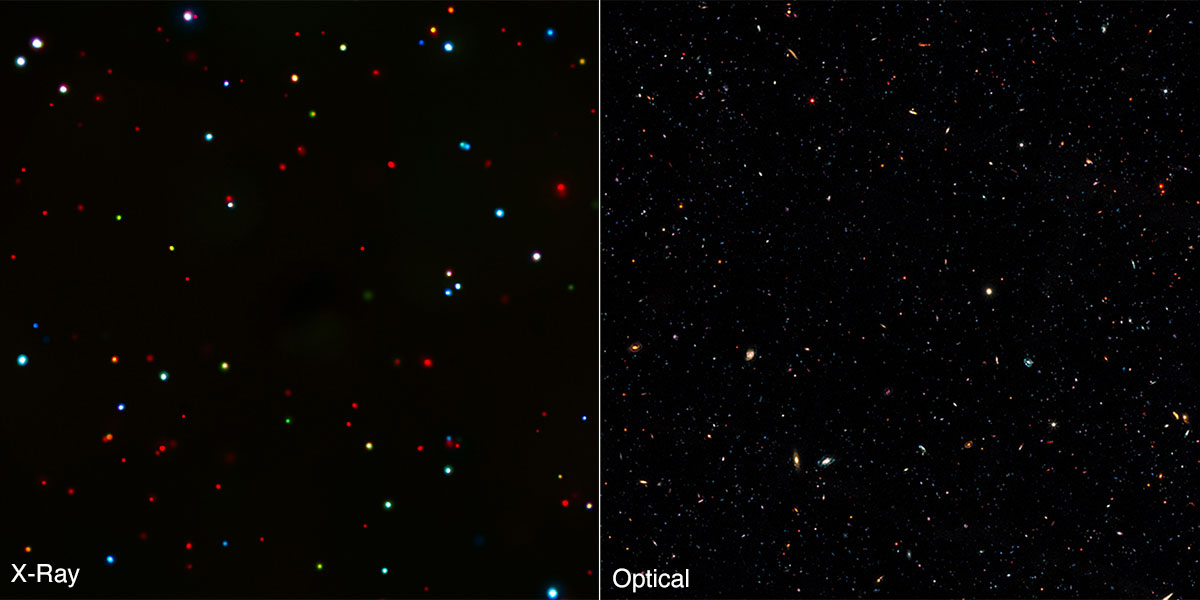
An unparalleled image from NASA’s Chandra X-ray Observatory gives astronomers the best look yet at the growth of black holes over billions of years beginning soon after the Big Bang.
This is the deepest X-ray image ever obtained, made with over 7 million seconds of observing time with NASA’s Chandra X-ray Observatory. These data give astronomers the best look yet at the growth of black holes over billions of years beginning soon after the Big Bang, as described in our latest press release.
The image is from the Chandra Deep Field-South, or CDF-S. The full CDF-S field covers an approximately circular region on the sky with an area about two-thirds that of the full Moon. However, the outer regions of the image, where the sensitivity to X-ray emission is lower, are not shown here. The colors in this image represent different levels of X-ray energy detected by Chandra. Here the lowest-energy X-rays are red, the medium band is green, and the highest-energy X-rays observed by Chandra are blue.
The central region of this image contains the highest concentration of supermassive black holes ever seen, equivalent to about 5,000 objects that would fit into the area of the full Moon and about a billion over the entire sky.
Researchers used the CDF-S data in combination with data from the Cosmic Assembly Near-Infrared Deep Extragalactic Legacy Survey (CANDELS) and the Great Observatories Origins Deep Survey (GOODS), both including data from NASA’s Hubble Space Telescope to study galaxies and black holes between one and two billion years after the Big Bang.
In one part of the study, the team looked at the X-ray emission from galaxies detected in the Hubble images, at distances between 11.9 and 12.9 billion light-years from Earth. About 50 of these distant galaxies were individually detected with Chandra. The team then used a technique called X-ray stacking to investigate X-ray emission from the 2,076 distant galaxies that were not individually detected. They added up all the X-ray counts near the positions of these galaxies, enabling much greater sensitivity to be obtained. Through stacking the team were able to achieve equivalent exposure times up to about 8 billion seconds, equivalent to about 260 years.
Using these data, the team found evidence that black holes in the early Universe grow mostly in bursts, rather than via the slow accumulation of matter. The team may have also found hints about the types of seeds that form supermassive black holes. If supermassive black holes are born as “light” seeds weighing about 100 times the Sun’s mass, the growth rate required to reach a mass of about a billion times the Sun in the early Universe may be so high that it challenges current models for such growth. If supermassive black holes are born with more mass, the required growth rate is not as high. The data in the CDF-S suggest that the seeds for supermassive black holes may be “heavy” with masses about 10,000 to 100,000 times that of the Sun.
Such deep X-ray data like those in the CDF-S provide useful insights for understanding the physical properties of the first supermassive black holes. The relative number of luminous and faint objects — in what astronomers call the shape of the “luminosity function” — depends on the mixture of the several physical quantities involved in black hole growth, including the mass of the black hole seeds and the rate at which they are pulling in material. The CDF-S data show a rather “flat” luminosity function (i.e., a relatively large number of bright objects) that can be used to infer possible combinations of these physical quantities. However, definitive results can only come from further observations.
The paper on black hole growth in the early Universe was led by Fabio Vito of Pennsylvania State University in University Park, Penn, and was published in an August 10th, 2016 issue of the Monthly Notices of the Royal Astronomical Society. It is available online [https://arxiv.org/abs/1608.02614]. The survey paper was led by Bin Luo, also of Penn State, and was recently accepted for publication in The Astrophysical Journal Supplement Series. It is also available online [https://arxiv.org/abs/1611.03501]
References:
“The deepest X-ray view of high-redshift galaxies: constraints on low-rate black-hole accretion” by Fabio Vito, Roberto Gilli, Cristian Vignali, William N. Brandt, Andrea Comastri, Guang Yang, Bret D. Lehmer, Bin Luo, Antara Basu-Zych, Franz E. Bauer, Nico Cappelluti, Anton Koekemoer, Vincenzo Mainieri, Maurizio Paolillo, Piero Ranalli, Ohad Shemmer, Jonathan Trump, Junxian Wang and Yongquan Xue, 10 August 2016, MNRAS.
DOI: 10.1093/mnras/stw1998
arXiv: 1608.02614
“The Chandra Deep Field-South Survey: 7 Ms Source Catalogs” by B. Luo, W. N. Brandt, Y. Q. Xue, B. Lehmer, D. M. Alexander, F. E. Bauer, F. Vito, G. Yang, A. R. Basu-Zych, A. Comastri, R. Gilli, Q.-S. Gu, A. E. Hornschemeier, A. Koekemoer, T. Liu, V. Mainieri, M. Paolillo, P. Ranalli, P. Rosati, D. P. Schneider, O. Shemmer, I. Smail, M. Sun, P. Tozzi, C. Vignali and J.-X. Wang, 27 December 2016, The Astrophysical Journal.
DOI: 10.3847/1538-4365/228/1/2
arXiv: 1611.03501
Never miss a breakthrough: Join the SciTechDaily newsletter.
Follow us on Google and Google News.
1 Comment
Where are these smbhs? Distance?
Do they account for any dark matter?