
Close Menu
    Facebook X (Twitter) Instagram
    SciTechDaily
    • Biology
    • Chemistry
    • Earth
    • Health
    • Physics
    • Science
    • Space
    • Technology
    Facebook X (Twitter) Pinterest YouTube RSS
    SciTechDaily
    Home»Space»New NASA Mission to Study Black Holes, Cosmic X-ray Mysteries
    Space

    New NASA Mission to Study Black Holes, Cosmic X-ray Mysteries

    By Felicia Chou, NASAJanuary 5, 2017No Comments2 Mins Read
    Facebook Twitter Pinterest Telegram LinkedIn WhatsApp Email Reddit
    Share
    Facebook Twitter LinkedIn Pinterest Telegram Email Reddit
    NASA Selects Mission to Study Black Holes, Cosmic X-ray Mysteries
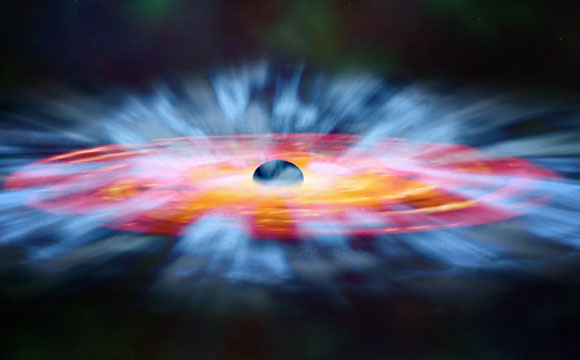
    Artist’s illustration of a black hole and cosmic X-ray.

    A new NASA mission will allow astronomers to explore the hidden details of some of the most extreme and exotic astronomical objects, such as stellar and supermassive black holes, neutron stars, and pulsars.

    Objects such as black holes can heat surrounding gases to more than a million degrees. The high-energy X-ray radiation from this gas can be polarized – vibrating in a particular direction. The Imaging X-ray Polarimetry Explorer (IXPE) mission will fly three space telescopes with cameras capable of measuring the polarization of these cosmic X-rays, allowing scientists to answer fundamental questions about these turbulent and extreme environments where gravitational, electric, and magnetic fields are at their limits.

    “We cannot directly image what’s going on near objects like black holes and neutron stars, but studying the polarization of X-rays emitted from their surrounding environments reveals the physics of these enigmatic objects,” said Paul Hertz, astrophysics division director for the Science Mission Directorate at NASA Headquarters in Washington. “NASA has a great history of launching observatories in the Astrophysics Explorers Program with new and unique observational capabilities. IXPE will open a new window on the universe for astronomers to peer through. Today, we can only guess what we will find.”

    NASA’s Astrophysics Explorers Program requested proposals for new missions in September 2014. Fourteen proposals were submitted, and three mission concepts were selected for additional review by a panel of agency and external scientists. NASA determined the IXPE proposal provided the best science potential and most feasible development plan.

    The mission, slated for launch in 2020, will cost $188 million. This figure includes the cost of the launch vehicle and post-launch operations and data analysis. Principal Investigator Martin Weisskopf of NASA’s Marshall Space Flight Center in Huntsville, Alabama, will lead the mission. Ball Aerospace in Broomfield, Colorado, will provide the spacecraft and mission integration. The Italian Space Agency will contribute to the polarization-sensitive X-ray detectors, which were developed in Italy.

    Never miss a breakthrough: Join the SciTechDaily newsletter.
    Follow us on Google and Google News.

    Astronomy Black Hole Cosmology IXPE NASA
    Share. Facebook Twitter Pinterest LinkedIn Email Reddit

    Related Articles

    NASA Cracks 30-Year X-ray Mystery With Blazing Black Hole Light Show

    NASA’s X-Ray Explorer Unveils Black Hole’s Hidden Layers

    Spitzer Provides Astronomers with a New Way to See the Milky Way’s Giant Black Hole

    Astronomers Discover X-Ray Echoes from a Black Hole That Shattered a Passing Star

    Fermi Helps Link Cosmic Neutrino to Blazar Blast

    Astronomers Discover a 17 Billion Solar-Mass Black Hole in an Unlikely Place

    WISE Reveals Most Luminous Galaxy W2246-0526 Is Ripping Itself Apart

    Evidence of Galaxy Star Birth Regulated by Black Holes

    NASA Data Suggests Black Holes Abundant Among the Earliest Stars

    Leave A Reply Cancel Reply

    • Facebook
    • Twitter
    • Pinterest
    • YouTube

    Don't Miss a Discovery

    Subscribe for the Latest in Science & Tech!

    Trending News

    Tyrannosaurus Tooth Found Embedded in Dinosaur Skull Reveals Brutal Prehistoric Attack

    This Supervolcano Is Refilling With Magma After 7,300 Years

    New Study Reveals Hidden Trade-Off in Popular Weight Loss Treatments

    Scientists “Bottle the Sun” With Revolutionary Liquid Battery

    This Ancient Ape Fossil Could Change Where Humans Came From

    This Simple Eating Habit May Help You Lose More Weight

    “Hulk Lizards” Are Wiping Out Millions of Years of Evolution

    Vitamin B2’s Dark Side: The Nutrient That May Help Cancer Cells Survive

    Follow SciTechDaily
    • Facebook
    • Twitter
    • YouTube
    • Pinterest
    • Newsletter
    • RSS
    SciTech News
    • Biology News
    • Chemistry News
    • Earth News
    • Health News
    • Physics News
    • Science News
    • Space News
    • Technology News
    Recent Posts
    • Antarctica’s Ancient Ice Cycles Once Controlled Life in Distant Oceans
    • Warming Waters Are Supercharging an Invasive Predator in Alaska
    • The Mediterranean Isn’t Safe: Scientists Warn of Inevitable Tsunami
    • This Deadly Parasite Stays Invisible by Shredding Its Own Genes
    • Researchers Uncover Hidden Genetic World Beneath Antarctic Seas
    Copyright © 1998 - 2026 SciTechDaily. All Rights Reserved.
    • Science News
    • About
    • Contact
    • Editorial Board
    • Privacy Policy
    • Terms of Use

    Type above and press Enter to search. Press Esc to cancel.