
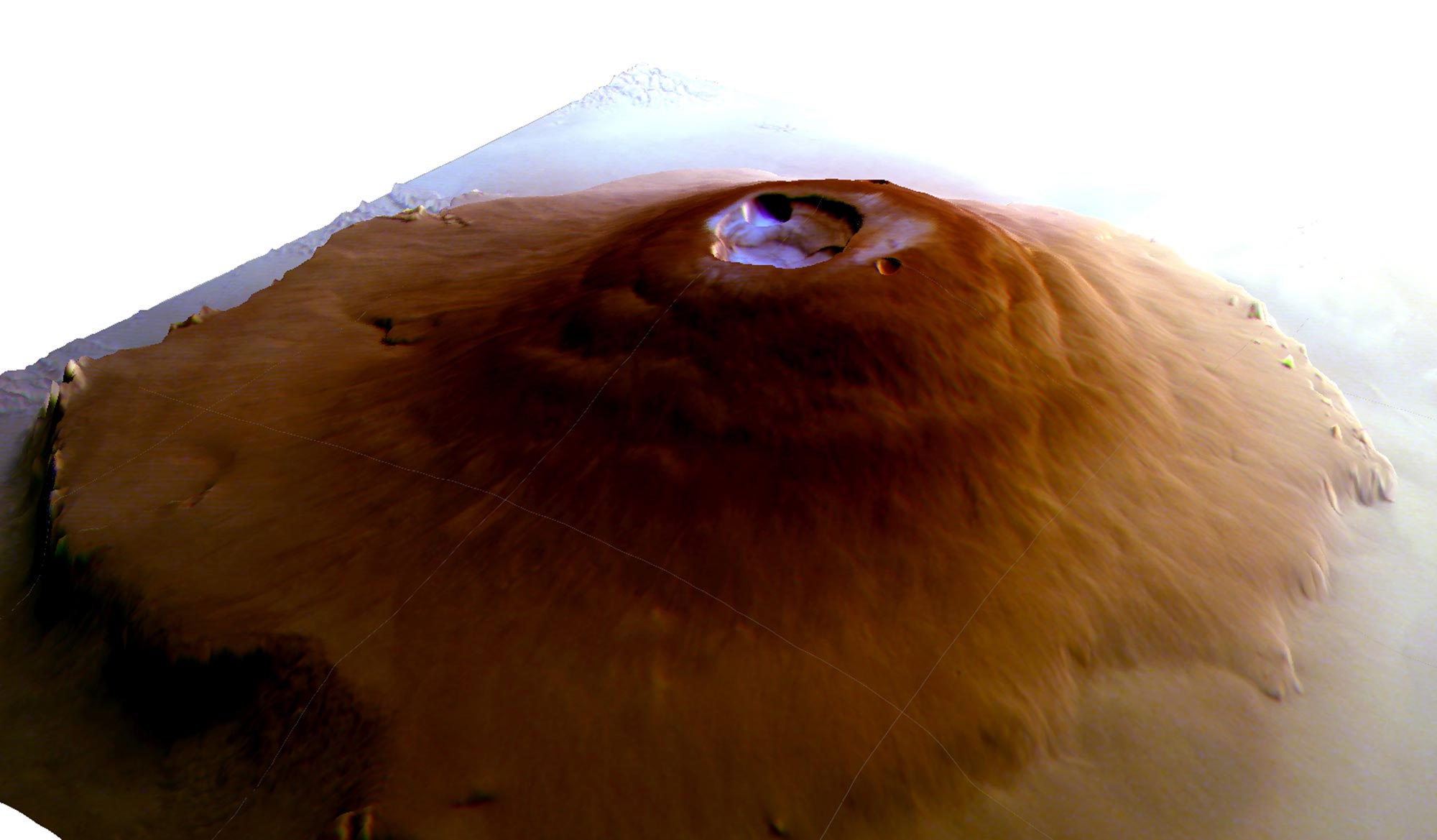
Frost detected on Mars’ equatorial volcanoes suggests unexpected climate dynamics and ancient weather patterns, offering insights into the planet’s water cycle and atmospheric conditions essential for future Mars missions.
An international team of planetary scientists has detected patches of water frost sitting atop the Tharsis volcanoes on Mars, which are not only the tallest volcanic mountains on the Red Planet but in the entire solar system.
The discovery marks the first time frost has been spotted near the planet’s equator, challenging existing perceptions of the planet’s climate dynamics, according to the team’s new study published today (June 10) in Nature Geoscience.
“We thought it was improbable for frost to form around Mars’ equator, as the mix of sunshine and thin atmosphere keeps temperatures during the day relatively high at both the surface and mountaintop — unlike what we see on Earth, where you might expect to see frosty peaks,” said Adomas Valantinas, a postdoctoral fellow at Brown University who led the work as a Ph.D. student at the University of Bern. “What we’re seeing may be a remnant of an ancient climate cycle on modern Mars, where you had precipitation and maybe even snowfall on these volcanoes in the past.”
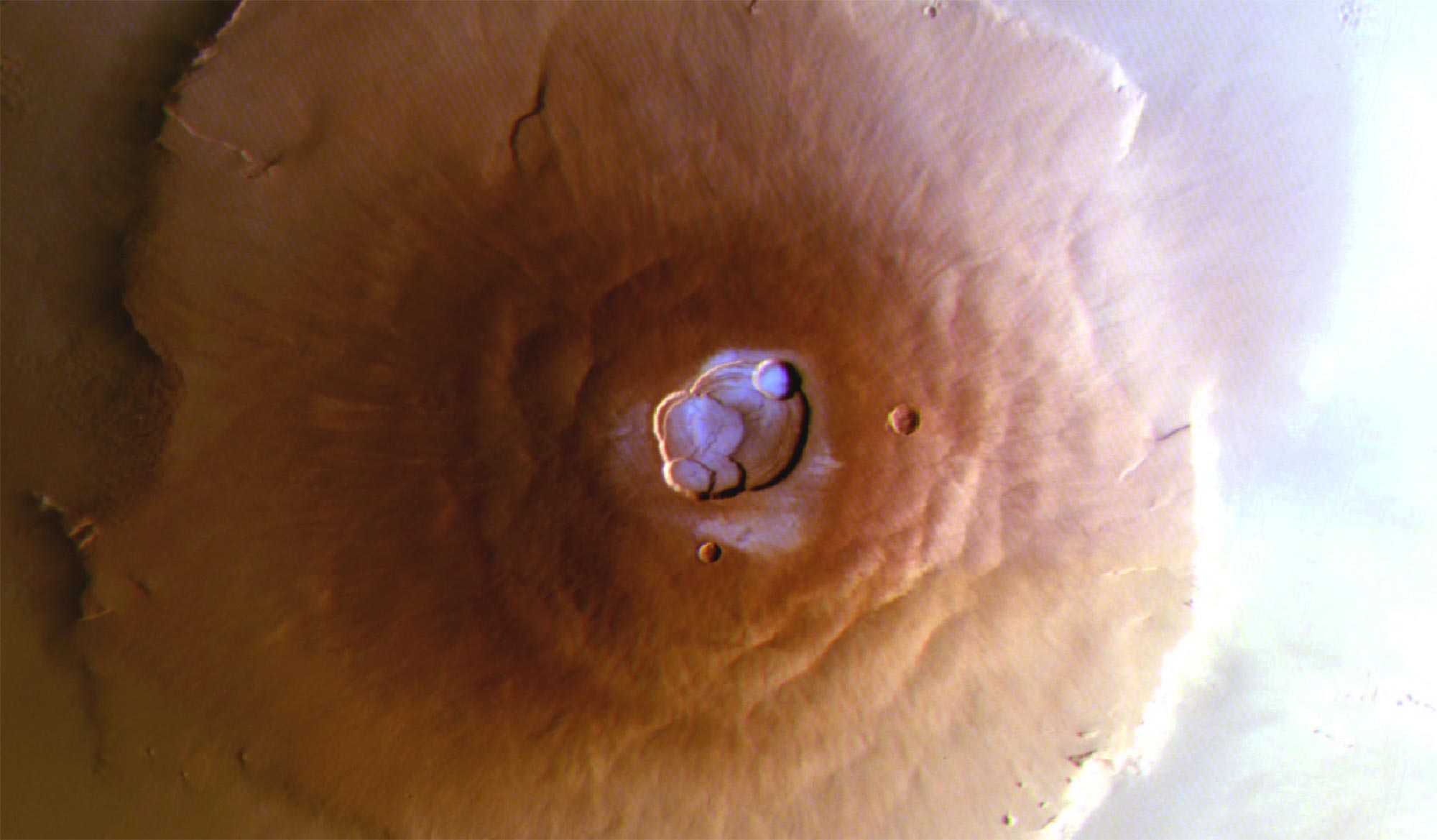
According to the study, the frost is present for only a few hours after sunrise before it evaporates in sunlight. The frost is also incredibly thin — likely only one-hundredth of a millimeter thick or about the width of a human hair. Still, it’s quite vast. The researchers calculate the frost constitutes at least 150,000 tons of water that swaps between the surface and atmosphere each day during the cold seasons. That’s the equivalent of roughly 60 Olympic-size swimming pools.
Tharsis, the region of Mars where the frost was found, hosts numerous volcanoes. They tower above the surrounding plains at heights ranging from one to two times that of Earth’s Mount Everest. Olympus Mons, for instance, is as wide as France.
The frost sits in the calderas of the volcanoes, which are large hollows at their summits created during past eruptions. The researchers propose that the way the air circulates above these mountains creates a unique microclimate that allows the thin patches of frost to form.
The researchers believe modeling how the frosts form could allow scientists to reveal more of Mars’ remaining secrets, including understanding where water exists and how it moves, as well as understanding the planet’s complex atmospheric dynamics, which is essential for future exploration and the search for possible signs of life.
The researchers detected the frost using high-resolution color images from the Colour and Stereo Surface Imaging System (CaSSIS) onboard the European Space Agency’s Trace Gas Orbiter. The findings were then validated using independent observations from the High Resolution Stereo Camera onboard the ESA’s Mars Express orbiter and by the Nadir and Occultation for Mars Discovery spectrometer onboard the Trace Gas Orbiter.
The effort involved analyzing over 30,000 images to both initially find the frost and then confirm its existence. Valantinas filtered the images based on where they were acquired as well as when they were acquired, like the time of day and the season. The meticulous approach helped isolate spectral signatures indicative of water frost and where it formed on the Martian surface.
Valantinas started analyzing the images in 2018. The majority of work was completed while earning his Ph.D. abroad but a portion of the reanalysis was completed while at Brown.
Transitioning to his role at Brown, Valantinas now plans to continue his exploration of Martian mysteries while pivoting to astrobiology. Working in the lab of Brown planetary scientist Jack Mustard, he’ll work toward characterizing ancient hydrothermal environments that could have supported microbial life. Samples from these environments may one day be brought back to Earth by the NASA-lead Mars Sample Return mission.
“This notion of a second genesis, of life beyond Earth, has always fascinated me,” Valantinas said.
Reference: “Evidence for transient morning water frost deposits on the Tharsis volcanoes of Mars” by A. Valantinas, N. Thomas, A. Pommerol, O. Karatekin, L. Ruiz Lozano, C. B. Senel, O. Temel, E. Hauber, D. Tirsch, V. T. Bickel, G. Munaretto, M. Pajola, F. Oliva, F. Schmidt, I. Thomas, A. S. McEwen, M. Almeida, M. Read, V. G. Rangarajan, M. R. El-Maarry, C. Re, F. G. Carrozzo, E. D’Aversa, F. Daerden, B. Ristic, M. R. Patel, G. Bellucci, J. J. Lopez-Moreno, A. C. Vandaele and G. Cremonese, 10 June 2024, Nature Geoscience.
DOI: 10.1038/s41561-024-01457-7
Never miss a breakthrough: Join the SciTechDaily newsletter.
Follow us on Google and Google News.