
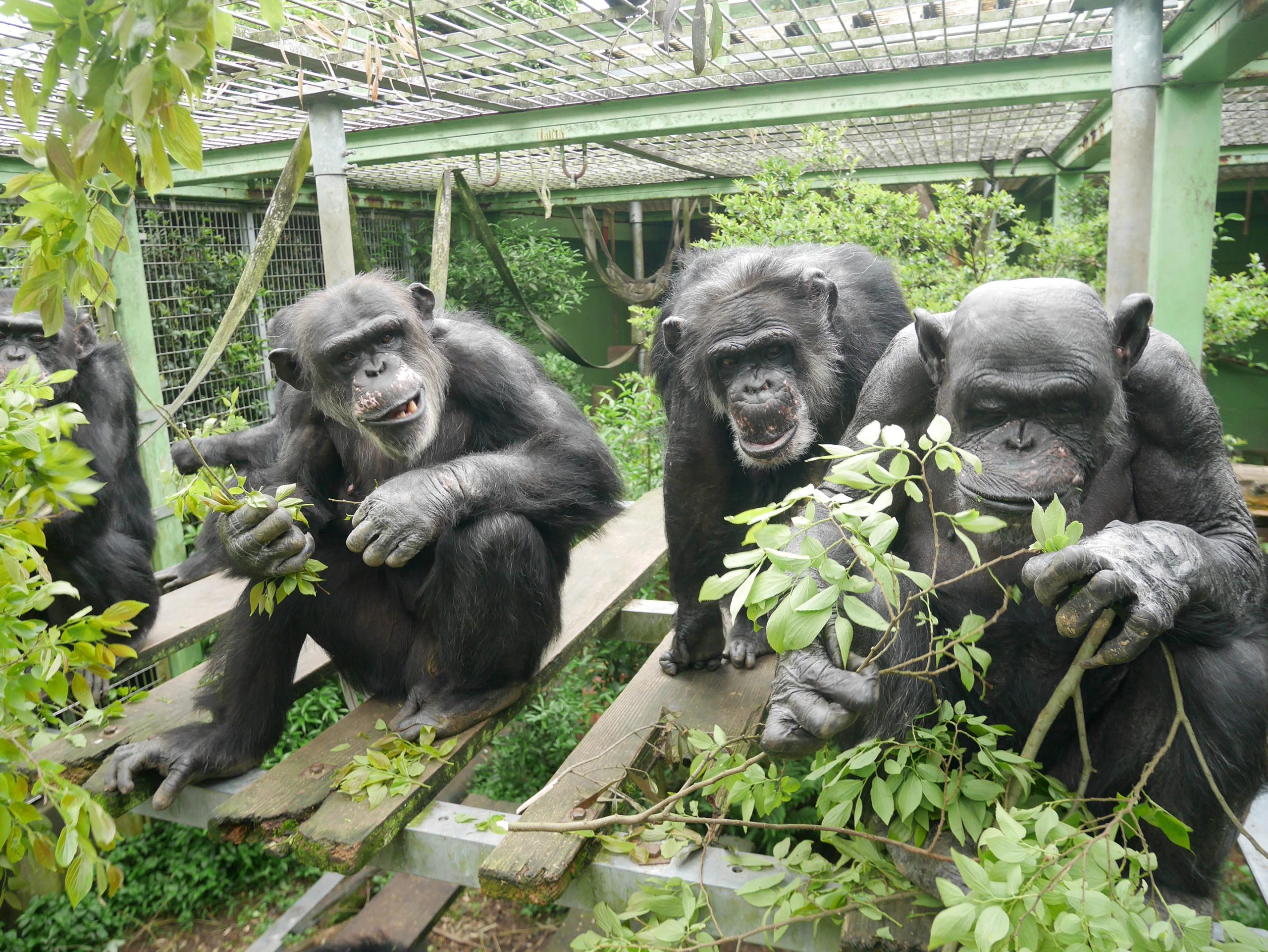
A new study has found that chimpanzees are more likely to urinate after observing a fellow chimp do so, particularly if they are lower in the social hierarchy.
This discovery suggests that this behavior, much like contagious yawning, might play a significant role in social interactions and group dynamics.
Contagious Urination in Chimpanzees
A new study published today (January 20) in the journal Current Biology is the first to identify a behavior researchers call “contagious urination.” The study, conducted on 20 captive chimpanzees at the Kumamoto Sanctuary in Japan, found that when one chimp urinates, others are more likely to do the same.
“In humans, urinating together can be seen as a social phenomenon,” says Ena Onishi of Kyoto University.
She points out that cultural references to group urination exist worldwide. For example, “an Italian proverb states, ‘Whoever doesn’t pee in company is either a thief or a spy’ (Chi non piscia in compagnia o è un ladro o è una spia), while in Japanese, the act of urinating with others is referred to as ‘Tsureshon’ (連れション). This behavior is represented in art across centuries and cultures and continues to appear in modern social contexts.
“Our research suggests that this phenomenon may have deep evolutionary roots. We found that chimpanzees, our closest relatives, tend to urinate in response to the urination of nearby individuals.”
Observational Study and Initial Findings
The researchers decided to study this behavior after noticing that the sanctuary chimpanzees seemed to pee at about the same time. It reminded them of human behavior, and they wondered whether it might be comparable to contagious yawning. To find out, they documented peeing behaviors in the Kumamoto chimpanzees over more than 600 hours, including 1,328 urination events. They analyzed the observational data to see whether peeing among the chimpanzees was significantly synchronized in time. They also explored whether it was influenced by nearby individuals or shaped by social factors.
The evidence showed that urination events were significantly more synchronized during observations than would be expected if the chimpanzees were simply peeing at random times with respect to one another. The likelihood of contagious urination also increased with physical proximity to the initial urinator, they report. Interestingly, individuals with lower dominance ranks were more likely to pee when others were peeing. The finding suggests that urination patterns are influenced by social hierarchy, with a tendency for the behavior to “flow down” the dominance structure, the researchers say.
Impact of Social Hierarchy on Behavior
“We were surprised to discover that the contagion pattern was influenced by social rank,” Onishi says. “Since there were no prior studies on contagious urination in any species, we drew parallels to contagious yawning, another semi-voluntary physiological behavior. Based on this, we initially expected that any social influences might resemble those seen in yawning—such as stronger contagion between socially close pairs. However, our results showed no evidence of effects related to social closeness. Instead, we observed a clear influence of social rank, with lower-ranking individuals being more likely to follow the urination of others.”
“This was an unexpected and fascinating result, as it opens up multiple possibilities for interpretation,” Shinya Yamamoto, also of Kyoto University, adds. “For instance, it could reflect hidden leadership in synchronizing group activities, the reinforcement of social bonds, or attention bias among lower-ranking individuals. These findings raise intriguing questions about the social functions of this behavior.”
Implications and Future Research Directions
The findings may have important implications for understanding and exploring the role of this behavior in maintaining group cohesion, facilitating coordination, or reinforcing social bonds within the group, according to the researchers. It reveals how this seemingly mundane and necessary behavior might be of overlooked social significance.
The researchers say more study is needed to understand the specific functions and mechanisms underlying contagious urination in chimpanzees. They’re also curious to know whether this phenomenon exists in other species.
Reference: “Socially contagious urination in chimpanzees” by Ena Onishi, James Brooks, Sota Inoue and Shinya Yamamoto, 20 January 2025, Current Biology.
DOI: 10.1016/j.cub.2024.11.052
Never miss a breakthrough: Join the SciTechDaily newsletter.
Follow us on Google and Google News.
1 Comment
thank you