
Marine predators and the prey they prefer are both declining.
Had you stopped monitoring the marine life of the Adriatic Sea in the mid-20th century, the prospects would have seemed bright. Throughout the late 1800s and early 1900s, both snails and the clams they prey on thrived, indicating a robust and healthy ecosystem.
Then, a threshold was crossed. Populations of both predator and prey abruptly plummeted and in some cases disappeared entirely. They were replaced by the common corbulid clam (Varicorbula gibba), which has the ability to slow down its metabolism in unfavorable conditions. Whenever paleontologists find an abundance of this species in the marine fossil record, it often means the environment they inhabited was challenging and unsuitable for other organisms.
Impacts of Human Activity on Marine Ecosystems
“This species became more abundant and grows much larger than it did previously because there are fewer predators and less competition from other species,” said Martin Zuschin, a paleontology professor at the University of Vienna. He and colleagues from Slovakia, New Zealand, Austria, Italy and the United States have published a new study documenting the decline of predator/prey interactions in the Adriatic Sea.
The findings add to a growing body of evidence that shows human activity has dangerously destabilized marine environments in the region. The rapid increase in fishing, bottom-trawling, nutrient runoff, the introduction of invasive species, and warming water temperatures caused by climate change have radically altered marine animal communities along parts of the Italian peninsula.
“From our research in the northern Adriatic Sea, we can say that species composition in these environments is much simpler than it used to be. In many places today, we’re lacking predators, grazers and organisms that live on top of the sediment, while other species, like deposit feeders and animals that live in the sediment, have become more abundant,” Zuschin said.
For a more familiar land-based analog, the northern Adriatic has essentially become the marine equivalent of a golf course, with low biodiversity and excess nutrients. Zuschin and his colleagues have studied the Adriatic’s deterioration for several years by comparing the organisms that currently live there with fossils from those that existed before the arrival of humans in the region.
Conservation Paleobiology and Species Interactions
This type of research, called conservation paleobiology, allows scientists to measure declines in biodiversity and make informed recommendations on how to restore natural areas.
The authors of the current study had the rare opportunity to go a step further. Instead of looking only at declines in the number of individuals and species, they could determine whether the interactions between species were affected as well. This task is virtually impossible with most types of fossils. Physical damage, like bite marks, can be used to study ancient scuffles between predator and prey, but paleontologists seldom find such fossils, and when they do, it can be extraordinarily difficult to determine the type of animal that inflicted the wound.
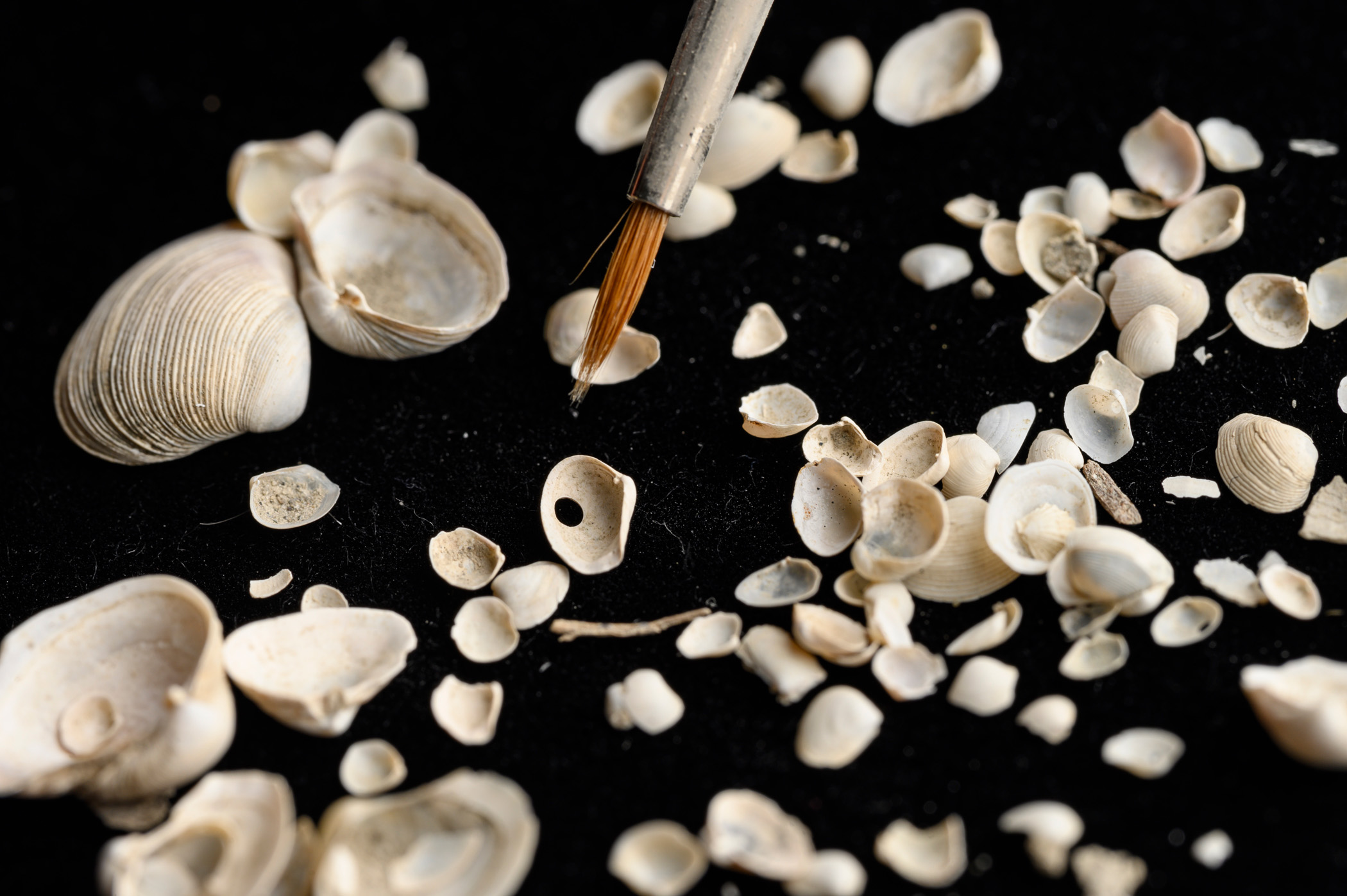
Seafloor environments are one of the only exceptions to this rule. For as long as there have been marine invertebrates that produce protective outer shells, there have been predators with the ability to bore through them. A variety of marine snails, worms, and even octopi have evolved structures to grind and pulverize shells.
“Some snails have specialized organs that secrete acid to soften the calcium carbonate in shells. This makes the drilling process more efficient,” said co-author Michal Kowalewski, the Thompson chair of Invertebrate Paleontology at the Florida Museum of Natural History.
The circular holes left behind are a calling card, which scientists use to quantify predation.
Research Methodology and Findings
The researchers took samples from two regions, one in the northwest Adriatic along the mouth of the Po River and another in the northeast Gulf of Trieste. At each site, they extracted sediment cores from the seafloor using long, cylindrical tubes. Sediment near the top was younger and had settled onto the seafloor more recently than sediment at the bottom of the tube.
Both locations showed the same pattern. The abundance of predators and prey along with the frequency of drill holes remained consistent until the mid-19th century, when all three spiked. Zuschin says this brief window of frenetic activity is a signature from the early days of Italian industrialization.
“A moderate increase in nutrient input is good for the ecosystem,” he said.
But this grace period didn’t last long. Excess nutrients in the Adriatic fueled the growth of algae, which sank to the seafloor when they died. Bacteria that degraded the dead algae used up much of the dissolved oxygen in the water, which suffocated nearby marine organisms. “It simply became too much, and the whole system crashed,” Zuschin said.
These periods of low oxygen, called eutrophication, weren’t detrimental to everything, though. They may have been beneficial for the common corbulid clam, Kowalewski said. “They’re less vulnerable to lower oxygen levels than some of their competitors, and they can proliferate quickly.”
Corbulid clams also don’t seem to be a favored food source for drilling predators. Their shells are occasionally found with tell-tale holes in them, but at a lower frequency than other species. With their only limitation being how much they can eat, corbulid clams have thrived in the denuded waters of the northern Adriatic.
And there’s another problem lurking on the horizon. Climate change is heating up the Adriatic, which means its water is becoming more stratified. This happens when increasingly warmer water on top mixes less with the colder water below, impeding the flow of oxygen from the surface to lower depths. In areas where eutrophication is already a problem, things are likely going to get worse.
Still, Zuschin says, there’s reason to be optimistic. Efforts are underway to reduce the amount of pollution that makes its way into Italy’s rivers, and samples from one location in the Po River Delta even show a small uptick in drill-hole frequency. Zuschin also warns that restoration won’t be easy and will only get harder the longer it gets put off.
“Environmental degradation is extremely expensive. You cannot even quantify it, because something that is gone that had a tremendous impact on the quality of life cannot be accounted for in terms of money.”
Reference: “Human-driven breakdown of predator–prey interactions in the northern Adriatic Sea” by Martin Zuschin, Rafał Nawrot, Markus Dengg, Ivo Gallmetzer, Alexandra Haselmair, Michał Kowalewski, Daniele Scarponi, Sandra Wurzer and Adam Tomašových, 1 September 2024, Proceedings of the Royal Society B.
DOI: 10.1098/rspb.2024.1303
Never miss a breakthrough: Join the SciTechDaily newsletter.
Follow us on Google and Google News.
2 Comments
Trawlers? Other than creating a lifeless smooth carpet=like sea bed, no worries. Read, The Unnatural History of the Sea, by Collum Roberts. We are setting an ambush for ourselves.
The Italians poisoned the Adriatic with their arrogance, callousness and stupidity. They poisoned the Italian side of Adriatic long ago, with the pollution from the Po river. And when their ship “Brigitta Montanari”, which transported highly poisonous chloroethene, sunk in 1984 off the coast of Croatia, they poisoned the Croatian side as well.