
In an effort to better understand coronal mass ejections and their potential effects on human technology, a newly published study takes a detailed look a moderate magnetic storm that produced a number of anomalous features.
A space weather storm from the sun engulfed our planet on January 21, 2005. The event got its start on January 20, when a cloud of solar material, a coronal mass ejection or CME, burst off the sun and headed toward Earth. When it arrived at our planet, the ring current and radiation belts surrounding Earth swelled with extra particles, while the aurora persisted for six hours. Both of these are usually signs of a very large storm – indeed, this was one of the largest outpouring of solar protons ever monitored from the sun. But the storm barely affected the magnetic fields around Earth – disturbances in these fields can affect power grids on the ground, a potential space weather effect keenly watched for by a society so dependent on electricity.
Janet Kozyra, a space scientist at the University of Michigan in Ann Arbor, thought this intriguing combination of a simultaneously weak and strong solar storm deserved further scrutiny. In an effort to better understand – and some day forecast – such storms and their potential effects on human technology, an unusual event like this can help researchers understand just what aspects of a CME lead to what effects near Earth.
“There were features appearing that we generally only see during extreme space weather events, when by other measures the storm was moderate,” said Kozyra. “We wanted to look at it holistically, much like terrestrial weather researchers do with extreme weather. We took every single piece of data that we could find on the solar storm and put it together to see what was going on.”
With observations collected from ground-based networks and 20 different satellites, Kozyra and a group of colleagues, each an expert in different aspects of the data or models, found that the CME contained a rare piece of dense solar filament material. This filament coupled with an unusually fast speed led to the large amount of solar material observed. A fortuitous magnetic geometry, however, softened the blow, leading to reduced magnetic effects. These results were published in the August 14, 2014, issue of Journal of Geophysical Research, Space Physics.
The researchers gathered data from spacecraft orbiting in Earth’s ionosphere, which extends up to 600 miles above the planet’s surface, and satellites above that, orbiting through the heart of Earth’s magnetic environment, the magnetosphere. The massive amount of data was then incorporated into a variety of models developed at the University of Michigan’s Center for Space Environment Modeling, which are housed at the Community Coordinated Modeling Center at NASA’s Goddard Space Flight Center in Greenbelt, Maryland, a facility dedicated to providing comprehensive access to space weather models.
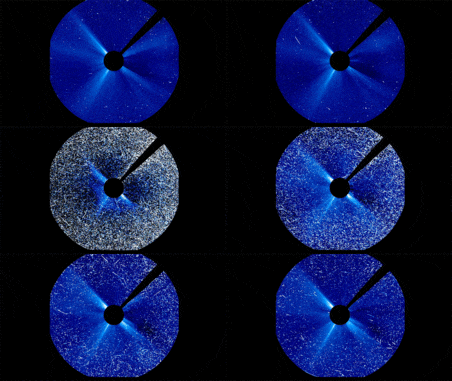
With the models in hand, the team could put together the story of this particular solar storm. It began with the CME on January 20, 2005. The European Space Agency and NASA’s Solar and Heliospheric Observatory, or SOHO, captured images of the CME. At their simplest, CMEs look like a magnetic bubble with material around the outside. In this case, there was an additional line of colder, denser solar material – an electrically charged gas called plasma – inside called a solar filament. Solar filaments are ribbons of dense plasma supported in the sun’s outer atmosphere – the corona – by strong magnetic fields. Filament material is 100 times denser and 100 times cooler than the surrounding atmosphere. When the supporting magnetic fields erupt, the filaments are caught up in the explosive release that forms the CME. Despite observations that the majority of eruptions like this involve solar filaments, the filaments are rarely identified in disturbances that reach Earth. Why this might be, is a mystery – but it means that the presence of the solar filament in this particular event is a rare sighting.
Subsequent observations of the CME showed it to be particularly fast, with a velocity that peaked at around 1800 miles per second before slowing to 600 miles per second as it approached Earth. Just how many CMEs have filaments or how the geometry of such filaments change as they move toward Earth is not precisely known. In this case, however, it seems that the dense filament sped forward, past the leading edge of the CME, so as it slammed into the magnetosphere, it delivered an extra big dose of energetic particles into near-Earth space.
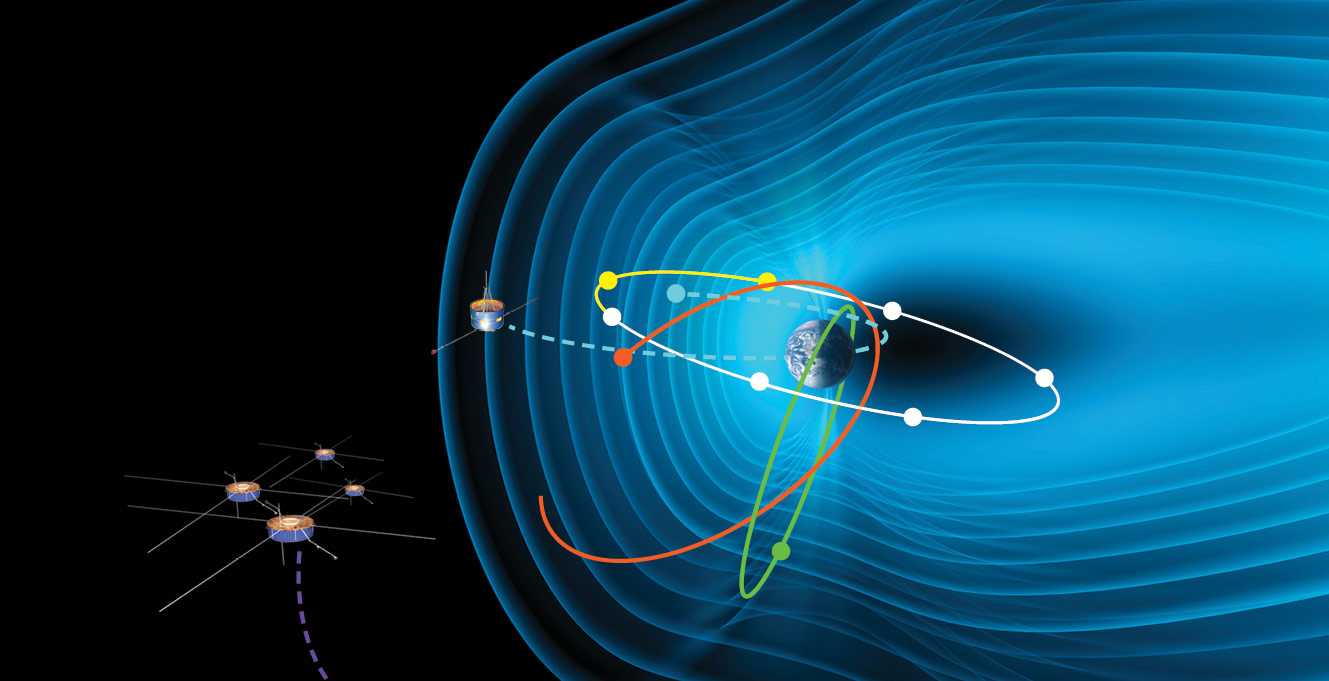
What happened next was observed by a flotilla of Earth-orbiting scientific satellites, including NASA’s IMAGE, FAST and TIMED missions, the joint European Space Agency, or ESA, and NASA’s Cluster, the NASA and ESA’s Geotail, the Chinese and ESA’s Double Star-1; other spacecraft 1 million miles closer to the sun including SOHO and NASA’s Advanced Composition Explorer, Wind various other spacecraft; as well as the National Science Foundation-supported ground-based SuperDARN radar network. At the time Cluster was in the solar wind directly upstream of Earth. Meanwhile, Double Star-1 was passing from the outer region of the planet’s magnetic field and entering the magnetosphere. This enabled it to observe the entry of the solar filament material as it crossed into near-Earth space.
“Within one hour of the impact, a cold, dense plasma sheet formed out of the filament material,” said Kozyra. “High density material continued to move through the magnetosphere for the entire six hours of the filament’s passage.”
Despite the intense amount of plasma carried by the CME, it still lacked a key component of a super storm. The magnetic fields embedded in this CME generally pointed toward Earth’s north pole, just as Earth’s own magnetic fields do. This configuration causes far fewer disruptions to our planet’s system than when the CME’s fields point southward. When pointing south, the CME’s fields clash with Earth’s, peeling them back and setting off magnetic perturbations that cascade through the magnetosphere.
The magnetic field orientation is what kept this solar storm at low levels. On the other hand, the extra solar material from the filament catalyzed long-term aurora over the poles and enhanced the particle-filled radiation belts around Earth, characteristic of a larger storm.
“This event, with its unusual combination of space weather effects, really demonstrates why it’s important to look at the entire system, not just individual elements,” said Kozyra. “Only by using all of this data, by watching the event from the beginning to the end, can we begin to understand all the different facets of an extreme storm like this.”
Understanding what created the facets of this particular 2005 storm adds to a much larger body of knowledge about how different kinds of CMEs can affect us here on Earth. By knowing what factors lead to the total strength of a storm, we can better learn to predict what the sun is sending our way.
This work was supported by NASA’s Heliophysics Division, in combination with the National Science Foundation’s Division of Atmospheric and Geospace Sciences.
Reference: “Solar filament impact on 21 January 2005: Geospace consequences” by J. U. Kozyra, M. W. Liemohn, C. Cattell, D. De Zeeuw, C. P. Escoubet, D. S. Evans, X. Fang, M.-C. Fok, H. U. Frey, W. D. Gonzalez, M. Hairston, R. Heelis, G. Lu, W. B. Manchester IV, S. Mende, L. J. Paxton, L. Rastaetter, A. Ridley, M. Sandanger, F. Soraas, T. Sotirelis, M. W. Thomsen, B. T. Tsurutani and O. Verkhoglyadova, 7 June 2014, Journal of Geophysical Research: Space Physics.
DOI: 10.1002/2013JA019748
Never miss a breakthrough: Join the SciTechDaily newsletter.
Follow us on Google and Google News.