
Close Menu
    Facebook X (Twitter) Instagram
    SciTechDaily
    • Biology
    • Chemistry
    • Earth
    • Health
    • Physics
    • Science
    • Space
    • Technology
    Facebook X (Twitter) Pinterest YouTube RSS
    SciTechDaily
    Home»Space»NASA Looks at the Impacts of Strong Solar Flares
    Space

    NASA Looks at the Impacts of Strong Solar Flares

    By Karen C. Fox, NASA's Goddard Space Flight CenterMay 14, 2013No Comments3 Mins Read
    Facebook Twitter Pinterest Telegram LinkedIn WhatsApp Email Reddit
    Share
    Facebook Twitter LinkedIn Pinterest Telegram Email Reddit
    Solar Activity is Ramping Up Toward Solar Maximum
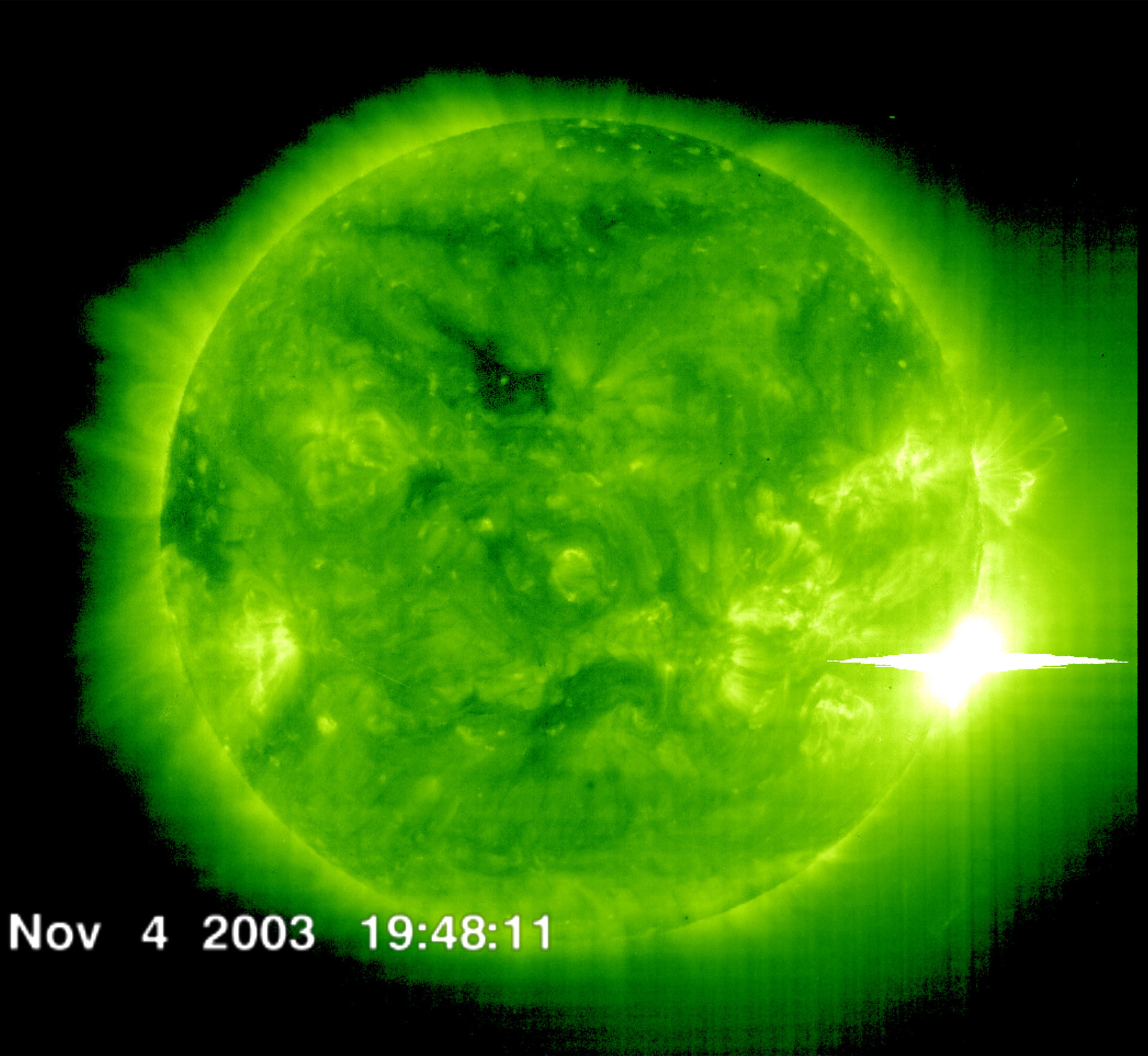
    The Solar and Heliospheric Observatory spacecraft captured this image of a solar flare as it erupted from the sun early on Nov 4, 2003. This was the most powerful flare measured with modern methods, classified as an X28. Credit: ESA and NASA/SOHO

    As solar activity continues to build up toward what is known as solar maximum, NASA details the impacts of coronal mass ejections and space weather on Earth.

    Given a legitimate need to protect Earth from the most intense forms of space weather — great bursts of electromagnetic energy and particles that can sometimes stream from the sun — some people worry that a gigantic “killer solar flare” could hurl enough energy to destroy Earth, but this is not actually possible.

    Solar activity is indeed currently ramping up toward what is known as solar maximum, something that occurs approximately every 11 years. However, this same solar cycle has occurred over millennia so anyone over the age of 11 has already lived through such a solar maximum with no harm.

    This is not to say that space weather can’t affect our planet. The explosive heat of a solar flare can’t make it all the way to our globe, but electromagnetic radiation and energetic particles certainly can. Solar flares can temporarily alter the upper atmosphere creating disruptions with signal transmission from, say, a GPS satellite to Earth causing it to be off by many yards. Another phenomenon produced by the sun could be even more disruptive. Known as a coronal mass ejection or CME these solar explosions propel bursts of particles and electromagnetic fluctuations into Earth’s atmosphere. Those fluctuations could induce electric fluctuations at ground level that could blow out transformers in power grids. A CME’s particles can also collide with crucial electronics onboard a satellite and disrupt its systems.

    In an increasingly technological world, where almost everyone relies on cellphones, and GPS controls not just your in-car map system, but also airplane navigation and the extremely accurate clocks that govern financial transactions, space weather is a serious matter.

    But it is a problem the same way hurricanes are a problem. One can protect oneself with advance information and proper precautions. During a hurricane watch, a homeowner can stay put … or he can seal up the house, turn off the electronics and get out of the way. Similarly, scientists at NASA and NOAA give warnings to electric companies, spacecraft operators, and airline pilots before a CME comes to Earth so that these groups can take proper precautions.

    NOAA’s Space Weather Prediction Center is the U.S. government’s official source for space weather forecasts, alerts, watches and warnings. Improving these predictive abilities the same way weather prediction has improved over the last few decades is one of the reasons NASA studies the sun and space weather. We can’t ignore space weather, but we can take appropriate measures to protect ourselves.

    And, even at their worst, the sun’s flares are not physically capable of destroying Earth.

    Never miss a breakthrough: Join the SciTechDaily newsletter.
    Follow us on Google and Google News.

    Astronomy Coronal Mass Ejections NASA Solar Flares Space Weather
    Share. Facebook Twitter Pinterest LinkedIn Email Reddit

    Related Articles

    NASA’s PUNCH Just Switched On and Could Revolutionize Space Weather Forecasting

    Powerful X-Class Solar Flare Erupts From Sun – Captured by NASA’s Solar Dynamics Observatory

    Massive Solar Eruption Captured by Solar Orbiter Spacecraft

    Solar Orbiter Images First Coronal Mass Ejections – See the Stunning Videos From Multiple Instruments

    NASA’s SDO Reveals Images of X4.9-Class Solar Flare

    NASA Captures Image of an M6.5 Class Flare

    NASA’s Solar Dynamics Observatory Captures Filament Explosion

    New Light Shed on the Origins of Extreme Space Storms

    Two Coronal Mass Ejections Strongly Compressed the Magnetopause

    Leave A Reply Cancel Reply

    • Facebook
    • Twitter
    • Pinterest
    • YouTube

    Don't Miss a Discovery

    Subscribe for the Latest in Science & Tech!

    Trending News

    Artificial Sweeteners May Harm Future Generations, Study Suggests

    Splashdown! NASA Artemis II Returns From Record-Breaking Moon Mission

    What If Consciousness Exists Beyond Your Brain

    Scientists Finally Crack the 100-Million-Year Evolutionary Mystery of Squid and Cuttlefish

    Beyond “Safe Levels”: Study Challenges What We Know About Pesticides and Cancer

    Researchers Have Found a Dietary Compound That Increases Longevity

    Scientists Baffled by Bizarre “Living Fossil” From 275 Million Years Ago

    Your IQ at 23 Could Predict Your Wealth at 27, Study Finds

    Follow SciTechDaily
    • Facebook
    • Twitter
    • YouTube
    • Pinterest
    • Newsletter
    • RSS
    SciTech News
    • Biology News
    • Chemistry News
    • Earth News
    • Health News
    • Physics News
    • Science News
    • Space News
    • Technology News
    Recent Posts
    • What if Dark Matter Has Two Forms? Bold New Hypothesis Could Explain a Cosmic Mystery
    • Researchers Expose Hidden Chemistry of “Ore-Forming” Elements in Biology
    • Geologists Reveal the Americas Collided Earlier Than We Thought
    • 20x Difference: Study Reveals True Source of Airborne Microplastics
    • Scientists Uncover Hidden Force Powering Yellowstone’s Supervolcano
    Copyright © 1998 - 2026 SciTechDaily. All Rights Reserved.
    • Science News
    • About
    • Contact
    • Editorial Board
    • Privacy Policy
    • Terms of Use

    Type above and press Enter to search. Press Esc to cancel.