
University of Chicago scientist lays out how LIGO gravitational waves could be scrambled, yielding information.
There’s something a little off about our theory of the universe. Almost everything fits, but there’s a fly in the cosmic ointment, a particle of sand in the infinite sandwich. Some scientists think the culprit might be gravity—and that subtle ripples in the fabric of space-time could help us find the missing piece.
A new paper co-authored by a University of Chicago scientist lays out how this might work. Published Dec. 21 in Physical Review D, the method depends on finding such ripples that have been bent by traveling through supermassive black holes or large galaxies on their way to Earth.
The trouble is that something is making the universe not only expand, but expand faster and faster over time—and no one knows what it is. (The search for the exact rate is an ongoing debate in cosmology).
Scientists have proposed all kinds of theories for what the missing piece might be. “Many of these rely on changing the way gravity works over large scales,” said paper co-author Jose María Ezquiaga, a NASA Einstein postdoctoral fellow in the Kavli Institute for Cosmological Physics at the UChicago. “So gravitational waves are the perfect messenger to see these possible modifications of gravity, if they exist.”
“Gravitational waves are the perfect messenger to see these possible modifications of gravity, if they exist.”
Astrophysicist Jose María Ezquiaga
Gravitational waves are ripples in the fabric of space-time itself; since 2015, humanity has been able to pick up these ripples using the LIGO observatories. Whenever two massively heavy objects collide elsewhere in the universe, they create a ripple that travels across space, carrying the signature of whatever made it—perhaps two black holes or two neutron stars colliding.
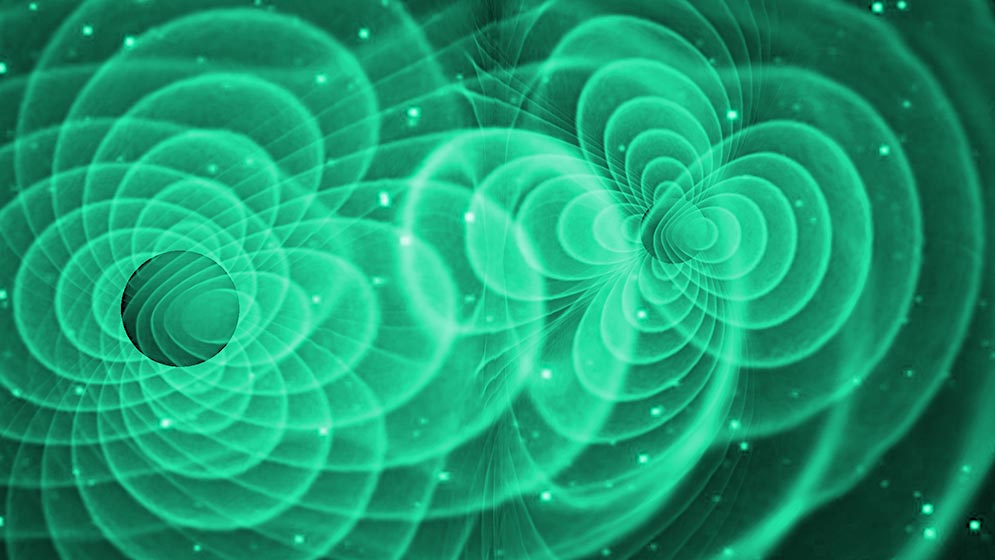
In the paper, Ezquiaga and co-author Miguel Zumalácarregui argue that if such waves hit a supermassive black hole or cluster of galaxies on their way to Earth, the signature of the ripple would change. If there were a difference in gravity compared to Einstein’s theory, the evidence would be embedded in that signature.
For example, one theory for the missing piece of the universe is the existence of an extra particle. Such a particle would, among other effects, generate a kind of background or “medium” around large objects. If a traveling gravitational wave hits a supermassive black hole, it would generate waves that would get mixed up with the gravitational wave itself. Depending on what it encountered, the gravitational wave signature could carry an “echo,” or show up scrambled.
“This is a new way to probe scenarios that couldn’t be tested before,” Ezquiaga said.
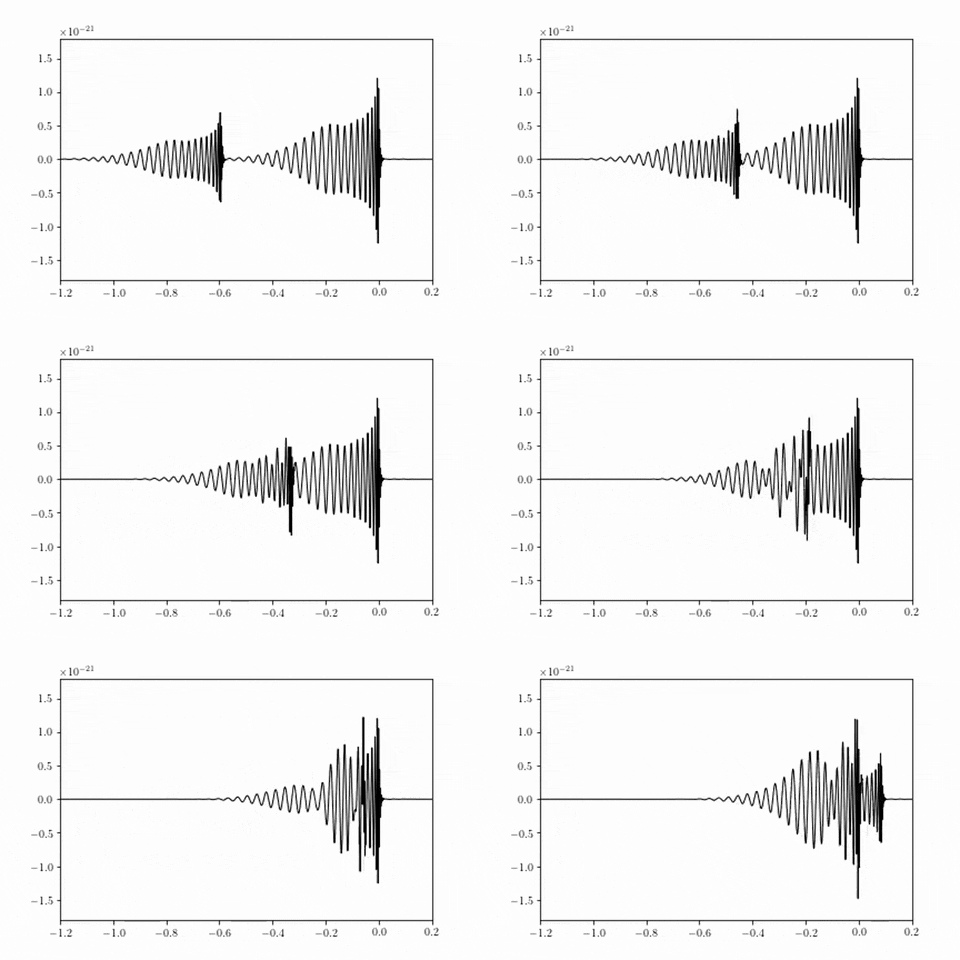
Their paper lays out the conditions for how to find such effects in future data. The next LIGO run is scheduled to begin in 2022, with an upgrade to make the detectors even more sensitive than they already are.
“In our last observing run with LIGO, we were seeing a new gravitational wave reading every six days, which is amazing. But in the entire universe, we think they’re actually happening once every five minutes,” Ezquiaga said. “In the next upgrade, we could see so many of those—hundreds of events per year.”
The increased numbers, he said, make it more likely that one or more waves will have traveled through a massive object, and that scientists will be able to analyze them for clues to the missing components.
Reference: “Gravitational wave lensing beyond general relativity: Birefringence, echoes, and shadows” by Jose María Ezquiaga and Miguel Zumalacárregui, 21 December 2020, Physical Review D.
DOI: 10.1103/PhysRevD.102.124048
Zumalácarregui, the other author on the paper, is a scientist at the Max Planck Institute for Gravitational Physics in Germany as well as the Berkeley Center for Cosmological Physics at Lawrence Berkeley National Laboratory and the University of California, Berkeley.
Funding: NASA, Kavli Foundation.
Never miss a breakthrough: Join the SciTechDaily newsletter.
Follow us on Google and Google News.
10 Comments
The propulsion, or the force if the proton, has to be equal to or greater than the matter to be moved. P(f) => m(delta). Given so that the inside of the branch of a crytaliized hydrogen atom, or nucleus, when receiving or sending as it would in a snowflakes CUBE, looking in motion as a hexagon, creates a coiling effect of the signature… nice, to produce sustain and maintain angular velocities like that in the star of david creating the branch, its length its width its dimension for our sight to see that which is produced and gathered as a stem and a leaf in 3d. Cool stuff.
Imagine living between two magnets, one the greater ight and two the lesser light, kept bound to the center by a field known as magnetic momentum. And the reflection of the energies being cast upon the core area from which its momentum is carved, through the neutron as a magnifying glass created as a force of centrifugal action, focusing on the inner layer of the densities of radiation in which the light is put… and the velocity of the revolving momentum creating the day and the night. The xray and the infrared. The black and white of nite and the full color of day… in accord with humans sight capabilities. Pitch on the inside and on the out.. radio frequencies and the ultraviolet. Combining in the midst to form as it is said… the engine… caiaphas. More cool stuff right. Now the propulsion like a train between alternating energies of alternate force… smooth it is. At least that is the appearance of such beauty on our eyes… within this carved not for our demise but for the love of our lives. Peace.
It does look as if the LIGO is going to pay off with new and unexpected knowledge. MOND looks better and better, or at least data backing the theory is being documented as compatible. Newton is a certified genius, his first guess has held up for over a hundred years, as has Einstein’s guesses. Third time is the charm, a new genius is waiting in the wings with formulas based upon those from the giants whos shoulders they stand. Dreams become data streams.
Look out universe, mankind is waking up.
Obviously not all of us, but reason eventually drowns out the static.
? Specifically Ligo was the culprit in killing off MOND 3 years ago:
“Troubled Times for Alternatives to Einstein’s Theory of Gravity
New observations of extreme astrophysical systems have “brutally and pitilessly murdered” attempts to replace Einstein’s general theory of relativity.
Miguel Zumalacárregui knows what it feels like when theories die. In September 2017, he was at the Institute for Theoretical Physics in Saclay, near Paris, to speak at a meeting about dark energy and modified gravity. The official news had not yet broken about an epochal astronomical measurement — the detection, by gravitational wave detectors as well as many other telescopes, of a collision between two neutron stars — but a controversial tweet had lit a firestorm of rumor in the astronomical community, and excited researchers were discussing the discovery in hushed tones.”
“At the meeting, Zumalacárregui joked to his audience about the perils of combining science and Twitter, and then explained what the consequences would be if the rumors were true. Many researchers knew that the merger would be a big deal, but a lot of them simply “hadn’t understood their theories were on the brink of demise,” he later wrote in an email. In Saclay, he read them the last rites. “That conference was like a funeral where we were breaking the news to some attendees.”
The neutron-star collision was just the beginning. New data in the months since that discovery have made life increasingly difficult for the proponents of many of the modified-gravity theories that remain.”
“Right before LIGO’s October announcement of a neutron-star merger, the researchers were going to publish a paper that would kill off TeVeS [the relativistic, better MOND]. But LIGO did the job for them, Freire said. “We need not go through that anymore.””
[ https://www.quantamagazine.org/troubled-times-for-alternatives-to-einsteins-theory-of-gravity-20180430/ ]
… “Clues to Missing Components of the Universe From Ripples in Space-Time”, …
… And if somebody hopes that it will be found, that doesn’t mean it is just a tipping point that make it sure, and it could still be other way…
… having fun jet… is it an endless rabbit whole or one that it stops where it begins,…
They don’t discuss it, but some of their gravitational wave lensing effects would turn up if gravitons have mass (due to wavelength dependent signal delays). So this technique could – more interestingly IMO, general relativity is so firmly established (but further tests are always good) – put constraints on that mass.
Domain walls in space?
… The brave scientists, have taken into account, that light from the edges of observable universe travels a long time till it reaches us, and that during that travel the space time was bit different, … The Universe is not a static one, that was a great calculation to perform, hope AA didn’t do it…
… I talked about gravity it is different and it is not just another nail that can be hammered by hammer, it takes a players and pick…
If you’re waiting for a grav wave to pass directly through an SMBH I’m afraid you’ll be waiting for an extremely long time…..