
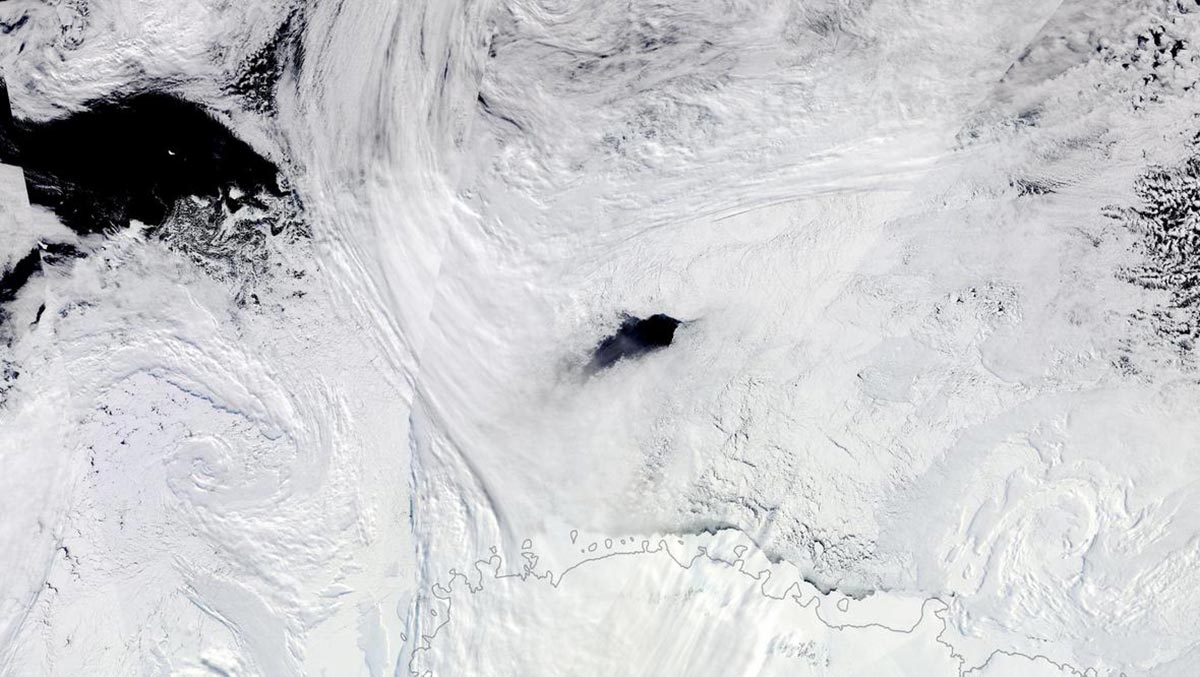
Researchers have discovered the missing piece of the puzzle behind a rare opening in the sea ice around Antarctica, that occurred during the winters of 2016 and 2017. It reveals a key process that had eluded scientists as to how the opening, called a polynya, was able to form and persist for several weeks. The results were published on May 1 in the scientific journal Science Advances.
The polynya that has eluded the researchers is called ‘Maud Rise’ and is sometimes formed in the Weddell Sea in Antarctica above the seamount with the same name. For many years, the Maud Rise polynya was formed only occasionally and for a limited time, but in 2016 and 2017, the polynya grew to be as big as Switzerland.
“We now understand that the polynya was caused by a complex interaction between the unique geography of the ocean floor and an unusually strong wind that produced unusually strong ocean currents transporting heat and salt water towards the surface. But it also required the contribution of a very specific key process,” says Fabien Roquet, Professor of Physical Oceanography at the Department of Marine Sciences at the University of Gothenburg, and one of the researchers behind the discovery.
Detective Work To Find Missing Piece
Polynyas are important areas that help mitigate the increase in atmospheric carbon dioxide and support enhanced biological activity in the sea ice-covered areas. They usually form in coastal areas when strong coastal winds blow off the continent and push the ice away, exposing the seawater below. But they can also sometimes – as over Maud Rise – form in sea ice over the open ocean as warm water is transported to the surface by ocean currents.

“This upwelling of warmer water explains how the sea ice might melt. But as sea ice melts this leads to a freshening of the surface water, which should in turn put a stop to this upwelling. So, another process must be happening for the polynya to persist. There must be an additional input of salt from somewhere,” says Aditya Narayanan, researcher at the National Oceanographic Centre (UK) and main author of the study.
A Special Process Brought Salt Into the Region
The researchers began their detective work to understand where the additional salty seawater came from. They used remotely sensed sea ice maps, observations from autonomous floats and tagged marine mammals, alongside a computational model of the ocean’s state.
They found that as the unusually strong Weddell Sea current flowed around Maud Rise, the turbulent eddies moved salt onto the top of the sea mount. From here, a process called ‘Ekman transport’ helped to move the salt onto the northern flank of Maud Rise, where the polynya first formed. ‘Ekman transport’, named after the Swedish oceanographer Vagn Walfrid Ekman who pioneered the study of how winds create ocean currents, is a very specific process that involves water moving at a 90-degree angle to the direction of the wind blowing above, influencing ocean currents.
“Ekman transport was the essential missing piece of the puzzle that was necessary to increase the balance of salt and sustain the mixing of salt and heat towards the surface water,” says Fabien Roquet.
Polynyas Are Important for the Climate
The effects of a polynya can persist in the ocean for years after they have formed. They can change the way water moves and how currents carry heat towards the continent. The dense waters that form here can spread across the global ocean.
“Some of the same processes that were involved in the forming of the Maud Rise polynya, such as the upwelling of deep and salty water, are also driving a general reduction in sea ice in the Southern Ocean,” says Professor Sarah Gille, University of California San Diego, a co-author of the study.
“This was the first time since the 1970s that we have had such a large and long-lived polynya in the Weddell Sea,” says Aditya Narayanan.
For more on this research, see Scientists Finally Explain Huge Hole in Antarctic Sea Ice.
Reference: “Ekman-driven salt transport as a key mechanism for open-ocean polynya formation at Maud Rise” by Aditya Narayanan, Fabien Roquet, Sarah T. Gille, Birte Gülk, Matthew R. Mazloff, Alessandro Silvano and Alberto C. Naveira Garabato, 1 May 2024, Science Advances.
DOI: 10.1126/sciadv.adj0777
Never miss a breakthrough: Join the SciTechDaily newsletter.
Follow us on Google and Google News.
3 Comments
It doesn’t look like anything has changed in the three days since the first press release was published.
Apparently, nothing has changed. Both articles reference the same scientific paper from May 1st.
The world will be off balanced from the ice melting and breaking off witch will result in tsunami from the world spinning to fast or slowing down that’s how the Great floods of time happened and how we went in to an ice age