

Two papers led by graduate students document that the river’s lower region long ago held a vast marine tidal basin and humid paleoclimate.
A team led by University of Oregon geologist Rebecca Dorsey has published two papers that provide new insights into the origins of the Colorado River, using data from ancient sedimentary deposits located east of the San Andreas fault near the Salton Sea in Southern California.
The papers, led by former master’s student Brennan O’Connell and doctoral candidate Kevin Gardner, respectively, present evidence that the now desert landscape of the river’s lower valley was submerged roughly 5 million to 6 million years ago under shallow seas with strong, fluctuating tidal currents that flowed back and forth along the trajectory of the present-day river.
Layers of sedimentary rocks bearing marine fossils, burrows, and diagnostic sedimentary structures, the researchers concluded, record a dramatic rise in sea level that drowned former alluvial fans and caused tidal waters to invade the valley prior to the arrival of the Colorado River and its voluminous load of water and sediment.
The studies, both funded by the National Science Foundation, were published online ahead of print in the international journal Sedimentology.
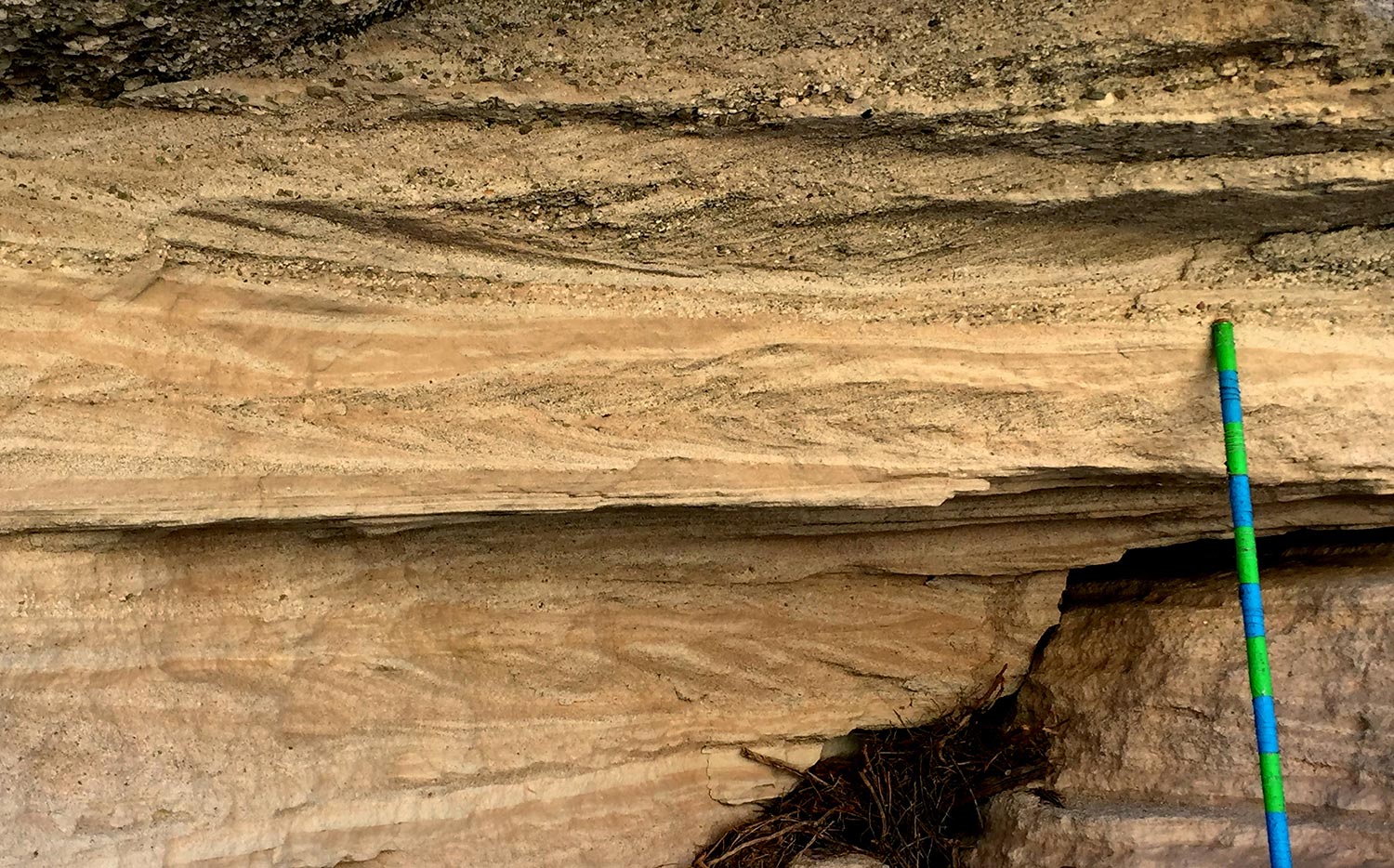
The first paper, which published on October 29, 2020, and was led by O’Connell, who is now pursuing a doctorate at the University of Melbourne in Australia, focused on sediments of the late Miocene to early Pliocene Bouse Formation exposed east of the Colorado River, south of Blythe, California.
Previously, O’Connell and a team of UO geologists had found evidence that the Gulf of California once reached as far north as Blythe, as detailed in the journal Geology in 2017.
In the new paper, O’Connell and co-authors describe a rich mixture of carbonate mudstones, plant debris, and traces of ancient organisms that record brackish water conditions where seawater was diluted by a large influx of fresh water due to high annual rainfall, before waters of the Colorado River flowed into the area.
The sediments, they found, formed in wide tidal flats along an ancient, humid-climate marine shoreline. An abrupt transition to low-energy subtidal lime mudstone records widespread marine flooding associated with a long-lived regional rise in sea level, they concluded. Relative sea level rise, they added, resulted from long-term tectonically controlled subsidence.
The combined evidence from paleontology, ichnology, and process sedimentology “provides a clear record of freshwater input and brackish water conditions due to mixing of freshwater and seawater in a humid climate with high annual precipitation,” O’Connell’s team wrote.
The second paper, published December 5 and led by Gardner, documents tidal sediments of the same age on the opposite side of the same ancient tidal strait. The sediments accumulated where strong daily reversing currents swept north and south along the axis of the tidal strait, driving migration of large subtidal dunes and depositing large-scale cross-bedded carbonate sands.
The authors argue that the migrating dune bedforms could not have formed by tidal like processes in a lake, as some scientists have proposed. The team’s results indicate that, after late Miocene to early Pliocene deposition, the sediments were uplifted to elevations up to 330 meters above sea level in the Chocolate Mountains, as a result of long-term crustal strain related to motion on the San Andreas fault.
“Taken together, our new papers provide conclusive evidence that the southern Bouse Formation formed in and around the margins of a marine tidal strait that filled the lower Colorado River valley prior to arrival of the modern river system,” said Dorsey, a professor in the UO’s Department of Earth Sciences.
A map of the southern Bouse tidal seaway, reconstructed with data from both studies, shows that desert communities from Blythe to Palo Verde, California, were submerged under shallow seas with strong fluctuating tidal currents during late Miocene to early Pliocene time.
The Miocene, a geological epoch, lasted from 23 million years ago to 5.3 million years ago; the Pliocene occurred between 5.3 million and 2.6 million years ago.
Co-authors with O’Connell and Dorsey on the first paper were Stephen T. Hasiotis, a geologist at the University of Kansas, and Ashleigh Hood at the University of Melbourne.
In 2018, another Dorsey-led paper in the journal Sedimentary Geology found that lower stretches of the Colorado River were influenced by tectonic shifts in underlying bedrock and changing sea levels. The river, that study concluded, experienced a series of stops and starts in sediment output during early stages of the river between roughly 6.3 and 4.8 million years ago.
References:
“Mixed carbonate–siliciclastic tidal sedimentation in the Miocene to Pliocene Bouse Formation, palaeo‐Gulf of California” by Brennan O’Connell, Rebecca J. Dorsey, Stephen T. Hasiotis and Ashleigh v.s. Hood, 29 October 2020, Sedimentology.
DOI: 10.1111/sed.12817
“Mixed carbonate–siliciclastic sedimentation at the margin of a late Miocene tidal strait, lower Colorado River Valley, south‐western USA” by Kevin Gardner and Rebecca J. Dorsey, 5 December 2020, Sedimentology.
DOI: 10.1111/sed.12834
Never miss a breakthrough: Join the SciTechDaily newsletter.
Follow us on Google and Google News.
6 Comments
Go Trump
Something needs to get done about human population. Otherwise we are killing ourselves.
Flood is the only answer.
Must be fun to make a living by guessing.
Where is the time-lapse computer generated video image depicting the oceanic ingress to the basin? Article needs some graphic of the geologic landforms, past & current,of the area for context
First off they did not discover…its been there for years. Sea life fossils always present. My guess its not from global warming. This planet goes through natural changes. Where starting that change now.
The sea water will soon claim the land it once held.man can do nothing to stop it.
Joe Biden