
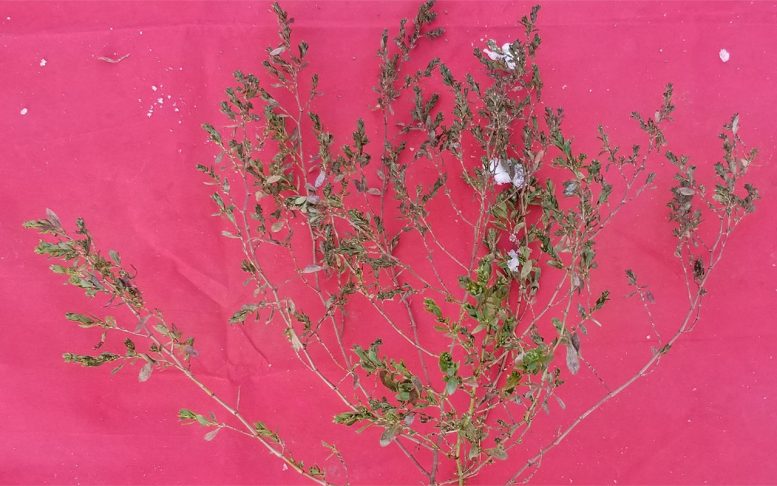
Scientists discover that specific traits make some plants more adaptable to human cultivation.
The story of how ancient wolves became humanity’s closest companions by the campfire is well known, even though the details are still being refined by scientists. For a wild animal to be domesticated, it must be tamable, meaning it can live near humans without displaying dangerous aggression or overwhelming fear. Taming was the essential initial stage in animal domestication, with some animals being more easily tamed than others.
However, did humans also select particular wild plants for domestication due to their greater “tamability”? Researchers from Washington University in St. Louis propose a reevaluation of the plant domestication process, drawing on nearly ten years of observations and experiments. The behavior of erect knotweed, a relative of buckwheat, has led WashU paleoethnobotanists to completely reassesse our understanding of plant domestication.
“We have no equivalent term for tameness in plants,” said Natalie Mueller, assistant professor of archaeology in Arts & Sciences at Washington University. “But plants are capable of responding to people. They have a developmental capacity to be tamed.”
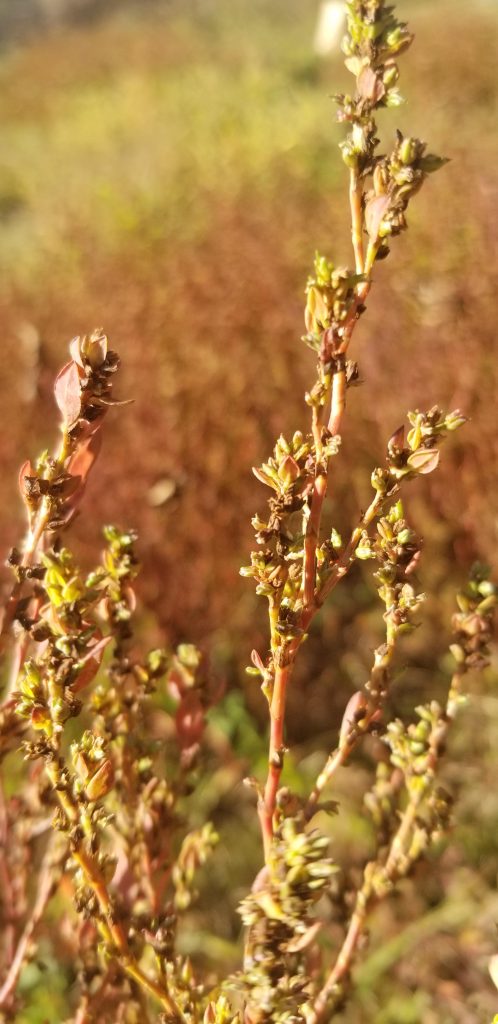
Her work with early indigenous North American crops shows that some wild plants respond quickly to clearing, fertilizing, weeding, or thinning. Plants that respond in ways that make cultivation easier or more productive could be considered more easily tamed than those that cannot.
“If plants responded rapidly in ways that were beneficial to early cultivators — for example by producing higher yields, larger seeds, seeds that were easier to sprout, or a second crop in a single growing season — this would have encouraged humans to continue investing in the co-evolutionary relationship,” she said.
This capacity to express different traits and characteristics in response to the environment is called plasticity, and not all species are equally plastic.
“Some plants respond quickly and obviously to cultivation and care,” Mueller said. “I think ancient people would have noticed that they could double their yields just by thinning out dense stands of plants. This is one of the simplest and most common gardening techniques, but it has many important effects on the development of plants.”
What Would an Early Farmer Do?
Mueller’s study, recently published in the journal PLOS ONE, focuses on work with a plant called erect knotweed, a member of the buckwheat family that was domesticated by indigenous farmers in eastern North America. The domesticated sub-species is now extinct; humans don’t eat it anymore. But Mueller and others have previously uncovered caches of seeds stored in caves, charred plant remnants in ancient hearths, and even the seeds of erect knotweed in human feces, clear evidence that this species was once consumed as a staple food.
Mueller, who studies lost crops, has spent years growing erect knotweed and other crop progenitors in experimental gardens, including at Washington University’s environmental field station, Tyson Research Center. She hasn’t always been successful with growing the plants she collects in the wild. In that way, Mueller can relate to the early farmers who similarly experimented with plants to discover their potential.
Her efforts have often been stymied by seed dormancy, a common feature among wild plants.
Unlike seeds you buy at the garden store, the seeds of most wild plants will not germinate if you simply sprinkle some water on them. Their requirements for germination are diverse and shaped by their evolutionary history. For example, if a plant has evolved in a place with a winter, like the Midwest, its seeds may not germinate unless they experience a long cold period. This prevents them from germinating too soon in the wild — they are waiting for spring. Domesticated plants have lost their diverse germination requirements.
The loss of germination inhibitors has presented a paradox to theorists of domestication. Many of the selective pressures that could have favored the evolution of this trait derive from planting seeds. But why would ancient people have started planting seeds if none of them germinated?
With erect knotweed, Mueller experienced a breakthrough of sorts. Based on four seasons of observations, Mueller determined that growing wild plants in the low-density conditions typical of a cultivated garden (i.e. spaced out and weeded) triggers plants to produce seeds that germinate more easily. This makes the harvests easier to plant successfully the next time around, eliminating a key barrier to further selection.
“Our results show that erect knotweed grown in low-density agroecosystems spontaneously ‘act domesticated’ in a single growing season before any selection has occurred,” Mueller said.
Think of it as the plant equivalent to that first wolf who, though still a wild animal, sat down with its human friend around the fire. This is a behavioral shift, rather than an evolutionary one, but it allows new evolutionary pathways to open up.
A Role for Plant Behavior
Mueller believes there is a bias in domestication studies toward viewing this changeability, or plasticity, as noise that is getting in the way of attempts to explain evolutionary change. Instead, this paper argues that we need to understand the development and behavior of wild crop relatives in order to explain the evolutionary process of domestication.
“Because we lack the practical experience with crop progenitors that ancient people had, these effects of the environment on plant development have gone mostly unnoticed and understudied,” Mueller said.
Her findings could have applications for developing new food crops: there is no reason why we have to be limited to the plants that our ancestors domesticated thousands of years ago.
Some researchers have been calling for de novo domestication — selecting wild plants with desirable characteristics and intentionally domesticating them. It may make sense to start looking to wild plants that are easily tamed as potential crops that could be developed for the future, Mueller said.
This paper also contributes to a growing awareness that plants are responsive and communicative beings. Though this idea is cutting-edge and hotly debated in biology and ecology, it is widespread in indigenous North American philosophies and probably would have been held by the people who domesticated erect knotweed and other plants thousands of years ago.
Recent research has shown how plants warn relatives about herbivores using chemical signaling, share resources through mycorrhizal networks, and even emit noises when they are injured or stressed.
“You can’t explain plant domestication if you only consider the behaviors of humans, because domestication is the result of reciprocal relationships between multiple species that are all capable of responding to each other,” Mueller said.
Reference: “The taming of the weed: Developmental plasticity facilitated plant domestication” by Natalie G. Mueller, Elizabeth T. Horton, Megan E. Belcher and Logan Kistler, 7 April 2023, PLOS ONE.
DOI: 10.1371/journal.pone.0284136
Never miss a breakthrough: Join the SciTechDaily newsletter.
Follow us on Google and Google News.