
Close Menu
    Facebook X (Twitter) Instagram
    SciTechDaily
    • Biology
    • Chemistry
    • Earth
    • Health
    • Physics
    • Science
    • Space
    • Technology
    Facebook X (Twitter) Pinterest YouTube RSS
    SciTechDaily
    Home»Health»Compound Discovered in Breast Milk Fights Harmful Bacteria – Could Be Added to Formula or Cow’s Milk
    Health

    Compound Discovered in Breast Milk Fights Harmful Bacteria – Could Be Added to Formula or Cow’s Milk

    By National Jewish HealthOctober 10, 2019No Comments3 Mins Read
    Facebook Twitter Pinterest Telegram LinkedIn WhatsApp Email Reddit
    Share
    Facebook Twitter LinkedIn Pinterest Telegram Email Reddit

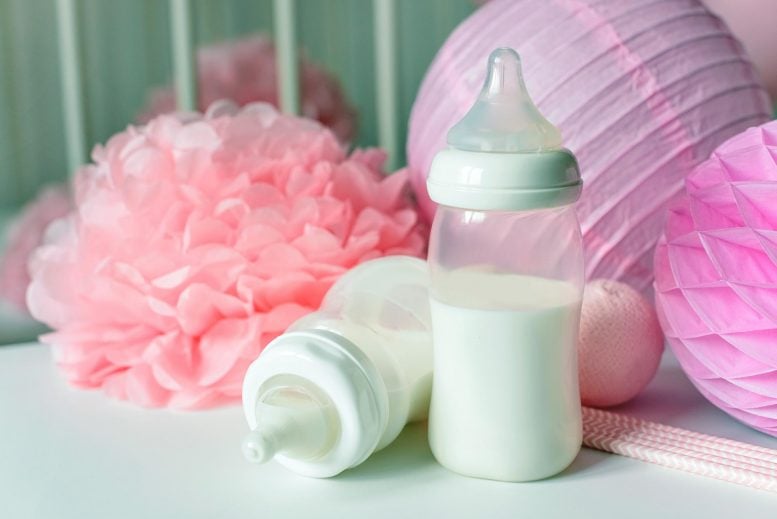
    Baby Bottles with Milk

    Researchers at National Jewish Health and the University of Iowa have identified a compound in human breast milk that fights infections by harmful bacteria while allowing beneficial bacteria to thrive. Human breast milk has more than 200 times the amount of glycerol monolaurate (GML) than is found in cows’ milk. Infant formula has none. GML is inexpensive to manufacture. Future research will determine if GML could be a beneficial additive to cow’s milk and infant formula.

    “Our findings demonstrate that high levels of GML are unique to human breast milk and strongly inhibit the growth of pathogenic bacteria,” said Donald Leung, MD, Ph.D., professor of pediatrics at National Jewish Health and senior author on a paper published in Scientific Reports.

    “While antibiotics can fight bacterial infections in infants, they kill the beneficial bacteria along with the pathogenic ones,” said Patrick Schlievert, Ph.D., professor of microbiology and immunology at the University of Iowa Carver College of Medicine and first author on the Scientific Reports paper. “GML is much more selective, fighting only the pathogenic bacteria while allowing beneficial species to thrive. We think GML holds great promise as a potential additive to cows’ milk and infant formula that could promote the health of babies around the world.”

    After determining that human breast milk contains much higher levels of GML than does cows’ milk, the researchers showed that human breast milk inhibits the growth of the pathogenic bacteria Staphylococcus aureus, Bacillus subtilis, and Clostridium perfringens, while neither cows’ milk nor infant formula had any effect. Human breast milk did not inhibit the growth of the beneficial bacteria Enterococcus faecilis. Babies fed on human breast milk have high levels of beneficial bifidobacteria, lactobacilli, and enterococci bacterial species.

    “GML is much more selective, fighting only the pathogenic bacteria while allowing beneficial species to thrive. We think GML holds great promise as a potential additive to cows’ milk and infant formula that could promote the health of babies around the world.” — Patrick Schlievert, PhD

    When researchers removed the GML from human breast milk, it lost its antimicrobial activity against S. aureus. When they added GML to cows’ milk, it became antimicrobial.

    The researchers also showed that GML inhibits inflammation in epithelial cells, which line the gut and other mucosal surfaces. Inflammation can damage epithelial cells and contribute to susceptibility to both bacterial and viral infections.

    Drs. Schlievert and Leung have applied for a patent for the use of GML as a beneficial additive to cows’ milk and infant formula.

    Reference: “Glycerol Monolaurate Contributes to the Antimicrobial and Anti-inflammatory Activity of Human Milk” by Patrick M. Schlievert, Samuel H. Kilgore, Keun Seok Seo and Donald Y. M. Leung, 10 October 2019, Scientific Reports.
    DOI: 10.1038/s41598-019-51130-y

    Never miss a breakthrough: Join the SciTechDaily newsletter.
    Follow us on Google and Google News.

    Antibiotics Bacteria National Jewish Health Nutrition Popular
    Share. Facebook Twitter Pinterest LinkedIn Email Reddit

    Related Articles

    Microbes in Your Gut May Affect Personality – Could Be Associated With Mental and Physical Fatigue

    Fasting May Help Ward Off Infections – Protects Against Foodborne Illness Such As Salmonella

    Pathogenic Bacteria Rendered Almost Harmless: New Strategy to Combat Antibiotic-Resistant Bacterium

    ‘Last Resort’ Antibiotic Kills Bacteria by Popping Them Like Balloons

    Infectious Diseases Experts: Superbugs on Track to Kill More People Than COVID-19

    Medieval Medicine Remedy – Found in 9th Century Bald’s Leechbook – Could Provide New Treatment for Modern Day Infections

    New Killing Mechanism Discovered in Potent Natural Antibiotic – Hailed a “Game Changer”

    Failure Against “Nightmare Bacteria” a Chilling Commentary on Future of Antibiotics – “Much of Modern Medicine May Become Infeasible”

    New Research Shows Antibiotics Work Differently Than Thought

    Leave A Reply Cancel Reply

    • Facebook
    • Twitter
    • Pinterest
    • YouTube

    Don't Miss a Discovery

    Subscribe for the Latest in Science & Tech!

    Trending News

    Popular Sugar-Free Sweetener Linked to Liver Disease, Study Warns

    What Is Hantavirus? The Deadly Disease Raising Alarm Worldwide

    Scientists Just Discovered How the Universe Builds Monster Black Holes

    Scientists Unveil New Treatment Strategy That Could Outsmart Cancer

    A Simple Vitamin May Hold the Key to Treating Rare Genetic Diseases

    Scientists Think the Real Fountain of Youth May Be Hiding in Your Gut

    Ravens Don’t Follow Wolves, They Predict Them

    This Common Knee Surgery May Be Doing More Harm Than Good

    Follow SciTechDaily
    • Facebook
    • Twitter
    • YouTube
    • Pinterest
    • Newsletter
    • RSS
    SciTech News
    • Biology News
    • Chemistry News
    • Earth News
    • Health News
    • Physics News
    • Science News
    • Space News
    • Technology News
    Recent Posts
    • This Dazzling Green Snake Was Hiding in Plain Sight for Decades
    • Scientists Discover That a Single Dose of Psilocybin Changes the Human Brain
    • “Totally Unexpected” – Scientists Discover Pancreatic Cancer’s Fatal Addiction
    • A Strange Quantum Effect May Explain One of Biology’s Greatest Mysteries
    • NASA’s Psyche Spacecraft Is About To Fly Shockingly Close to Mars
    Copyright © 1998 - 2026 SciTechDaily. All Rights Reserved.
    • Science News
    • About
    • Contact
    • Editorial Board
    • Privacy Policy
    • Terms of Use

    Type above and press Enter to search. Press Esc to cancel.